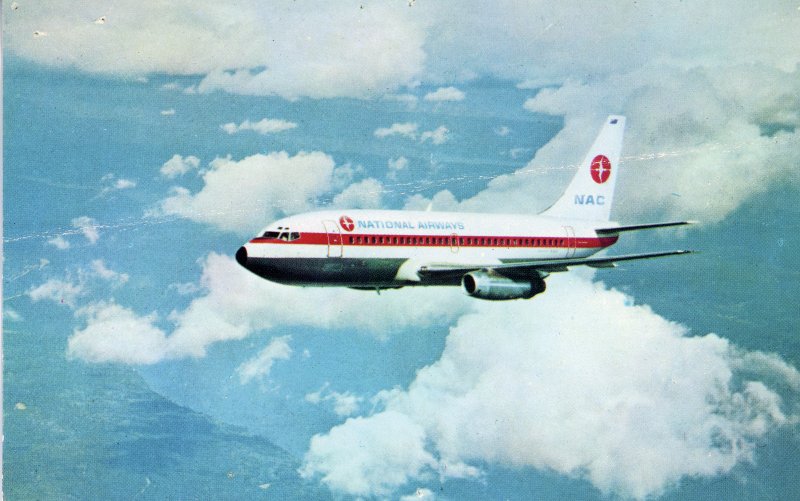
On April 25, 2005, a Boeing 737-282 (registration N789TM) was involved in an aviation accident near Denver, CO. Investigators recorded the probable cause as: A complete lack of communication among interested parties accompanied by the assigning unqualified agents and a lack of direct supervision was the major cause of this accident. This summary draws on records from the U.S. National Transportation Safety Board (NTSB) historical archive; 2 related events involving the same aircraft type or operator are linked below.
Photo: San Diego Air & Space Museum Archives / Public domain, via Wikimedia Commons
During marshalling, an airplane was directed to the wrong stop bar line, leading to a loading bridge impact with the left engine pylon fairing. Investigators cited communication failures and lack of supervision.
Incident Overview
An airplane was being marshalled to the gate by ground personnel from another operator when the incident occurred. The marshaller guided the airplane to a "727" stop bar line located approximately 25 feet forward of the "737" stop bar line. After the airplane was parked, the loading bridge operator maneuvered the bridge toward the aircraft, and the bridge struck the airplane's left engine pylon fairing. At the time of impact, the loading bridge wheels were within the painted hash-mark box.
Investigation Findings
The ground operations investigation report identified the major cause as "a complete lack of communication among interested parties accompanied by the assigning unqualified agents and a lack of direct supervision." The report further stated that the supervisor on duty directed the marshaller to bring the aircraft to the 727 stop block, which was approximately 25–30 feet forward of the 737 stop block. This instruction was communicated only to the marshaller and not to anyone else. Additionally, the supervisor was not present during the aircraft's arrival. The marshalling task was an irregular operation for the ground personnel, who normally handle regional jets.
Probable cause
A complete lack of communication among interested parties accompanied by the assigning unqualified agents and a lack of direct supervision was the major cause of this accident.
A SkyWalk Join't 3 paraglider crashed into the ground near Las Vizcachas, Chile, on September 1, 2024. The pilot and passenger sustained serious spinal…
PARAPENTE (ULTRALIVIANO NO MOTORIZADO)·2024-09-01DGAC Chile
A Cessna 172N struck electrical cables while on final approach to land at Aucó Aerodrome in Chile. The pilot was uninjured, but the aircraft sustained damage…
A Bombardier DHC-8-402 suffered a tail strike during landing at Puerto Williams on September 9, 2024. All 76 occupants were unharmed, but the aircraft…
A MYD JS-MD 3 glider veered off the runway and struck a wall at Vitacura Aerodrome on January 6, 2025. The pilot was uninjured, but the aircraft sustained…
A recreational paraglider flight in Puchuncaví, Chile, ended with the pilot sustaining serious injuries after a rapid descent and impact with a hillside on…
PARAPENTE (ULTRALIVIANO NO MOTORIZADO)·2025-03-29DGAC Chile
A Tecnam P2006T landed on its belly at an aerodrome in Poland after the crew failed to confirm landing gear deployment. The incident resulted in no injuries…