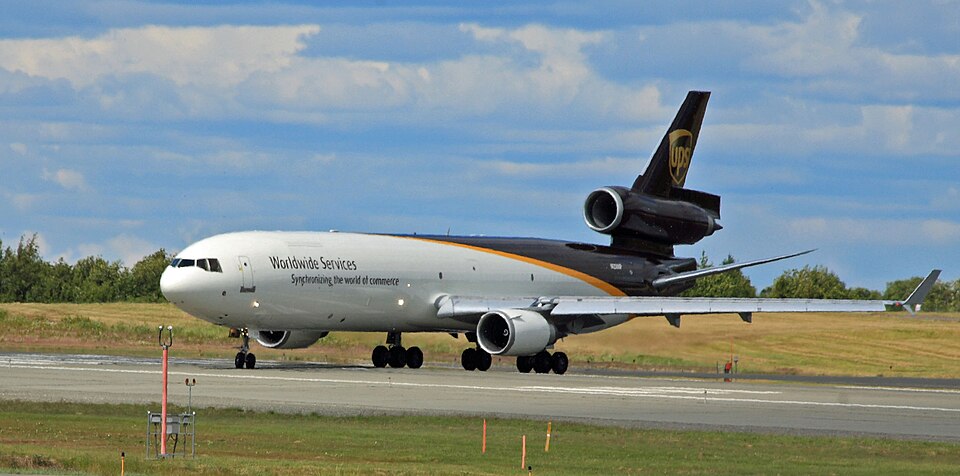
Incident Overview
A McDonnell Douglas MD-11F cargo aircraft sustained a nose landing gear collapse during landing on an 8,579-foot-long concrete runway. The flight was conducted under night visual meteorological conditions. The captain occupying the left seat was the pilot flying and was receiving initial operating experience (IOE). A captain seated in the right seat acted as the pilot-in-command (PIC) of the flight.
Sequence of Events
After the main landing gear touched down, the nose gear subsequently contacted the runway and collapsed. The airplane sustained damage to and around the pressure bulkhead at fuselage station 625.
Flight Data Recorder Analysis
Data from the flight data recorder (FDR) revealed that following main gear touchdown, the control column was moved sharply forward, resulting in a change in pitch attitude from approximately 5 degrees nose-up to about 1 degree nose-down. This movement was accompanied by a reduction in vertical load factor to approximately 0.3 g. Upon nose wheel contact, the vertical load factor spiked to approximately 2.5 g, which is over twice the value typical for a landing. The load factor increment of 0.75 g was also noted as excessive.
Metallurgical Examination
Metallurgical examination of the remnants of the nose landing gear assembly indicated that the failure was consistent with overstress. No evidence of any preexisting fractures was observed in the components.
Damage Assessment
The primary damage was localized to the area around the pressure bulkhead at station 625, with the nose landing gear collapsing under the excessive loads.