Background
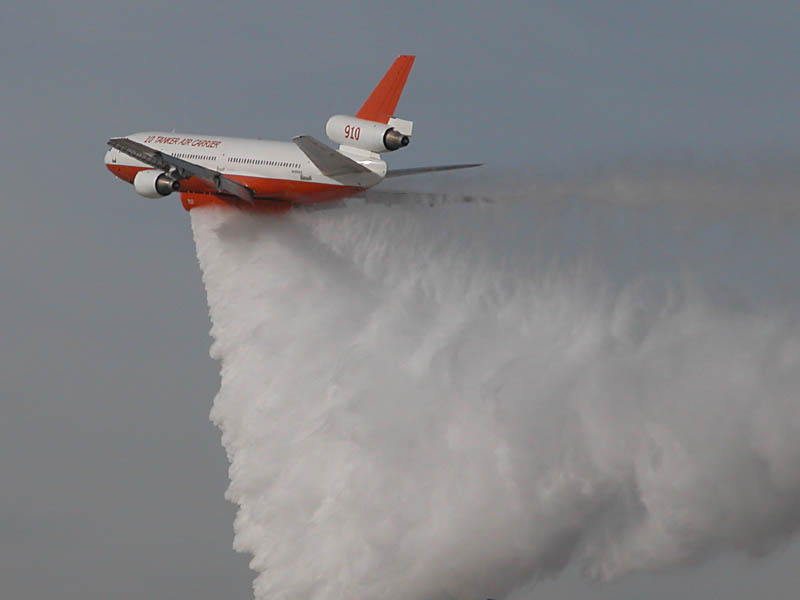
The accident airplane was a transport category aircraft modified for use as a firefighting air tanker. It was under contract to the State of California for exclusive use during the fire season. The operator, flight crew, and the specific airplane were in their second fire season together. To support the airplane's availability, the contracting agency had increased the personnel assigned to the program.
Standard operating procedures required a lead airplane to fly the intended flight profile before the air tanker. The air tanker crew would observe the lead's profile and then follow the lead while executing the drop. The lead airplane was responsible for pointing out obstacles and other concerns along the flight path.
Incident Sequence
On the accident run, the originally assigned lead airplane, whose pilot was specifically trained for DC-10 fire retardant drop procedures, departed to return to base for refueling. It was replaced by a backup lead airplane and pilot. The backup lead flew the flight profile before the accident airplane joined for its retardant drop.
During the run, the accident airplane's captain flew the profile at a lower altitude than the lead airplane. The airplane entered a left turn and subsequently struck multiple trees with its left wing.
Data Recorder Information
The digital flight data recorder (DFDR) indicated that the airplane reached a left bank angle of 35 degrees. The vertical acceleration ranged from 0.8 to 1.4 G's, consistent with normal loading conditions during a banked turn.
Crew Experience and Training
Although the flight crew had experience operating the accident airplane, they had limited fire suppression experience. The operator provided training on the airplane and on operating in the fire environment. The majority of the crew's retardant drop experience, exceeding 100 hours using water for drops, was gained during certification testing of the airplane.