History of Flight
On June 3, 2012, at 1347 mountain daylight time, a Lockheed P2V-7, registration N14447, designated as Tanker 11 (T-11), collided with mountainous terrain while conducting firefighting operations approximately 20 miles north of Modena, Utah. The airplane was operated by Neptune Aviation Services under contract with the US Forest Service as an exclusive public-use fixed-wing airtanker service contract under the operational control of the Bureau of Land Management (BLM). Both pilots sustained fatal injuries. The airplane was destroyed by impact forces and post-crash fire. Visual meteorological conditions prevailed, and a company flight plan had been filed. The flight originated in Cedar City, Utah, at 1315.
The crew consisted of a pilot, copilot, and crew chief, based out of Missoula, MT, and had been together for the previous three weeks. Normally, crews stay together for the entire fire season. Tanker 11 crew had operated out of Reno for the two weeks prior to the accident. During fire drop operations, the tanker is manned by the pilot and copilot, while the crew chief remains at the fire base. The day before the accident, while en route from Reno to Cedar City, they performed one retardant drop on the White Rock fire, then landed at Cedar City. The crew departed the tanker base and arrived at their hotel around 2230. The following morning, the crew met at 0815 and rode to the tanker base together. Tanker 11 took off at 1214 for its first drop on the White Rock fire and returned at 1254. The crew shut down the airplane, reloaded retardant, and did not take on fuel.
Tanker 11 departed the tanker base at 1307 for its second retardant drop, intended for the same location as the first. Upon arriving in the Fire Traffic Area (FTA), Tanker 11 followed the lead airplane, a Beech Kingair 90, into the drop zone. The drop zone was located in a shallow valley 0.4 miles wide and 350 feet deep. The lead airplane flew a shallow right-hand turn onto final and descended to 150 feet above the valley floor over the intended drop area. While making the right turn onto final behind the lead plane, Tanker 11's right wing tip collided with terrain approximately 700 feet left of the lead airplane's flight path, resulting in a rapid right yaw, followed by impact with terrain; a fireball subsequently erupted. Tanker 11 created a 1,088-foot-long debris field and post-impact fire.
Personnel Information
The captain, age 48, held an Airline Transport Pilot (ATP) certificate with ratings for airplane multiengine land and commercial privileges for single-engine land, issued January 25, 2010, and a second-class medical certificate issued January 17, 2012, with no limitations. He reported on his Forest Service Airplane Qualification and Approval Record, dated February 23, 2012, 6,136 total flight hours. His most recent FAR Part 61.58 pilot-in-command proficiency check was dated February 20, 2012, and he was issued his USDA USID Interagency Airplane Pilot Qualification Card, with an expiration date December 31, 2012.
The first officer, age 40, held an ATP certificate with ratings for airplane multiengine land and commercial privileges for airplane single-engine land, issued October 29, 2010, and a first-class medical certificate issued March 5, 2011, with no limitations. He reported 4,253 total flight hours on his Forest Service Airplane Pilot Qualification and Approval Record, dated February 20, 2012. His most recent FAR Part 61.55 second-in-command check flight was completed on February 20, 2012, and he was issued his USDA USID Interagency Airplane Pilot Qualification Card, with an expiration date December 31, 2012.
Aircraft Information
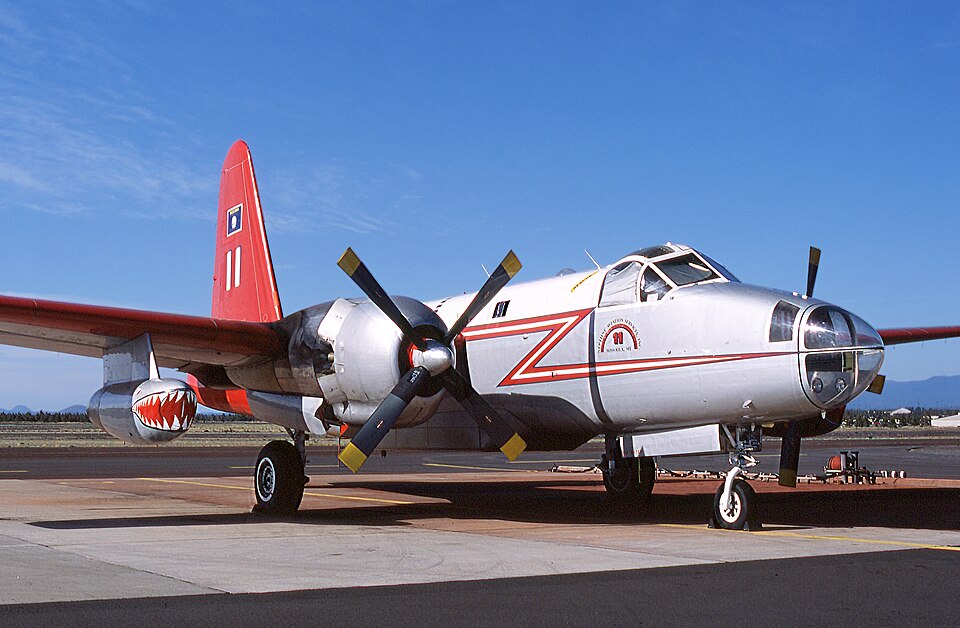
The Lockheed P2V-7 Neptune (serial number 8010, manufactured 1962) was a decommissioned US Navy four-engine maritime patrol airplane converted for firefighting by Neptune Aviation Services, Inc., and registered to them on September 13, 1993. It was powered by two Curtis Wright R3350-32W 3,400-hp engines with four-bladed Hamilton Standard propellers and two Westinghouse J34-WE-36A 3,400-lbf jet engines. Maintenance records showed the airplane was on an approved inspection program; the most recent annual inspection was completed on March 9, 2012, at 12,293.6 total aircraft hours. At the time of the accident, total airframe time was 12,311.9 hours. Engine times since major overhaul (TSMOH) or time in service were: No. 1 radial 1,643.9 hours, No. 2 radial 948 hours, No. 1 propeller 2,777.3 hours, No. 2 propeller 2,360.9 hours, No. 1 jet 227.3 hours, No. 2 jet 246.8 hours.
Weight and balance documentation dated June 26, 2010, showed maximum gross weight 80,000 lbs and operational weight with 18,720 lbs retardant at 76,793 lbs. Maximum forward CG was 19.5% MAC and aft 38.0% MAC. The calculated accident weight with two crew, 18,676 lbs retardant, and 7,500 lbs fuel was 71,117 lbs, resulting in a takeoff CG of 32.4% MAC.
Wreckage and Impact
The Hamblin Valley terrain consisted of two ridges running downhill to the northeast starting at about 7,500 feet msl, creating a shallow valley with a 26-degree slope, populated with pinion pine, juniper, and sagebrush. The area was completely burned over at examination.
The initial point of impact was identified by severed tree tops and the edge of a retardant strip released by the airplane. The farthest heavy debris was the right-hand radial engine, located 1,088 feet down-valley on a bearing of 057 degrees magnetic. Wreckage on the ridge near initial impact included the right jet engine, right wing tip, and wing flap section. Two flap jackscrews were found nearby. Light debris (cockpit instruments, canopy bows, propeller, Appareo memory module, fuselage skin) was scattered about 450 feet downhill. Heavy debris starting about 865 feet downhill contained retardant tanks and bay doors, cockpit, left radial engine and propeller, left jet engine, wing box, and tail section. The CVR was located next to the tail wreckage. The right-hand radial engine was about 225 feet beyond the main wreckage.
Two witnesses positioned about 1/3 mile from Hamblin Valley on a fire access road captured a five-frame photo sequence. The first photo showed the airplane in a right bank with right wingtip hidden by trees and a plume of red retardant. The second showed the tanker rotated about 90 degrees right, right wing hidden, and a fireball erupting near the right wingtip. The third showed the airplane rotated 180 degrees and a large fireball from the right side. The fourth and fifth frames showed an expanding fireball and black smoke. In all frames, the lead Beech Kingair 90 was visible ahead and slightly more south, at lower altitude between the ridges.
Flight Recorders
The Appareo GAU2000 recorder (lightweight attitude, air-data, and GPS recording system) was recovered. Its memory chip was removed, cleaned, and read. The recording contained about 60 flights over several years. The data stopped about 1/4 mile from the first impact point due to the unit's buffer/write cycle.
Data for the accident flight was continuous from Cedar City to 1/4 mile before impact. It showed Tanker 11 flying northwest 58 miles, executing a right-hand 360° holding orbit, then a tighter 270° orbit, then a left teardrop course reversal to start the approach. During the last 74 seconds, the tanker maintained 7,750 feet msl (zero glide slope) while terrain rose at about 712 fpm. The ground track aligned with the drop zone similarly to the first drop. Comparison showed the first drop approach was initiated from about 1,000 feet above the ridge line with a steady descent, while the accident approach was at ridge elevation in level flight while turning onto final, turning inside and below the shallow valley.
The Cockpit Voice Recorder (CVR) recorded the last 30 minutes. Despite extensive fire and heat damage, the memory was successfully downloaded. The recording began at 1308:28, prior to engine start. Crew contacted lead airplane (Lead 8) at 1328:54. At 1335:55, captain called to start jet engines and set flaps to 10 degrees. At 1336:25, first officer stated number 2 jet engine didn't start; Lead 8 informed of a tailwind and to start final early, stating 7,100 feet would clear terrain and higher terrain off the right wing. At 1337:26, number 2 jet started. At 1339:09, captain said spacing was good; Lead 8 replied he'd start base turn and keep it in to final. At 1340:08, Lead 8 said he had the retardant line in sight. At 1340:13, captain called "jets to idle," eight seconds later called "jets," first officer called "airspeed," captain called "jets" again, followed by sounds of first impact. The recording ended at 1340:24 when electrical power discontinued.
Medical Information
An autopsy on the captain on June 4, 2012, by the Utah Department of Health listed cause of death as blunt force trauma. FAA forensic toxicology on specimens from the captain showed negative results for ethanol and listed drugs; carbon monoxide and cyanide tests were not performed.
An autopsy on the first officer on June 4, 2012, also listed cause of death as blunt force trauma. FAA forensic toxicology showed negative results for cyanide, ethanol, and listed drugs; carbon monoxide tests were not performed due to specimen suitability.