History of Flight
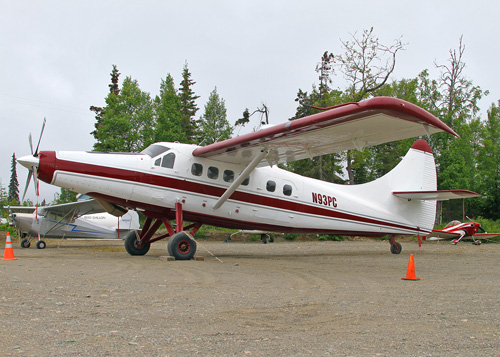
On July 7, 2013, about 1120 Alaska daylight time, a de Havilland DHC-3 Otter, registration N93PC, collided with terrain shortly after takeoff from Soldotna Airport, Soldotna, Alaska. The commercial pilot and nine passengers died, and the airplane was destroyed. The aircraft was registered to Rediske Family Limited Partnership and operated by Rediske Air under 14 Code of Federal Regulations Part 135 as an on-demand charter flight destined for Bear Mountain Lodge, about 90 miles southwest of Soldotna. Visual meteorological conditions prevailed; no flight plan was filed.
The pilot, originally scheduled to fly a different trip that was canceled, decided to use the Otter to transport the group of nine passengers together. The lodge operator supplied about 300 pounds of groceries and supplies, which the pilot and lodge owner loaded onto the airplane. Fueling records were not kept; a witness reported seeing the pilot top off the forward tank and begin fueling the center tank. The first leg from Nikiski to Soldotna, where passengers boarded, was uneventful.
Witnesses at Soldotna Airport observed the pilot taxi to runway 25 for departure. No witnesses saw the accident sequence. The airplane impacted ground about 2,320 feet from the runway threshold and 154 feet right of the centerline, consistent with a nose-low, right-wing-low attitude.
Personnel Information
The 42-year-old pilot held a commercial pilot certificate with single-engine, multiengine, and instrument ratings. His most recent second-class medical certificate was issued July 11, 2012, with no limitations. He was approved as a check airman for Rediske Air on April 24, 2012. His initial DHC-3 ground training was completed June 28, 2011; his most recent competency check in the Otter was June 15, 2012, and recurrent ground training on the same date. He received Cessna 206 competency and line checks on May 15, 2013.
Personal logbooks were not located. An insurance application dated April 23, 2013, listed total flight time of 7,765 hours, with 105 hours in DHC-3 aircraft (down from 155 hours the previous year). Total flying time in the last 12 months was 350 hours. Company flight and duty records were incomplete after June 23, 2013; recreated records showed the pilot flew 1.9 hours the day before the accident and 6.1 hours in the preceding 72 hours. His spouse reported he had a normal work routine and slept between 2100 and 2130 the night before.
Aircraft Information
The DHC-3 Otter, serial number 280, was manufactured in 1958. It was a single-engine, propeller-driven, high-wing STOL airplane modified with a Honeywell TPE 331-10R-511C turboprop engine per a Texas Turbine Conversions STC, and equipped with a Hartzell HC-B4TN-5NL four-blade propeller. A Baron STOL kit STC was also installed. The airplane could carry 10 passengers and cargo, with a maximum gross weight of 8,000 pounds. Cargo area load limits were increased via STC to 750 pounds. The aircraft underwent a major overhaul and turbine conversion in July 2010 by Recon Air Corporation, including STCs for extended range fuel, pulse light system, and avionics updates. Rediske Family Limited Partnership purchased the airplane in October 2010. Maintenance was conducted under an Approved Airplane Inspection Program (AAIP) with phase inspections every 50 hours. The most recent inspection (phases 2, 3, and 4) was completed June 13, 2013, at 22,831.8 hours total time, with 295.3 hours on the engine since overhaul. Ten discrepancies were rectified; none were major.
Weight and balance records showed empty weight calculations based on a July 2010 weighing and subsequent recalculations. The operator’s OpSpecs required actual weights for weight and balance, but did not include the DHC-3 in its loading schedules. The flight manual and supplements were carried on the accident flight.
Meteorological Information
The Soldotna Airport AWOS reported at 1116: wind from 190° at 6 knots, 10 miles visibility, temperature 12°C, dew point 8°C, altimeter 29.58 in Hg. Visual flight rules conditions prevailed.
Wreckage and Impact Information
The airplane impacted terrain 2,320 feet from the threshold of runway 25 and 154 feet right of the centerline, consistent with a nose-low, right-wing-low attitude. An extensive postcrash fire consumed most of the cockpit and cabin. The engine was within the main wreckage with fire damage but no evidence of uncontainment. All four propeller blades exhibited rotational scoring and bending. Flight control cables were traced; separations showed tension overload signatures. All primary and secondary flight controls remained attached except the outboard half of the right aileron.
Additional Information
Rediske Air was a Part 135 on-demand operator based in Nikiski, Alaska, with a satellite base at Soldotna. The accident pilot was owner and director of operations. The company operated six aircraft, including the accident Otter. FAA oversight was provided by the Anchorage FSDO. The principal operations inspector noted the company was a good operator and visited a couple times per year. The principal maintenance inspector had worked for Rediske Air before joining the FAA and visited the operation every three months.