Overview
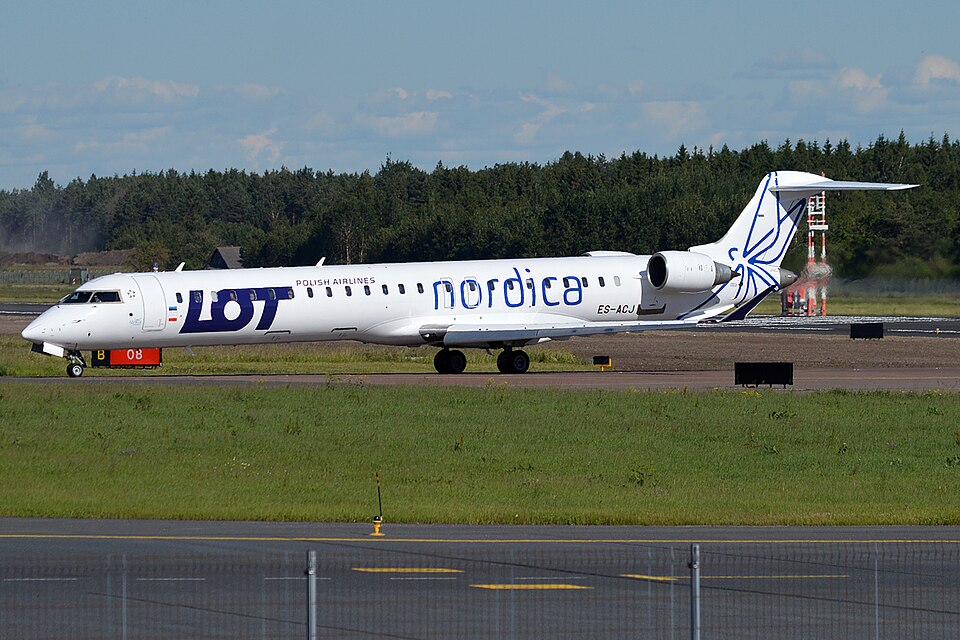
On 13 October 2018, a Bombardier CRJ900, registration ES-ACJ, experienced a serious incident at Warsaw Chopin Airport (EPWA). The incident involved smoke entering the cockpit and cabin, prompting the crew to declare an emergency. The aircraft landed without further consequences.
Incident Details
At 11:51 local time, while holding second in line for landing on runway 11, the crew transmitted a distress message due to smoke in the cockpit. The airport activated a second-degree alert for ground services. The aircraft landed at 11:53 escorted by the airport fire brigade. After landing, the crew requested the fire service to check for external smoke. No smoke was found externally, and the aircraft taxied to its parking position via taxiway N1. The captain deemed passenger evacuation unnecessary.
The crew reported noticing gray smoke from cockpit ventilation vents and a smell of burning shortly before landing, prompting them to don oxygen masks. Cabin crew informed the captain of smoke in the rear passenger cabin. The captain announced to passengers that the smoke was due to an air conditioning system malfunction. After the smoke dissipated, the crew removed their masks but noted an increased temperature in the cockpit.
Investigation
Technical inspection revealed that the smoke was caused by a malfunction of the left pneumatic air cycle kit (PACK). The Air Conditioning Unit (ACU), which includes the Air Cycle Machine (ACM), was sent to Lufthansa Technik (LHT) for further analysis.
Prior to disassembly, the ACM turbine was found seized. During teardown, investigators found:
- Significant wear of the foil air bearing, its retainers, and shims;
- Scoring and scratches on the turbine wheel and shroud surfaces from contact during rotation;
- Signs of severe overheating of the bearing.
The turbine rotor is supported by a maintenance-free foil air bearing (a sliding bearing). Its principle relies on an air cushion forming between the shaft and bearing surface due to pressurized airflow. When airflow is sufficient, rotating parts lift and friction nearly disappears. However, during ACM startup, the shaft contacts the bearing until the air cushion forms. To reduce friction, the bearing surface is coated with Teflon foil, and damping foil springs separate rotating parts.
This design causes the Teflon coating to degrade with each start and stop. Gradual wear of the foil springs occurs from temperature changes and loads. The progressing bearing degradation may have prevented formation of the air cushion during a phase of reduced engine bleed air pressure, increasing friction and ultimately jamming the turbine rotor.
According to LHT, the observed bearing, wheel, and shroud damages are common after ACM failure. The likely cause of the bearing failure was operational wear. The affected components had accumulated over 10,000 flight hours. LHT's experience indicates that many ACMs with the same part number and comparable operating conditions exhibit wear at similar operating hours.
Findings
The investigation concluded that the probable cause of the incident was operational wear of the foil air bearing in the left ACM. No contributing factors were identified. After repair, the ACM was returned to service.
Conclusion
The incident underscores the importance of monitoring air conditioning system components, particularly foil air bearings in Air Cycle Machines, as they are subject to wear over extended service life.