Incident Overview
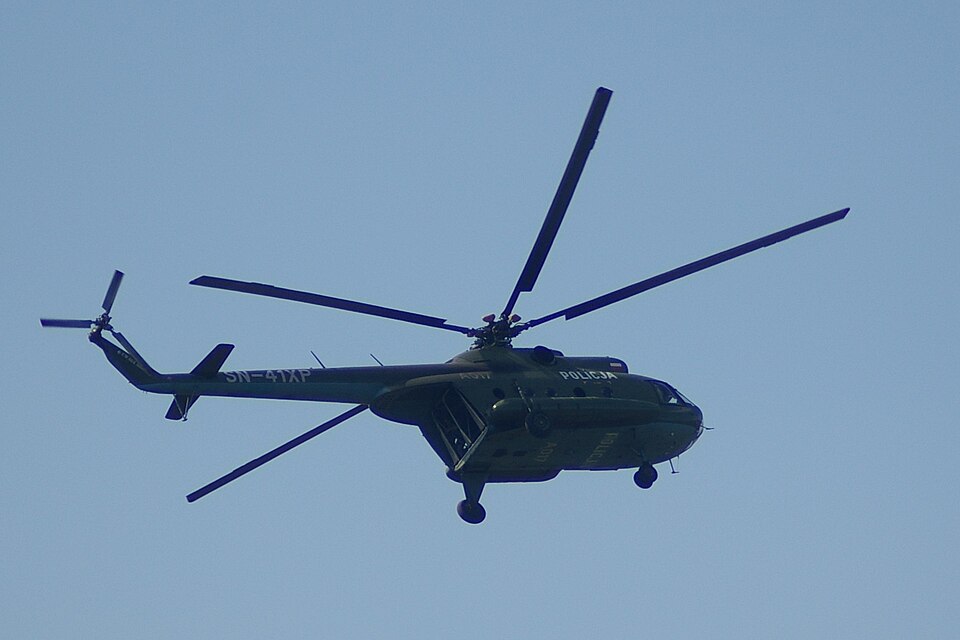
On 4 September 2019 at 18:12 LMT, a serious incident occurred at Warsaw Babice airport (EPBC) involving two helicopters: a PZL Mi-8 (registration SN-41) operated by the Polish State Aviation and a Robinson R44 (registration SP-SWS) operated by a private owner. Both aircraft were conducting flights in the traffic pattern. The Mi-8 was performing a training flight with a simulated single-engine landing, while the R44 was on a private flight. Weather conditions were visual meteorological conditions (VMC) and daylight, and meteorological factors were not considered contributory.
Sequence of Events
The Mi-8 was on downwind for runway 28 and contacted Babice Radio, announcing its intention to land with one engine inoperative. The controller instructed the crew to report on final. Shortly thereafter, the R44 pilot called, approaching the ZULU navigation point, requesting landing conditions. Babice Radio replied that runway 28 was in use and asked the R44 to report position after the fourth turn.
The Mi-8 crew then transmitted: "Downwind 28, we see the one over ZULU, we will go after him." The R44 responded: "Helicopter at my 3 o'clock, you are number 2." The Mi-8 replied: "Most likely, before us to the fourth turn a aircraft is coming, we will do one engine landing."
Between the third and fourth turns, the Mi-8 began the procedure to reduce power on one engine. Just prior to the fourth turn, while maintaining 1,400 feet, the Mi-8 received a TCAS traffic advisory indicating a contact at zero miles. The crew aborted the engine shutdown procedure. Shortly after, they observed the R44 from their left front, approximately 200 feet below, crossing their flight path from left to right. The R44 landed on the north side of runway 28 near a hangar. The Mi-8 landed safely on the south side of the runway.
The Mi-8 pilot reported the near collision to the Flight Information Duty Officer, who submitted a report to the Polish Civil Aviation Authority's Central Database.
Commission Findings
The State Commission on Aircraft Accident Investigation (PKBWL) identified the following: 1. Babice Radio did not react to the conflicting traffic situation during the circuit flights, particularly during the fourth turn. 2. The flight crews did not maintain separation as required by circuit procedures. 3. Radio communication between the crews was improper. 4. The event was referred to the Military Aviation Accidents Commission (KBWL LP) because a State Aviation helicopter was involved. On 15 November 2019, KBWL LP responded that the event did not meet the criteria of an aircraft accident.
Cause
The cause of the serious incident was failure to maintain separation required in the circuit pattern.
Safety Recommendations
No safety recommendations were formulated.