History of the Flight
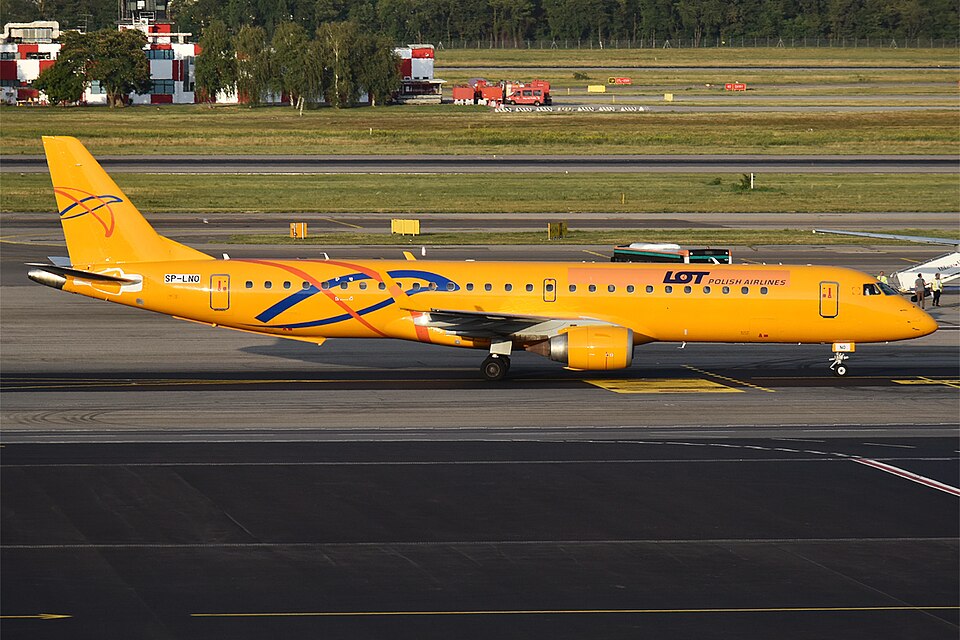
On 11 October 2019, the crew of an Embraer ERJ 190-200 LR, registration SP-LNO, operated by PLL LOT, performed a flight from Brussels to Warsaw. The First Officer (FO) was the Pilot Flying (PF). Three persons were in the cockpit: the captain, the FO, and a cabin crew member.
The approach was to Runway 33 (RWY33) at Warsaw Chopin Airport (EPWA). The aircraft was configured with flaps in position 5. During the approach, wind was from 240° (left side) with gusts up to 21 kt. The approach parameters at 1,000 ft and 500 ft met the operator's stabilised approach criteria.
After receiving landing clearance, the PF disengaged the autopilot and manually flew the approach. Just before touchdown, a crosswind of 10 to 15 kt was recorded. The aircraft slightly deviated from its path and touched down with a vertical acceleration of 1.96 g. It bounced off the runway, and the PF initiated a go-around. The autothrottle disengaged automatically per system logic. The thrust lever was moved to 72° TLA without pressing the TO/GA button.
Go-Around and Upset
During the go-around, the maximum climb rate reached 4,384 ft/min, prompting air traffic control to ask the crew to confirm vertical speed. The pilots responded to decreasing speed by advancing the thrust levers to 75° TLA, which further increased the pitch angle to a maximum of 32.2°.
At an altitude of 1,470 ft (1,218 ft AGL), the aircraft's speed dropped to 95 kt. The critical angle of attack warning system and stick shaker activated, accompanied by yoke shaking and an audible signal. The crew had already begun an upset recovery manoeuvre by pushing the yoke, causing the aircraft to pitch down momentarily and increase speed.
The aircraft was recovered at 1,382 ft (1,044 ft AGL). Stick shaker activation lasted one second (from 10:14:21 to 10:14:22). The system terminated warnings on nearing critical angle of attack at 1,382 ft. The crew then pressed TO/GA, activating the Flight Guidance Control System (FGCS). Following ATC instructions, they turned right, conducted another approach, and landed safely on RWY33.
Injuries and Damage
There were no injuries to persons. The aircraft sustained no damage.
Findings and Causes
The investigation determined that the serious incident resulted from: incorrect execution of the 'Bounced Landing Recovery' and 'Go-Around' procedures, and delayed reaction of the Pilot Monitoring to errors made by the Pilot Flying during landing and go-around.
Safety Recommendations
After the investigation, the State Commission on Aircraft Accidents Investigation (PKBWL) issued four safety recommendations to the operator, PLL LOT.