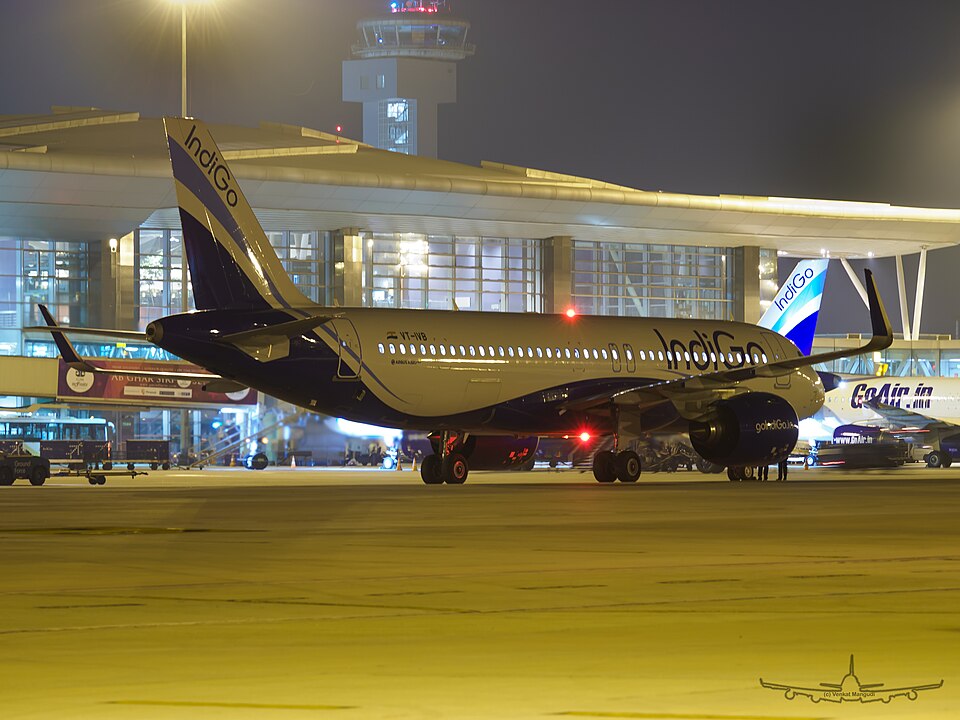
History of the Flight
On 1 April 2019, IndiGo flight 6E-914, operated by an Airbus A320-271 NEO (registration VT-IVB), departed Jaipur Airport at approximately 1249 UTC bound for Hyderabad. The aircraft was under the command of an ATPL (FATA) holder as pilot-in-command and an ATPL holder as co-pilot. There were 128 persons on board, including four cabin crew members.
During climb, passing through 14,600 feet altitude at 1308 UTC, the crew heard a loud bang. The ECAM (Electronic Centralized Aircraft Monitor) displayed an ENG 1 STALL warning, followed by ENG 1 HGH VIB (high vibration) and ENG 1 EGT OVERLIMIT (exhaust gas temperature overlimit). N1 and N2 vibration indications reached 10, and EGT rose above 1000°C.
The crew performed the ECAM and QRH (Quick Reference Handbook) procedures for engine stall, vibration, and EGT overlimit. As engine parameters remained abnormal, they decided to divert back to Jaipur. They informed the company via ACARS and ATC Jaipur. No emergency was declared. After obtaining clearances, the aircraft landed safely at Jaipur at 1327 UTC. After landing, the ECAM displayed ENG 1 OIL CHIP DETECTED, and while taxiing to the bay, ENG 1 FAIL and ENG 1 START FAULT appeared.
Post-flight visual inspection of engine #1 revealed damage to all blades of the low-pressure turbine (LPT) third stage.
Damage to Aircraft
Teardown examination of engine #1 (Pratt & Whitney PW1127G-JM, serial number P770187) identified the following damage:
- Score marks on the LPT drive shaft.
- Damage to several blades of LPT stages 1 and 2.
- Fracture of all blades of LPT stage 3.
- Cracks in LPT stage 1 and stage 2 stator insulation segments.
- Deformation/rubbing of LPT stage 1 honeycomb cell walls.
- Damaged honeycomb wall on LPT stage 2 shroud segments.
- Impact damage on LPT stage 3 vanes.
- Heavy deformation, nicks, and cracks on the LPT case.
- Impact damage on the turbine exhaust case.
There was no fire and no injuries to any occupants.
Personnel Information
The pilot-in-command, aged 53, held a valid FATA (Flight Air Transport Attestation) license with A320 endorsement and a valid Class I medical certificate. Total flying experience was 10,444.24 hours, with 4,091.24 hours on type. The co-pilot, aged 27, held an ATPL with A320 endorsement and a valid Class I medical certificate. Total flying experience was 2,678.20 hours, with 2,478.20 hours on type. Both pilots had adequate rest before the flight.
Aircraft Information
The aircraft, an Airbus A320-271 NEO (manufacturer serial number 7914, year of manufacture 2017), was powered by two Pratt & Whitney PW1127G-JM engines. The left engine had accumulated 4,086 hours and 2,766 cycles; the right engine had 2,319 hours and 1,558 cycles. All applicable airworthiness directives, service bulletins, and modifications were complied with as of the event date.
Meteorological Information
METAR reports from Jaipur Airport around the time of the incident indicated visibility of 3000–4000 meters with haze, temperature around 35–36°C, and wind from the northwest at 3–6 knots. The weather was noted as having no relevance to the incident.
Communications and Navigation
Two-way communication between the aircraft and ATC was positive throughout. All navigational aids at Jaipur were serviceable, and the aircraft had no recorded defects in navigational equipment prior to the flight.
Flight Recorders
Both the Solid State Cockpit Voice Recorder (SSCVR) and Solid State Flight Data Recorder (SSFDR) were downloaded for analysis (details not provided in this summary).