History of Flight
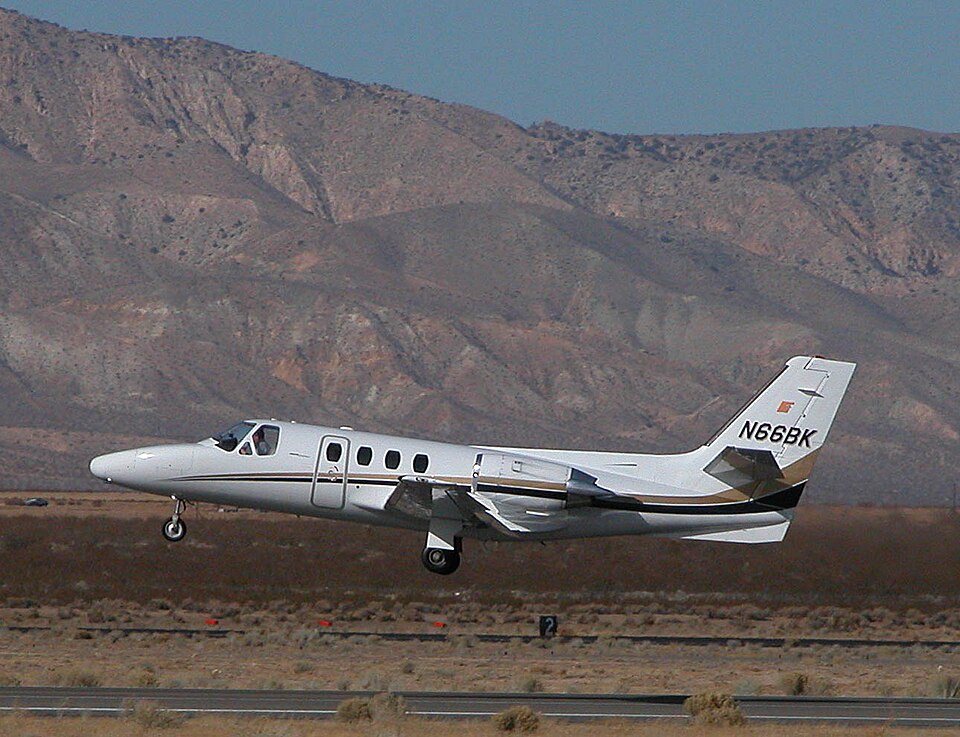
On May 29, 2021, at about 1055 central standard time, a Cessna Citation CE-501, registration N66BK, was destroyed when it struck Lake Percy Priest shortly after departing from Smyrna Airport (MQY), Smyrna, Tennessee. The pilot, a pilot-rated passenger, and five passengers were fatally injured. The flight was operated under 14 Code of Federal Regulations Part 91.
The pilot had filed an instrument flight rules flight plan to Palm Beach International Airport (PBI), West Palm Beach, Florida. He purchased 414 gallons of Jet A fuel, topping off the tanks to 574 gallons. After taxiing to runway 32, he was cleared for takeoff and instructed to turn to a heading of 90° and climb to 3,000 ft mean sea level (msl). The pilot initially read back the clearance incorrectly, and the controller corrected him.
The airplane departed at 1053:06 and made a climbing right turn to the east. At 1054:27, the controller instructed the pilot to turn right to 130°, but the pilot did not acknowledge until four seconds later. At 1055:11, the controller instructed the airplane to climb to 15,000 ft, but no response was received. Radar data showed several heading changes, climbs, and descents before the airplane entered a steep left turn. The last radar return indicated an altitude of 700 ft msl, descending at 31,000 fpm, on a heading of 090°.
Witnesses reported hearing a sound like a military jet and seeing the airplane impact the water in a near-vertical attitude. No fire or explosion was observed.
Meteorological Information
At 1056, weather at MQY reported wind from 310° at 10 knots, visibility 10 miles, overcast ceiling 1,300 ft, temperature 14°C, dewpoint 12°C, and a barometric setting of 30.04 inHg.
Pilot Information
The pilot held a commercial pilot certificate with multiengine and instrument ratings, a private helicopter rating, and a CE-500 type rating. He had 1,680.5 total flight hours, with 83 hours in the accident airplane and 39.8 hours of actual instrument experience (5.9 hours in the accident airplane). His last second-class medical (November 12, 2019) required corrective lenses.
In January 2020, the pilot attended Citation II initial training at Flight Safety International but did not meet the performance level for the check ride. He later received 11.4 hours of training in the accident airplane from a flight instructor, who noted the pilot struggled with the Garmin 430/530 systems and relied heavily on an iPad. Another pilot reported that the accident pilot struggled in instrument meteorological conditions (IMC) and with the autopilot, and was not proficient for complex airspace.
The pilot-rated passenger had obtained a commercial multiengine certificate two days before the accident, with 310 total hours. He was not type-rated in the accident airplane.
Aircraft Information
The Cessna CE-501 was a seven-place business jet powered by two Pratt & Whitney Canada JT15D-1B turbofan engines. The last phase inspections were completed on February 25, 2021, at 4,781.4 hours. The airplane was equipped for IMC operations.
Wreckage and Impact
Wreckage was found in Lake Percy Priest in 2 to 8 feet of water, heavily fragmented. Recovery was hampered by poor visibility and mud. About two-thirds of the wreckage was recovered, including both engines, the main cabin door (with pins out), landing gear (fully retracted), and flight control surfaces. No evidence of fire was found.
Cockpit instruments showed the pilot’s heading indicator at 340°, attitude indicator at 60° nose-down and 45° left bank. The power quadrant showed the right engine power lever fully aft and the left fully forward. The flap actuator showed flaps retracted. Engine examination revealed powered rotation at impact with no preimpact mechanical malfunction.
Medical and Pathological Information
Autopsy reports for the pilot and pilot-rated passenger listed cause of death as multiple blunt traumatic injuries, manner accident. Toxicology detected ethanol in pilot’s muscle tissue (0.052 gm/hg) and in the pilot-rated passenger’s muscle and kidney tissues (0.021 and 0.013 gm/hg). No other drugs were found.
Performance Study
An ADS-B data study and six-degree-of-freedom simulation indicated that after entering clouds, the airplane pitched and rolled, with accelerations that could have caused spatial disorientation. The simulation suggested that the pilot might have misperceived the aircraft’s attitude due to somatogravic illusion, a condition where the inner ear cannot distinguish between acceleration and tilt, especially in poor visibility. The pilot had limited visual cues in IMC and would have relied on instruments to maintain orientation.