Flight History
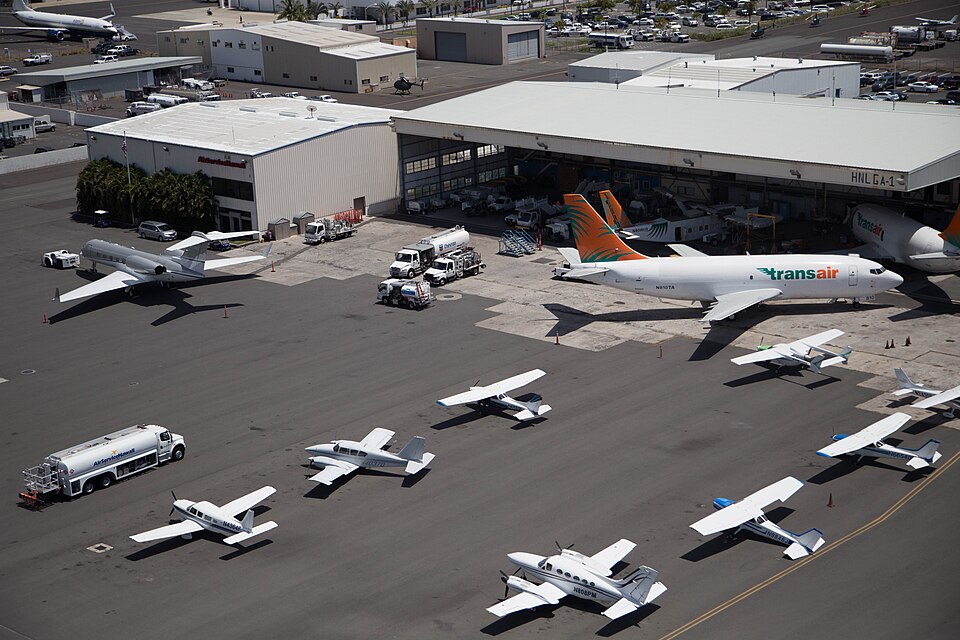
On July 2, 2021, about 0145 Hawaii-Aleutian standard time, Rhoades Aviation flight 810, doing business as Transair flight 810, a Boeing 737-200 (registration N810TA), experienced an engine anomaly shortly after takeoff from Daniel K. Inouye International Airport (HNL), Honolulu, Hawaii. The flight was a cargo operation under Title 14 Code of Federal Regulations Part 121, destined for Kahului International Airport (OGG), Kahului, Hawaii. The captain sustained serious injuries, the first officer sustained minor injuries, and the airplane was destroyed.
The flight crew arrived at the company’s flight-following office at HNL by 0015 for the scheduled 0100 departure. After discussing weather and performance, cargo was loaded. The first officer conducted a preflight inspection and found dried fluid on the right main landing gear, which was examined by the captain and a mechanic and deemed not a concern.
Engine Anomaly and Emergency
After engine start and taxi, the flight was cleared for takeoff on runway 8R at 0132:20. During the takeoff roll, the captain observed exhaust gas temperature (EGT) indications at the line between green and yellow ranges on both engines, which he considered normal based on previous flights. At 0133:52, a thud sound was recorded, followed by a low-frequency vibration. The right engine lost power, causing a yaw to the right, corrected with left rudder. The captain declared an emergency to air traffic control (ATC).
The left engine initially maintained takeoff power, but its EPR (engine pressure ratio) began decreasing around 0135:16, eventually settling near flight idle by 0135:56. The right engine also decreased to near flight idle by 0137:09. The crew discussed engine status and attempted checklists. The captain took control of the airplane at 0137:13. Despite efforts, the airplane could not maintain altitude. The crew informed ATC of the possibility of losing the remaining engine due to high EGT.
Ditching and Aftermath
At 0144:11, the crew requested the closest airport, but the airplane was unable to reach land. The captain announced they would be in the water at 0145:11. The airplane struck the water at 0145:17. The left engine EPR was 1.05 and the right engine EPR was 1.46 at impact. Emergency services responded. The NTSB investigation determined that the left engine was capable of producing normal thrust but was not used by the crew during the flight.