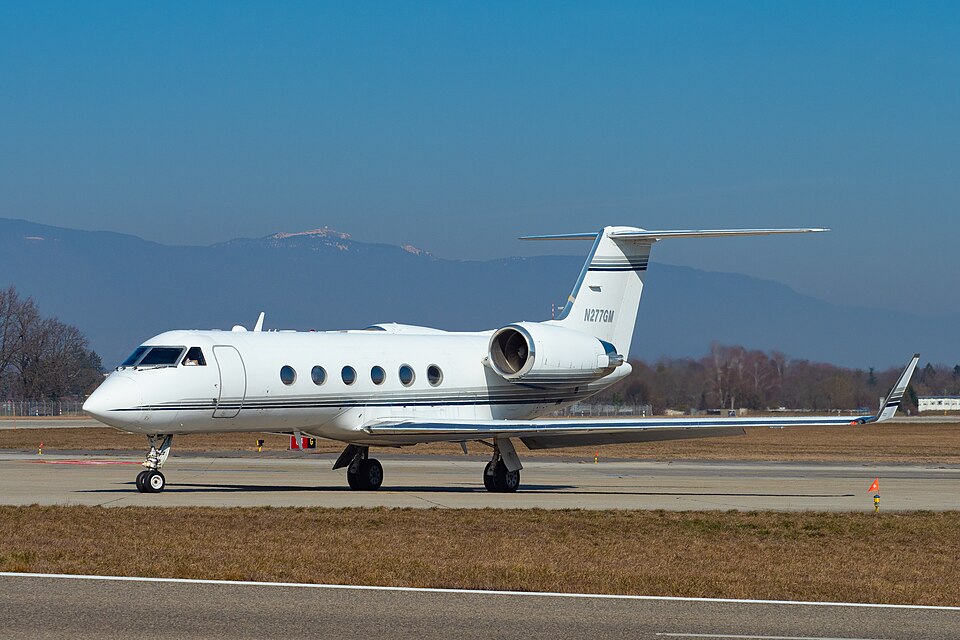
Accident Sequence
On August 21, 2021, about 1340 eastern daylight time, a Gulfstream Aerospace G-IV airplane, registration N277GM, was substantially damaged during a rejected takeoff at Fort Lauderdale Executive Airport (FXE), Fort Lauderdale, Florida. The airplane, operated under Title 14 Code of Federal Regulations Part 91 as a personal flight, carried 4 crewmembers and 10 passengers, none of whom were injured.
The pilot in command (PIC) reported that the takeoff roll on runway 9 was initially normal. At about 100 to 110 knots, he felt a severe shimmy that worsened progressively. He recalled the forward deck angle lowering, as if tires had blown, and immediately aborted the takeoff using braking and thrust reversers. The airplane slowed but veered off the runway, striking a concrete slab holding approach lighting equipment with the right wing and right main landing gear before coming to a stop.
The second-in-command (SIC) noted a slight shimmy and rattle in the rudder pedals after 80 knots, which intensified dramatically. The PIC aborted, and during the procedure the nose gear collapsed. After stopping, the SIC opened the main cabin door and assisted passengers in an emergency evacuation.
Postaccident Examination
Examination of the runway and accident site revealed the airplane came to rest in a sandy grass area about 200 feet right of runway 9 centerline. The left main landing gear remained intact; the right main landing gear punctured upward into the inboard aft section of the right wing, causing substantial damage.
All major components of the nose landing gear (NLG) were found on or near the runway. The NLG pip pin (upper torque link pin) was located first, about 2,215 feet from the main wreckage. The bulk of the NLG rested near the runway centerline approximately 900 feet farther. The safety pin, normally installed through the pip pin, was found intact, attached to the separated NLG by its lanyard cord. The second lanyard, safety clip, and handle were absent from the recovered NLG and pip pin.
Towing and Preflight Details
Ground personnel reported that a few hours before departure, they towed the airplane using an electric tow cart. The NLG upper torque link arm was already disconnected, and the pip pin was installed in the steering collar. After towing, a ramp crewmember removed the pip pin but noticed the plunger button and locking balls were stuck depressed. Attempts to free them by shaking and tapping with a wooden chock failed. The pip pin was reinserted with the upper torque link arm attached, but the safety pin could not be inserted due to the stuck locking balls. The safety pin was left dangling on the right side of the NLG.
The ramp supervisor informed an arriving flight crewmember (the observer pilot) to check the nose pin. The observer pilot, who was training for the G-IV, reported he was not told of the issue. He and the SIC performed a preflight inspection, noting the pip pin was installed and flush. The SIC could not recall whether the safety pin was installed and did not see it dangling. The PIC did his own final look but did not see the safety pin. Neither the SIC nor PIC were informed of the prior pip pin problem.
Cockpit Recorders
Both the cockpit voice recorder (CVR) and flight data recorder (FDR) stopped recording before the runway excursion, likely due to high-amplitude shimmy affecting a G-switch. Data showed a normal accelerating takeoff with a peak airspeed of 122 knots.
Postaccident Testing
Testing of the separated NLG and pip pin revealed no anomalies. The pip pin could be inserted and the plunger and locking balls operated correctly. With locking balls released, the safety pin inserted without issue. The pip pin could not be removed by hand when locked.
The fixed-base operator afterward updated standard operating procedures to ensure anomalies are communicated to the PIC or SIC.