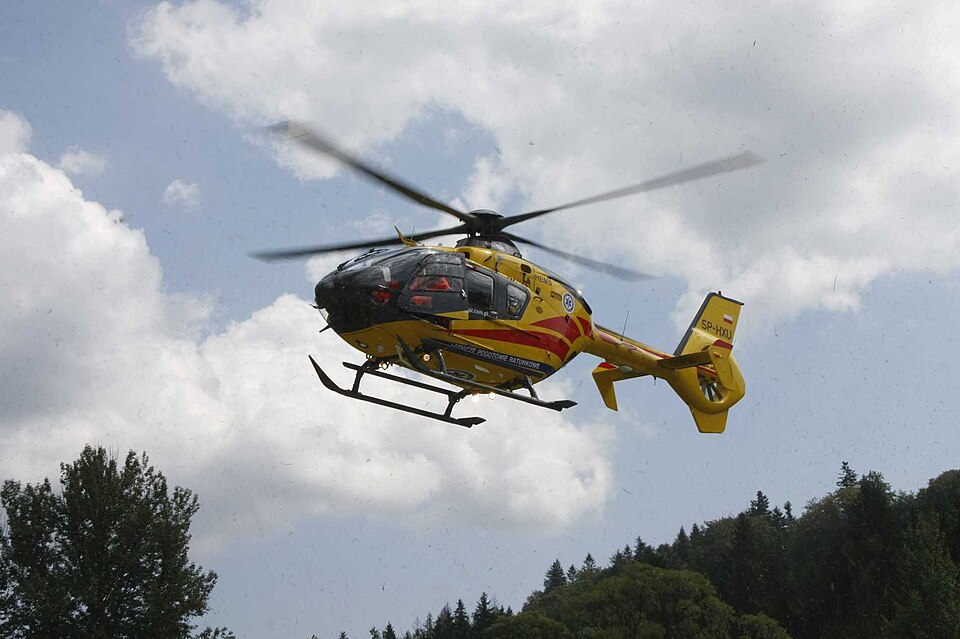
On November 7, 2021, an EUROCOPTER, EC-135 P2+ (registration SP-HXU) operated by Pilot zawodowy CPL(H) was involved in an aviation accident near Kielce - Masłów (EPKA), PL. Investigators recorded the probable cause as: Incorrect operation of the TWIST GRIP control during the final phase of landing under conditions of a simulated FADEC system failure. This summary draws on records from the Polish State Commission on Aircraft Accidents Investigation (PKBWL).
On 7 November 2021, an EC135-P2 PLUS (SP-HXU) exceeded engine torque limits during a training flight at EPKA. The incident was attributed to incorrect TWIST GRIP operation during a simulated FADEC failure.
Incident Overview and Aircraft Details On 7 November 2021, an EC135-P2 PLUS helicopter, registration SP-HXU, was involved in an incident at EPKA airport. The event occurred during a training flight, referred to as a methodological flight, which was conducted following earlier operational irregularities. The flight instructor was the Head of Pilot Training. ## Sequence of Events The incident involved an exceedance of the torque (TQ) on engine number 2, which reached 96.00% for a duration of 0.5 seconds. This event was part of a series of occurrences that began on 6 November 2021. On that date, during two separate flights involving simulated FADEC failures, the torque on engine number 1 exceeded limits at 93.6% for 0.25 seconds, and engine number 2 exceeded limits at 94.4% for 0.875 seconds. In response to these earlier exceedances, the Head of Pilot Training, who also served as the Head of the Air Group, decided to conduct a methodological flight on 7 November 2021. During this flight, the torque on engine number 2 was again exceeded, reaching the values noted above. ## Operational Factors In all three flights, the operational error involved the pilot's manipulation of the TWIST GRIP control during the approach to hover. Specifically, with the TWIST GRIP in the 'N' position, the pilot performed a rapid decrease and subsequent increase in the power of the operating engine. This action resulted in the engine torque exceeding the limited values. ## Investigation and Maintenance Actions The exceedances were recorded in the Pilot's Logbook (PDT) and reported to the Safety Management Department. An analysis of the UMS/PGS system records confirmed that the permissible torque limits for both engine number 1 and engine number 2 were exceeded, classified as category 'F'. Following the incident, a maintenance review was conducted in accordance with CRS 114/010/HXU/1/1 and AMM 05-51-00, 6-8. The checks included: - Inspection of the main gearbox metal detector: no remarks. - Inspection of the tail gearbox metal detector: no remarks. - Inspection of the main rotor shaft: no remarks. - Inspection of the main rotor blades: no remarks. The helicopter was subsequently released for continued operation. ## Probable Cause and Safety Actions The investigation determined that the cause of the incident was the incorrect operation of the TWIST GRIP control during the final phase of landing under conditions of a simulated FADEC system failure. The commission accepted the following preventive actions implemented by the investigating entity: - The pilot involved in the training was required to suspend further flight operations until the relevant procedures were practiced on a simulator. - A detailed discussion of the incident was conducted with the OSL LPR instructors. - During a standardization session, the instructors practiced the FADEC failure procedure on a simulator. The commission did not issue any additional safety recommendations.