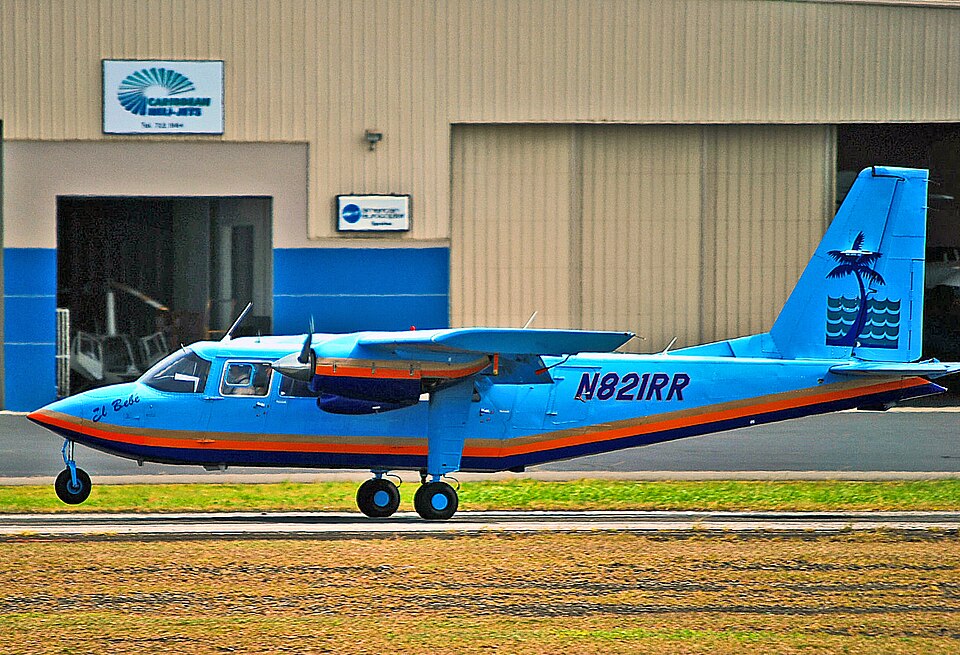
Accident Details
On February 15, 2022, at about 0955 Atlantic standard time, a Britten-Norman BN-2A-9 airplane, registration N821RR, was substantially damaged after veering off the runway at Benjamin Rivera Noriega Airport (CPX) near Isla de Culebra, Puerto Rico. The aircraft was operated by Air Flamenco as a Title 14 Code of Federal Regulations Part 91 instructional flight. The pilot receiving instruction, the flight instructor, and a pilot-rated passenger were not injured.
Pilot and Instructor Accounts
The pilot, recently hired by Air Flamenco after retiring from flying large transport-category airplanes, had completed ground school training on the BN-2A-9. This was his first flight with the company and his first landing at CPX. He entered a left downwind for runway 13, estimating wind from 090° at 15 to 16 knots. The instructor advised him to aim for the grass area preceding the landing threshold. The approach was flown at about 80 knots and about 100 ft above the normal flightpath. The pilot reported that wind was not a factor. After touchdown, the airplane “leaned to the right” and veered off the right side of the runway.
The flight instructor confirmed this was the pilot’s first flight. He described a stabilized approach at 70 knots, followed by a three-point, flat landing, after which the airplane turned right almost immediately. The instructor stated it was not a hard landing. In the company flight log, he reported “experienced strong wind conditions sliding the aircraft off of the runway.” In a separate report, he noted that because the nosewheel is free-castering, it turned 90° to the right at touchdown, causing the aircraft to drift right and making directional control difficult.
The commercial pilot seated in the back remarked that the landing was not hard but was “harder than anything he had experienced before at that airport.”
Postaccident Examination
An FAA aviation safety inspector photographed witness marks on the runway, including propeller strikes and orange paint transfers from the wingtip. The right propeller blades showed tip curling, and the orange-painted wingtip had impact damage, scraping, and asphalt transfer. The distance between the marks was consistent with the distance between the propeller spinner and the wingtip. The right main landing gear was mounted to the aft portion of the right engine. The right wing was twisted downward, and the aft portion was deformed upward at the wing root, resulting in substantial damage.
Postaccident examination of the airplane by the FAA revealed no evidence of preimpact mechanical anomalies with the nosewheel. A detailed inspection of the wing found the right half deformed aft, the leading edge twisted down, and the lower spar cap deformed upward. The forward spar cap was bent aft, and the rear spar caps were significantly deformed. Abrasions and yellow paint transfers were observed on the runway. No appreciable corrosion was found, and all fracture surfaces had a dull, grainy appearance consistent with overstress separation.
Airport and Approach Information
Approach to CPX involves maneuvering due to terrain west of the airport. The initial approach begins at 800 ft mean sea level (msl) and 80 knots over Flamenco Lagoon, with flaps at 56°. The aircraft descends to 400 ft msl to a saddle about 2,000 ft northwest of the runway 13 threshold, then makes a left 40° turn to align with the runway, rolling right to wings level before touchdown. The recommended speed is 80 knots. Training materials include a note: “If you do not land in the first 1,300 feet of RWY 13 or you are above 80 kts, a go-around procedure must be executed. Turbulence may be experienced when the wind is from the north.”
Britten-Norman Aircraft Limited provided information on certification landing loads, stating that under a hard landing condition exceeding design limit loads by 20% to 50%, the rear spar web would likely fracture first, followed by bending of the spar caps. Typical hard landings within design limits would damage the lower nacelle and upper wing skin above the main landing gear.