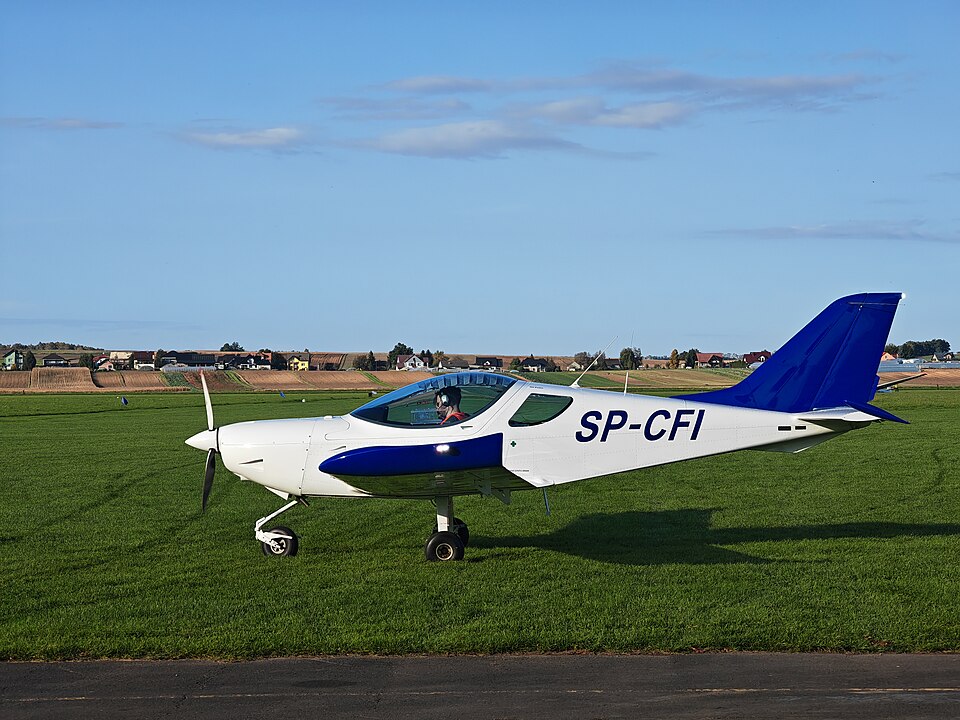
Accident Overview
On 12 July 2024, a PS-28 Cruiser with registration SP-CFI, operated by Technics ATSM Sp. z o.o. SK, was involved in an accident during a training flight at Płock Airport (EPPL). The aircraft sustained substantial damage when the nose gear failed and the airplane nosed over after a series of bounces during landing. The student pilot, the sole occupant at the time, was not injured.
Flight Details
The flight originated from Warsaw-Babice (EPBC) at approximately 13:29 UTC with a student pilot and an instructor on board. After arriving at EPPL around 14:10, the crew performed four circuits to Runway 12, including a go-around, a touch-and-go, and two full-stop landings. The instructor assessed the maneuvers as correct. The student was then cleared for solo flights.
The student completed a first series of solo flights, landing after about 40 minutes. Following a 15-minute rest, the student began a second solo series. The first three landings were uneventful.
Landing and Bounce Sequence
During the fourth approach, the aircraft touched down on the grass runway. It then bounced repeatedly. The instructor, observing from the ground, transmitted three radio instructions to correct the control inputs but did not command a go-around. The aircraft bounced four times. On the final bounce, the nose wheel detached, resulting in a fracture of the nose gear strut. The propeller blades then struck the ground, and the aircraft nosed over onto its back.
Data Reconstruction
The aircraft was equipped with a Dynon SkyView SV-D1000 system that recorded flight data at 1 Hz. Reconstruction of the landing profile showed that the approach was controlled. During the flare, slight pitch oscillations occurred: pitch angles varied between -2.5°, 0°, -7.5°, and +1°. Airspeed was 51–48 kt with engine RPM around 2700–2800. Touchdown occurred with the nose slightly raised.
After touchdown at 48 kt, the student likely pushed the control stick forward, causing a pitch change to -7.5° and the first bounce. Subsequent control inputs led to two more bounces. After the third bounce, the stick was again pushed forward, increasing pitch to -10°. At this point, the nose gear strut likely fractured, leading to the nose-over.
Post-Accident Actions
The instructor immediately declared an emergency and notified relevant services. The aircraft manufacturer later published Service Bulletin SB-CR-110 on 1 November 2024, addressing verification of nose gear attachment bolts.
Probable Cause and Contributing Factors
The direct cause of the accident was the student pilot's improper reaction after incorrect contact with the runway and failure to execute a go-around. A contributing factor was the instructor's lack of an unambiguous command to perform a go-around.