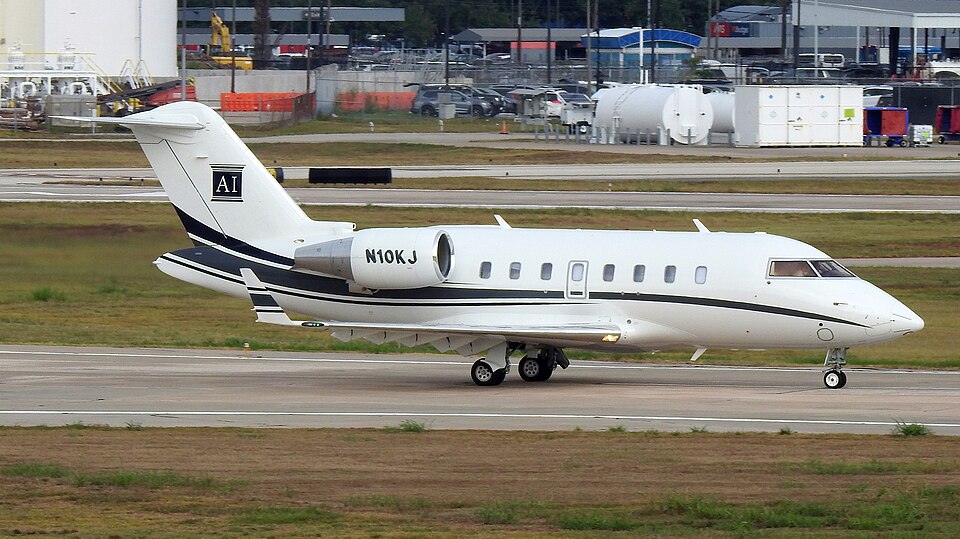
Accident Overview
On January 25, 2026, at 1944 eastern standard time (EST), a Bombardier CL-600-2B16 (Challenger 650) airplane, N10KJ, sustained substantial damage when it was involved in an accident near Bangor, Maine. The pilot, copilot, and 4 passengers were fatally injured. The airplane was operated as a Title 14 Code of Federal Regulations Part 91 business flight.
Flight History
The airplane departed William P Hobby Airport (KHOU), Houston, Texas, at 1420:47 central standard time, on the first leg of a two-leg transatlantic flight to Châlons Vatry Airport (LFOK), Châlons-en-Champagne, France. At 1809:15 EST, it landed on runway 33 at Bangor International Airport (KBGR) and taxied to the fixed based operator (FBO) ramp to refuel.
Refueling and Deicing
According to the flight data recorder (FDR), at 1815:22, the airplane arrived at the FBO ramp. Both engines were shut down, and the auxiliary power unit (APU) provided electrical power while the airplane was refueled with Jet A-1 fuel. After refueling, the total fuel load was about 19,872 lbs. At 1913:42, the airplane began taxiing to the deice pad, stopping at 1917:46. The engines were shut down in preparation for deicing.
Airport closed-circuit television (CCTV) footage showed the airplane facing northwest during deicing and anti-icing applications. The deicing process started at 1919:26 and concluded at 1927:04, using about 41 gallons of Type I deice fluid (Inland Technologies SafeTemp ES Plus). The anti-icing application started at 1927:43 and concluded at 1930:55, using about 28 gallons of Type IV anti-ice fluid (Dow Chemical Inc. UCAR FLIGHTGUARD AD-49). Airport weather conditions at the time included surface visibility of 3/4 statute miles, light snow, outside temperature of -16°C, and surface wind from 040° at 6-8 knots (055° magnetic). Nighttime conditions existed.
Taxi and Takeoff
After anti-icing, the airplane sat for 4 minutes 51 seconds before taxiing from the deice pad at 1935:46. About 8 minutes 3 seconds had elapsed since the start of anti-icing. The cockpit voice recorder (CVR) captured the flight crew discussing holdover times during taxi. The pilot stated it was “standard” to have 14-18 minutes and that if the wait exceeded 30 minutes, they would return to the ramp to deice again. The copilot concurred.
At 1940:16, the airplane stopped about 200 ft before the runway 33 hold short line. At 1940:54, the tower controller asked the flight crew to report when ready for takeoff. The copilot replied they would advise. At 1942:50, the copilot announced readiness on runway 33. The controller cleared the airplane for takeoff, reporting runway 33 RVR greater than 6,000 ft and surface wind 060° magnetic at 9 knots. At 1942:56, the airplane resumed taxi onto the runway, and at 1943:04, the copilot read back the clearance correctly.
According to the FDR, at 1943:57, engine power began increasing toward the selected takeoff thrust of 85%. The takeoff began with flaps at 20°, pitch trim at -4.8°, and wing and cowl anti-ice systems engaged.
Accident Sequence
At 1944:05, the copilot announced takeoff power set and airspeed indicator functioning. At 1944:10, airspeed was 80 KIAS. At 1944:18, the copilot called V1 (136 KIAS), but FDR data indicated the airplane was accelerating through 127 KIAS. At 1944:22, the copilot called VR (139 KIAS); the FDR showed the airplane at 140 KIAS and the nosewheel weight-on-wheel indication changed from ground to air. At 1944:24, both main landing gear weight-on-wheel indications changed from ground to air.
At 1944:25, the airplane's radio altitude was 6 ft, pitch angle about 13° nose-up, angle-of-attack (AOA) about 19°, and roll nearly level. About a second later, radio altitude was 11 ft, pitch angle about 11° nose-up, the airplane in a 1°-2° left roll, AOA about 20°, and both stick shakers activated for about 1 second. At 1944:27, radio altitude was 14 ft, pitch angle about 9° nose-up, AOA about 16°, and the airplane transitioned from a left to a right roll. As the right roll increased, both aileron deflections increased to their limits, consistent with full left-wing-down control wheel input.
At 1944:30, just before the FDR stopped recording, pitch angle was about 6° nose-up and bank angle about 77° right-wing-down. Both stick shakers activated again. The radio altimeter indicated 31 ft, but this value was likely affected by the roll angle. A preliminary review of FDR data revealed no evidence of a flight control malfunction or failure; both engines continued to develop takeoff power until recording stopped.
Wreckage and Impact
Airport CCTV cameras captured the airplane impacting the ground, followed by multiple explosions. Scrape marks began about 5,808 ft from the approach end of runway 33, 42 ft right of centerline, oriented on a 338° magnetic heading. A wide area of fuel residue extended about 57 ft near the right edge of the runway. The airplane departed the right side of runway 33 into the grass runway safety area about 20° right of the runway heading. The debris path included the right winglet and both winglet tips, windshield sections, main entry door, flight deck components, and engine parts, spanning about 1,270 ft long and 150 ft wide. The airplane came to rest upside down on a magnetic heading of 355°. The cockpit, cabin, and empennage exhibited thermal damage consistent with a prolonged postimpact fire. The fuselage, between the main entry door and wing root, showed damage consistent with rescue efforts. Wings remained attached. Nose and main landing gear were extended. Both turbofan engines remained partially attached to the pylons and contained debris, firefighting foam, and ice. There was no evidence of preimpact separation of any component or structure.
Holdover Time Guidelines
Holdover time is the estimated period for which deicing or anti-icing fluid prevents ice, snow, or frost accumulation. According to FAA Holdover Time Guidelines for Winter 2025-2026, the corrected snowfall intensity associated with 3/4 sm visibility at night and temperature at or below -1°C was considered “moderate.” A “moderate” snowfall intensity and -16°C outside temperature resulted in a maximum holdover time of 9 minutes from the start of anti-ice application.
Investigation
The wreckage was recovered for further examination. Ongoing activities include aircraft operations, aircraft performance, flight recorders, airport operations, survival factors, and human performance. A transcript of the CVR content applicable to the accident flight will be released as part of the investigation.