History of the Flight
On 19 May 2025, at about 1649 Singapore Local Time, a Boeing 737-800 aircraft (registration 9M-MLL, operated by Malaysia Airlines) was cleared to taxi to Holding Point T2 for departure on Runway 20C. The flight crew comprised a Pilot-in-Command (PIC) and a Second Officer (SO); the PIC was taxiing while the SO communicated with air traffic control.
While taxiing, the Runway Controller (RWC) cleared the aircraft to line up on Runway 20C. The RWC switched off the red stop bar lights at Holding Point T2. As the aircraft approached the holding point, the flight crew informed the RWC they needed two more minutes before departure. The RWC switched on the stop bar lights and cancelled the line-up clearance, instructing the aircraft to report when ready. The PIC read back incorrectly: “cleared line-up and wait” and continued taxiing toward the runway. The RWC then instructed the aircraft to hold at Holding Point T2, but due to a transmission issue, only “Holding Point T2” was received. The PIC replied that they were lining up and waiting on Runway 20C. The RWC received a STOPBAR visual alert from the Advanced Surface Movement Guidance and Control System (ASMGCS) indicating the aircraft had crossed the red stop bar lights.
After assessing the situation, the RWC decided not to stop the aircraft, reasoning that a runway incursion had already occurred and she had planned to clear it for line-up anyway. She also managed an arrival aircraft that was taxiing slowly on a rapid exit taxiway. The aircraft continued onto the runway and at about 1654 LT, after the arrival aircraft had vacated, the RWC cleared Aircraft A for take-off. The RWC did not inform the flight crew of the incorrect readback or the incursion.
Personnel Information
The PIC, aged 38, held an Air Transport Pilot Licence issued by the Civil Aviation Authority of Malaysia, valid until 30 June 2025. His Class 1 medical certificate was valid until 30 June 2025 with a requirement for correction of defective distant vision. He had 9,624 total flying hours, including 2,378 hours on type. The SO, aged 29, also held an Air Transport Pilot Licence, valid until 31 August 2025, with no medical restrictions. He had 2,352 total flying hours, with 2,186 on type.
Communication and Phraseology
According to the investigation, the PIC misinterpreted the RWC’s cancellation of line-up clearance. The investigation noted that the phraseology used by the RWC (“line-up clearance cancelled and report when ready”) differed from the standard phraseology prescribed in ICAO and local procedures for cancelling a line-up clearance, which is “leave the runway immediately.” The RWC did not use the prescribed phraseology.
Analysis
The analysis in the report focused on three areas: the PIC’s readback, radiotelephony phraseology for cancellation of line-up clearance, and the RWC’s assessment in not correcting the PIC’s incorrect readback. The report also documented that the PIC had a medical condition requiring correction for defective distant vision, but no causal link was established.
Injuries
There was no injury to any person.
Aircraft and Operator
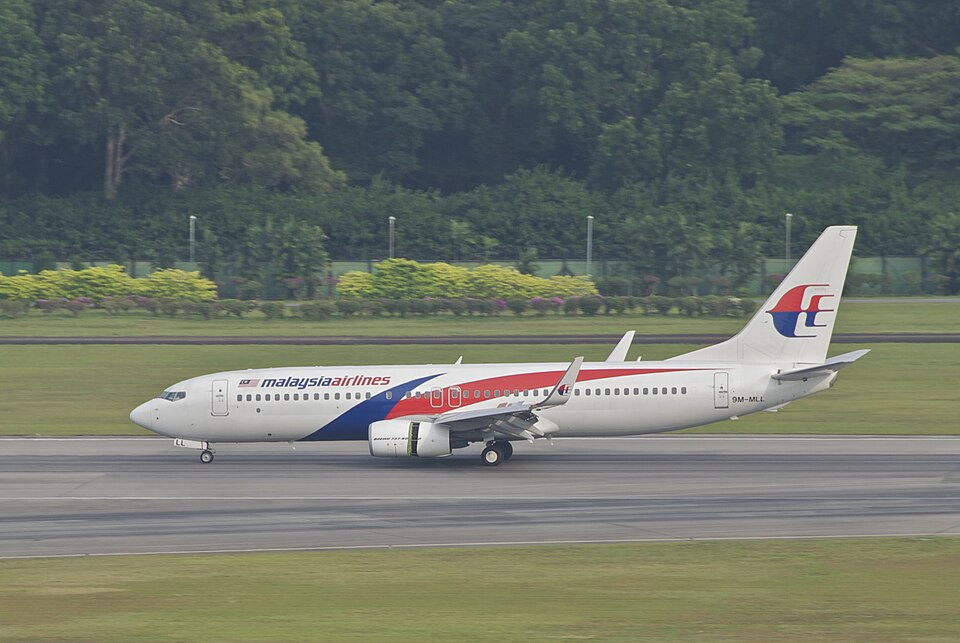
The aircraft was a Boeing 737-800, registration 9M-MLL, operated by Malaysia Airlines. The flight was a scheduled passenger service with 145 persons on board. The incident occurred at Singapore Changi Airport on 19 May 2025 at 1653 LT.