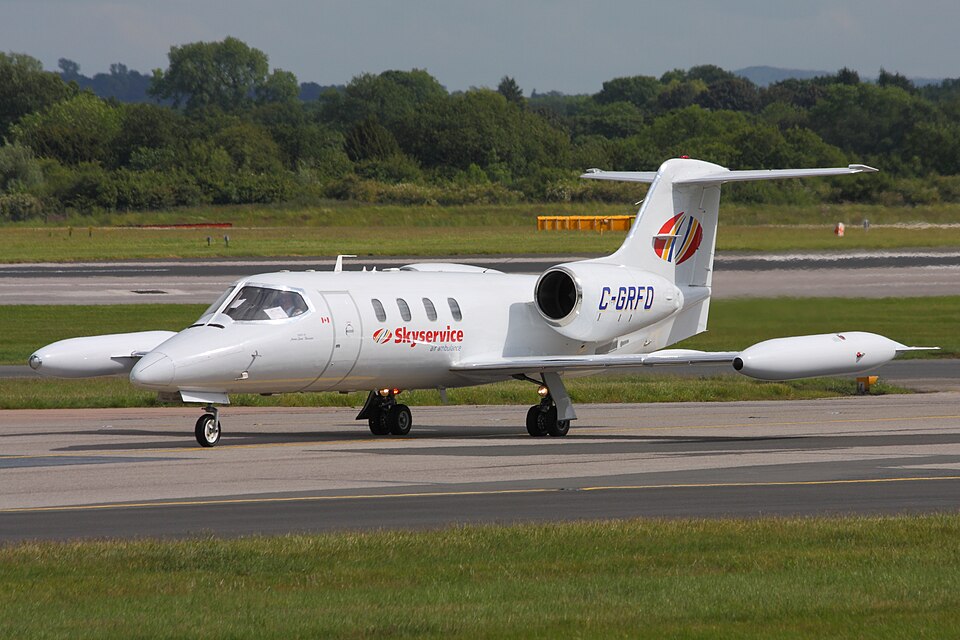
Synopsis
On 25 November 2004 at 21:05 UTC, a Learjet 35A, registration C-GRFO, operated by Skyservice Lifeguard, initiated a takeoff roll from runway 03 at Lisbon Airport, Portugal. The aircraft was on an ambulance flight to Montreal, Canada, with intermediate stops in the Azores and Newfoundland. On board were two pilots, three medical attendants, and one patient.
Flight History
During the takeoff roll, at approximately 125 kts, the captain heard a sound under the fuselage and suspected foreign object debris. Unbeknownst to the crew, one of the two right main gear tires had blown out. As the speed was below V1, the captain aborted the takeoff by reducing thrust to idle, applying brakes, and extending spoilers. The drag chute was not deployed. During the abort, the second right main gear tire also failed, and the aircraft skidded on the right wheel rims. It decelerated along the runway, staying near the centerline, then at low speed veered left and departed the runway onto grass, stopping about 6 meters (20 feet) from the runway edge.
Injuries and Damage
There were no injuries to any occupants. No fire occurred. The aircraft sustained substantial damage restricted to the right main landing gear: both tires were completely destroyed, wheel rims and brake assemblies were severely eroded, hydraulic lines were destroyed, and other components were damaged. The aircraft belly showed no evident damage. Third parties were not affected.
Personnel and Aircraft Information
The captain held an FAA ATP, with 8,500 total flying hours (2,500 on type). The first officer held an FAA ATP, with 5,954 total hours (155 on type). Both held valid first-class medical certificates with no restrictions. The aircraft, a Gates Learjet Corp. model 35A (serial number 100, year of manufacture 1993), had a valid certificate of airworthiness and was powered by two Garrett TFE731-2-2B engines. Total time was 19,087 hours and 11,875 landings. Maintenance was performed by the owner's organization, which conducted daily inspections including tire pressure checks; on the day of departure, tire pressures were recorded as correct.
Meteorological and Airport Information
The wind was 310 degrees at 6 knots, sky clear, visibility more than 10 km, and the runway was dry. Runway 03 is 3,805 m long and 45 m wide, with a takeoff run available of 3,715 m. The airport operations service (SOA) performs scheduled runway inspections for foreign objects; the last inspection before the incident was at 17:10 (sunset). After the incident, the runway was inspected and no foreign objects were found other than tire, rim, and brake debris. Adjacent areas were inspected the next day with no foreign objects found.
Investigation Findings
The anti-skid system was tested before takeoff and functioned normally; post-incident inspection of sensors also showed normal operation. Tire remains and runway traces indicated that the first blown tire was found at a point approximately 330 feet before visible rim marks began. From that point, a large amount of rubber and metal debris was present along the runway for about 4,800 feet until the aircraft stopped. The aircraft's flight recorders were not analyzed.
No probable cause was explicitly stated in the report.