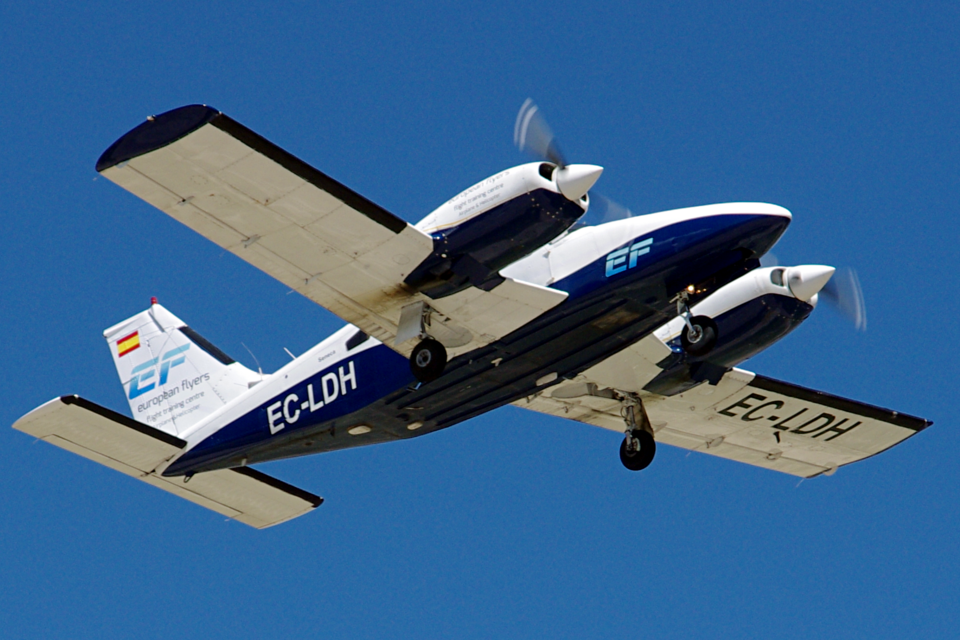
Accident Overview
On Friday, 10 June 2016, at 20:05 local time, a Piper PA-34-200T aircraft, registration EC-LDH, experienced a nose gear collapse during its second landing on runway 28 at Cuatro Vientos Airport (Madrid). The aircraft was operating under flight number FYS535 and had departed at 18:20:55. All four persons on board – one pilot and three passengers – were uninjured.
Flight Purpose and Tasks
The flight was part of the Master's in Flight Testing and Aircraft Certification program at the Universidad Politécnica de Madrid (UPM). Its objective was to evaluate the Piper PA-34 for aerial photography and short-field landing operations. A flight plan of 2 hours 5 minutes was established, comprising 22 tasks. Most tasks were conducted in the Almorox area (Toledo), with the final task to be performed during the approach and landing at Cuatro Vientos.
Landing and Accident Sequence
After approximately 1.5 hours of uneventful flight, the aircraft returned to Cuatro Vientos from the south, contacting the tower at 19:56:32. The final task involved landing with a side-step approach and flaps set to 40° (full flaps). During the second landing attempt, the nose landing gear collapsed.
Investigation Findings
The investigation determined that the accident was caused by an incorrect execution of the flare during landing. Contributory factors included a delay in the decision to abort the landing on the second attempt, the pilot's limited experience in the aircraft type, a lack of recent experience in similar aircraft, and differences in handling, dimensions, systems, and procedures between the aircraft the pilot usually flew and the accident aircraft.
Recommendations
The investigation identified three safety recommendations addressed to UPM regarding pilot experience and qualification, and preparation for test flights. However, as the university had already implemented the recommended improvements, the recommendations were not issued.