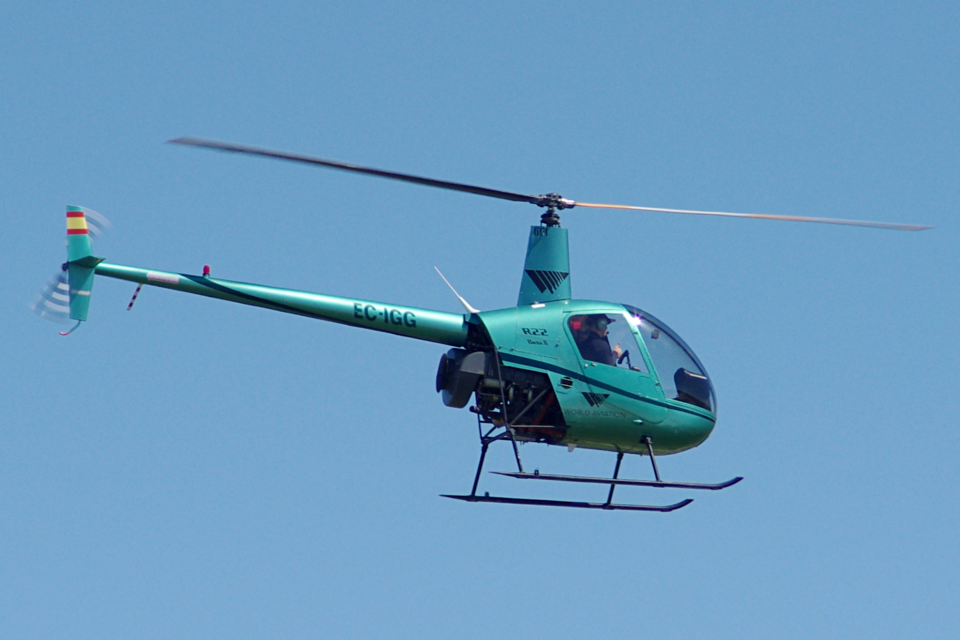
Helicopter crashes into power lines over Valmayor Reservoir

Casualties unknown • Valdemorillo (Madrid), ES

A Robinson R-22-BETA crashed into high-voltage power lines over a Spanish reservoir, resulting in two fatalities.

What happened

On July 16, 2016, a Robinson R-2/2-BETA, registration EC-IGG, was conducting a local private flight departing from Cuatro Vientos airport. While overflying the Valmayor Reservoir in Valdemorillo, Madrid, the helicopter struck a 20,000-volt high-voltage power line. The impact caused the aircraft to lose stability, rotate forward, and plunge into the reservoir, where it subsequently sank.

The collision resulted in two fatalities, involving both the pilot and the passenger. The aircraft was destroyed upon impact and submersion, with several components, including the main rotor and tail rotor, not being recovered.

The investigation

The CIAIAC investigation examined the wreckage, the electrical infrastructure, and the pilot's flight history. Investigators analyzed the damage to the aircraft's landing gear and fuselage, finding metallic traces on the aircraft that matched the twisted wires of the power line. The investigation also reviewed the visibility of the obstacle, noting that the electrical cables and supporting poles lacked any aeronautical marking or lighting.

Technical analysis of the flight path revealed that the aircraft was flying at an altitude of approximately 845–847 meters. Given the terrain elevation, this placed the helicopter significantly below the minimum altitude required by Visual Flight Rules (VFR), which mandates a minimum of 150 meters above the highest obstacle or water surface in that area.

Findings

  • The primary cause of the accident was the pilot's failure to detect or the late detection of the power lines while flying at an altitude well below the legal VFR minimums, which prevented timely evasive action.
  • The electrical lines and supporting structures lacked any visible marking or lighting, making them extremely difficult to identify from the pilot's perspective, especially given the presence of nearby vegetation and a bridge that may have distracted the pilot's attention.
  • The pilot had limited recent experience, having flown only approximately 4 hours and 49 minutes in the six months preceding the accident.
  • The aircraft was flying in a stable, level manner and was not in an autorotation state at the time of the strike.

Safety action

  • REC. 45/17: The CIAIAC recommended that the Spanish Aviation Safety and Security Agency (AESA) conduct studies on reservoirs used for firefighting operations. In cases where electrical lines pose an operational risk, the agency should mandate the installation of signaling or lighting on those obstacles.

Probable cause

The accident was caused by the pilot's inability to identify the high-voltage power lines due to low flight altitude and the lack of obstacle markings, preventing an effective evasive maneuver.

Frequently asked questions

What happened in the 2016-07-16 Robinson R-22-Beta accident near Valdemorillo (Madrid), ES?

A Robinson R-22-BETA crashed into high-voltage power lines over a Spanish reservoir, resulting in two fatalities.

What aircraft was involved and where did it happen?

The accident on 2016-07-16 involved a Robinson R-22-Beta, registration EC-IGG, at Valdemorillo (Madrid), ES.

What was the probable cause of the accident?

The accident was caused by the pilot's inability to identify the high-voltage power lines due to low flight altitude and the lack of obstacle markings, preventing an effective evasive maneuver.

Investigation report by the Spanish Civil Aviation Accident and Incident Investigation Commission (CIAIAC). Original record: https://www.transportes.gob.es/recursos_mfom/2016_025_a.pdf. This page is a structured re-presentation; facts and quotes are in the Comision de Investigacion de Accidentes e Incidentes de Aviacion Civil (CIAIAC), Spain - Ministerio de Transportes y Movilidad Sostenible.

Loading the flight search…