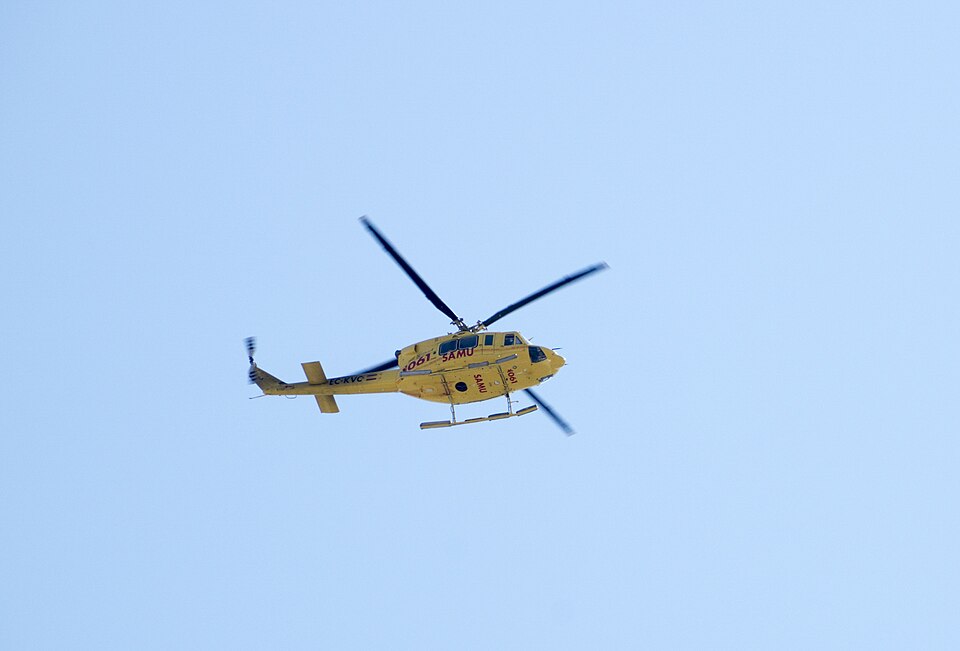
Bell 412EP rotor blades damaged during HEMS landing in Madrid

Casualties unknown • Soto del Real (Madrid), ES

A medical evacuation helicopter sustained significant rotor blade damage after landing in a restricted area, leading to the aircraft being placed out of service.

What happened

On June 27, 2018, a Bell 412EP, registration EC-KVC, operated by Babcock International Group PLC, was performing a Helicopter Emergency Medical Service (HEMS) mission to evacuate a patient following a traffic accident near Soto del Real, Madrid.

After an initial landing in a nearby field, the crew determined that the terrain made it impossible to transport the patient to the aircraft. The crew subsequently decided to land directly on a local road. During this second landing, the main rotor blades made contact with tree branches. Following the contact, the crew performed a visual inspection and, seeing only superficial green marks from the vegetation, decided to proceed with the mission.

During the subsequent flight, the crew noticed increasing vibrations in the rotor. They performed a precautionary landing at a nearby location to transfer the patient to a ground ambulance. After a second visual inspection, the crew decided to return to their base. Upon arrival at the base, a more thorough inspection revealed significant damage, including fiberglass delamination and blade tip deformations, resulting in the aircraft being removed from service.

The investigation

The CIAIAC investigation examined the landing site, the aircraft's maintenance history, and the crew's adherence to operational procedures. The investigation focused on the dimensions of the landing area relative to the company's Operations Manual, which requires a clearance of at least 34.5 meters (2xD) for such operations. The investigation also reviewed the crew's decision-making process regarding the continued flight despite the presence of vibrations and the lack of communication with the operational control center during the incident.

Findings

  • The landing site on the road provided a clearance of only approximately 15 meters, which was below the minimum dimensions required by the company's Operations Manual.
  • The contact between the rotor blades and the tree branches was likely facilitated by the airflow generated by the rotor, which pushed the branches toward the blades.
  • The damage to the rotor blades was progressive, increasing in severity during the flight from the accident site to the base.
  • The crew did not contact the operational control center (OCC) following the incident, as required by their company's procedures.
  • The decision to continue the flight to the base was likely influenced by the short distance to the base (approximately 7 minutes) and the desire to avoid leaving the aircraft grounded at an uncontrolled location.

Probable cause

The primary cause of the accident was the decision to land in an area with insufficient clearance from obstacles, which led to the rotor blades striking vegetation and causing progressive structural damage to the main rotor blades.

Frequently asked questions

What happened in the 2018-06-27 Bell 412 accident near Soto del Real (Madrid), ES?

A medical evacuation helicopter sustained significant rotor blade damage after landing in a restricted area, leading to the aircraft being placed out of service.

What aircraft was involved and where did it happen?

The accident on 2018-06-27 involved a Bell 412, registration EC-KVC, at Soto del Real (Madrid), ES.

What was the probable cause of the accident?

The primary cause of the accident was the decision to land in an area with insufficient clearance from obstacles, which led to the rotor blades striking vegetation and causing progressive structural damage to the main rotor blades.

Investigation report by the Spanish Civil Aviation Accident and Incident Investigation Commission (CIAIAC). Original record: https://www.transportes.gob.es/recursos_mfom/comodin/recursos/2018_027_a.pdf. This page is a structured re-presentation; facts and quotes are in the Comision de Investigacion de Accidentes e Incidentes de Aviacion Civil (CIAIAC), Spain - Ministerio de Transportes y Movilidad Sostenible.

Loading the flight search…