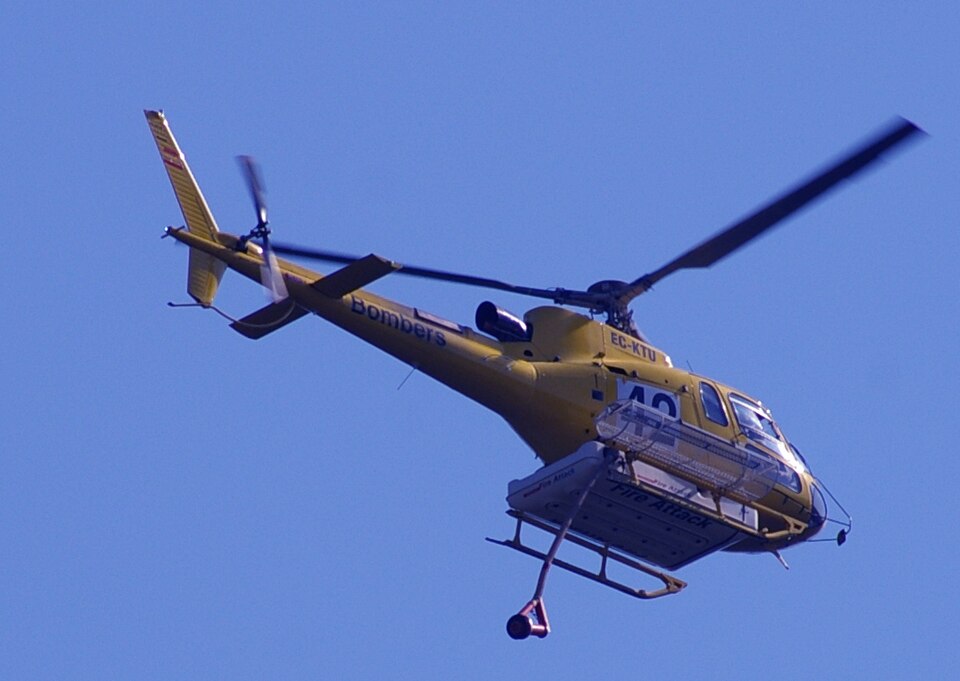
History of the Flight
On 24 August 2012, a Eurocopter AS-350-B3 helicopter, registration EC-KTU, was engaged in firefighting operations on the west face of the Pregón Ravine, near Guils de Cerdanya, Girona, Spain. The helicopter was equipped with a Simplex 310 firefighting system, which included a belly tank and a 3.68-meter hose with a suction pump hanging 3.25 meters below the right skid. The crew had completed two firefighting flights that day. During the second flight, while making a water drop on pass number 23, the crew heard a noise like an impact, followed by destabilization and increasing vibrations. The pilot flew for about thirty seconds before executing a power-on landing nearby. Both crewmembers were uninjured. After landing, they observed the hose resting on the engine exhaust nozzle; the suction pump was broken, and there was damage to the helicopter frame and main rotor blades.
Damage to Aircraft
Two of the three main rotor blades were damaged: one on its bottom surface, the other missing a section approximately 100 cm long and 15 cm wide. The main structure had impact damage near the tailboom attachment, and a 32-cm crack with orange paint marks consistent with the suction pump paint was found on the tailboom forward of the right horizontal stabilizer. Charred remains of the hose were on the engine exhaust nozzle. The fill hose was burned, and the suction pump had broken due to impact with a solid object.
Personnel Information
The flight crew consisted of a pilot (age 40) and a flight operator (age 27). The pilot held a Commercial Helicopter Pilot License with AS-350 type rating and an agricultural (firefighting only) rating. He had 6,632 total flight hours, 1,495 on type. The flight operator had a Commercial Helicopter License and 683 total hours, including 254 on the AS-350.
Meteorological Information
Crew reported turbulent and highly variable winds gusting between 15 and 25 kt, scattered clouds with intermittent rain, temperature 25°C, and visibility affected by smoke. The national weather agency reported lightning strikes in the area, indicating convective clouds nearby.
Tests and Research
The pilot stated the flyover was at low altitude, south-north, at 20–25 kt ground speed. They made the first water drop; about two seconds later they heard an impact noise, felt a shudder, then vibrations. The helicopter remained controllable. The flight operator monitored engine instruments after the drop and reported no anomalies. Neither crewmember could identify what the suction pump struck.
Organizational Information
The operator's Operations Manual defined the flight operator as a crewmember providing support during firefighting missions, with a minimum crew of one pilot and one flight operator. Seven days after the accident, the operator issued an internal memo emphasizing a minimum 50-foot clearance between the suction pump and obstacles. The company's Technical Commission on Flight Safety issued a report noting the suction pump struck vegetation.
Additional Information
A similar event occurred on 22 June 2009, when an AS-350 B3 with a Simplex 320 system crashed after the suction pump struck the main rotor blades. The final report recommended design modifications for the firefighting system.