History of the Flight
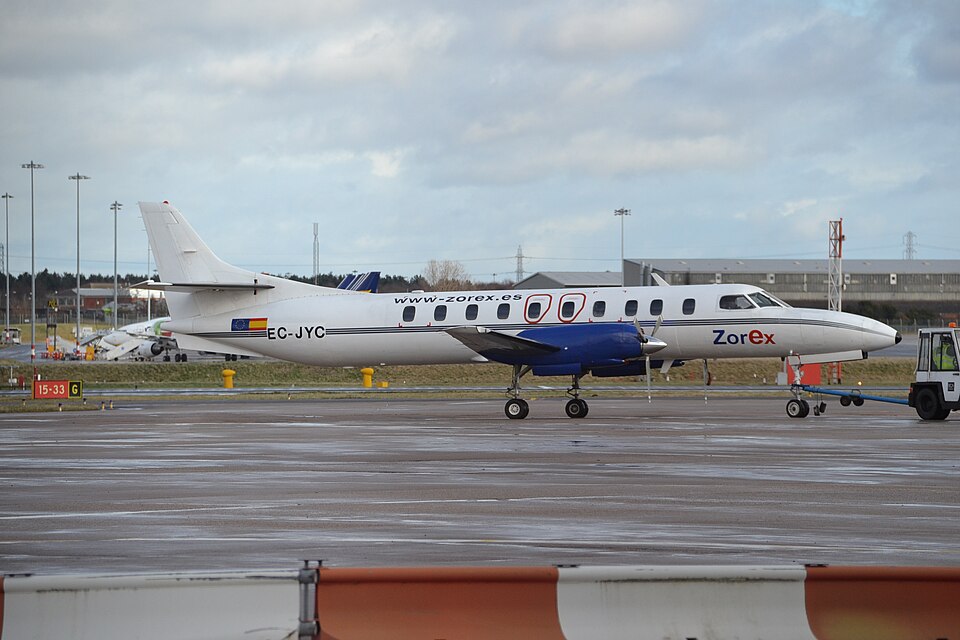
On 13 November 2012, a FAIRCHILD SA-226-TC aircraft, registration EC-JYC, operated by Zorex, had completed a patient transport flight from Pamplona Airport to Murcia Airport earlier that morning. Approximately one hour after landing, the aircraft prepared for a ferry flight to Huesca Airport with both pilots on board. The first officer was the pilot flying. During the takeoff run on runway 05R at San Javier Airport, the aircraft veered left and departed the runway. It crossed the first access taxiway on the left and came to a stop near the intersection of the taxiway and the runway. Both crew members exited the aircraft unaided and sustained no injuries. The aircraft suffered significant damage.
Investigation
Tracks at the accident site indicated that the aircraft began deviating left approximately 15 meters before the aiming point marking. Both nose gear wheels skidded while turning left over a distance of about 47 meters. The nose gear tracks came within 60 centimeters of the left main gear tracks (normal distance is about 2.25 meters). The aircraft struck the edge of the access taxiway, after which the wheels returned to their normal position and the aircraft stopped a short distance later. The right propeller sustained significant damage from blade strikes on the ground; left propeller damage was less severe. The right wing was damaged, causing fuel leakage. The nose gear attachment structure was damaged, likely during post-accident movement to the apron. Several dents, possibly from stones, were found on the right fuselage near the propeller.
Inspection of the landing gear revealed no mechanical faults aside from damage caused by the runway departure. However, electrical wires for the gear components lacked protection against moisture and other external agents beyond wire insulation. The nose wheel steering system was cycled in dry and wet conditions to simulate the accident environment (the runway was wet and water entered the gear well). No faults were observed. The investigation also noted that the nose wheel steering system had been modified per several service bulletins, some of which had not been implemented at the time of the accident.
Aircraft Information
The FAIRCHILD SA-226-TC, serial number TC-303, was manufactured in 1979. It is a pressurized twin-engine turboprop powered by two HONEYWELL TPE 331-10UA-511G engines. The aircraft has a tricycle landing gear with two wheels per leg. The nose wheel steering system, installed per Service Bulletin 226-32-037, allows steering via a pushbutton on the power lever (left side, accessible from the captain's seat) and the rudder pedals when the system is armed. An arming switch on the left console, a green NWS light, and an amber NWS FAIL light provide system status. The system can become inoperative, requiring asymmetric braking and thrust for directional control.
Crew Information
The captain, aged 33, held a Commercial Pilot License with instrument and type ratings, and had 5,100 total flight hours (3,015 on type). The first officer, aged 31, held an Airline Transport Pilot License and had 2,800 total flight hours (1,400 on type). Both had valid medical certificates. According to the captain, the first officer did not release the nose wheel steering button until reaching about 60 knots during the takeoff roll, as per usual procedure. At that point, the aircraft began veering left. The captain retook control and applied right rudder and asymmetric reverse thrust. No flight simulator training was available for this aircraft type; emergency training was conducted during instructional flights.
Aerodrome Information
San Javier Airport is a controlled dual-use civil/military aerodrome. Runway 05R, used by civil traffic, is 2,320 meters long and 45 meters wide. The aircraft had accessed the runway via taxiway B.