What happened
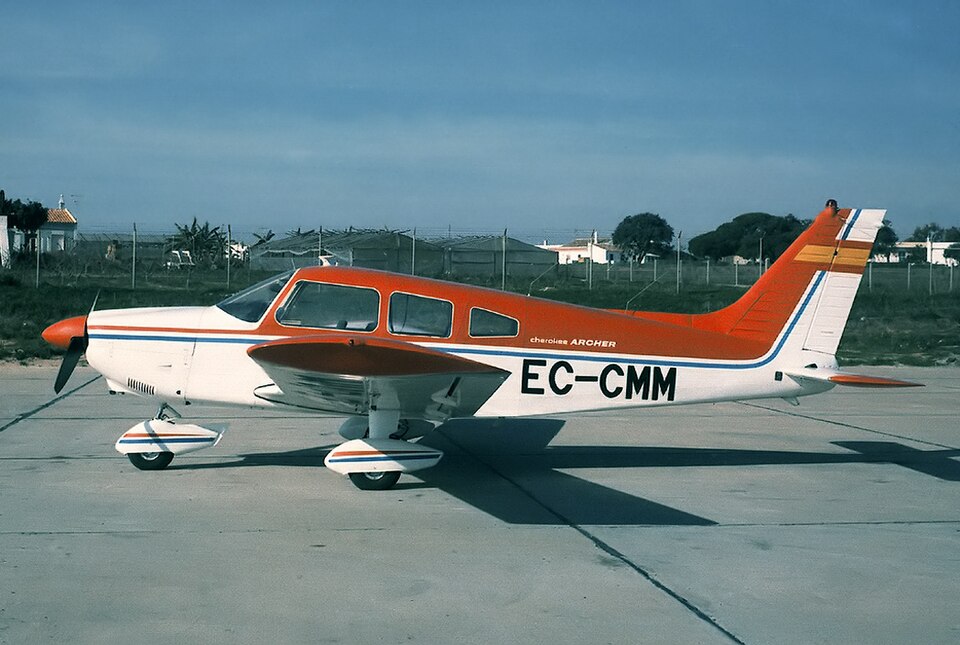
On August 10, 2022, a PIPER PA-28-180, registration EC-CMM, was conducting a local flight departing from and returning to the Casarrubios del Monte aerodrome in Toledo, Spain. The aircraft was occupied by the pilot and two passengers. Due to the pilot's recent lack of flight time in this specific airframe, a safety pilot was also on board to provide oversight.
During the landing phase for runway 08, the aircraft was on a stabilized long final approach at approximately 60 knots with two flaps extended. As the aircraft approached the threshold, the underside of the left wing made contact with vegetation located before the runway. This impact caused the aircraft to veer sharply to the left.
Despite the pilot's attempt to apply power and climb, the aircraft struck the ground with its landing gear. The aircraft slid across the terrain for approximately 69 meters before encountering a sandy area near a dry stream bed. The impact with the uneven terrain caused the nose gear and the left main gear to collapse. The aircraft came to rest resting on its right main gear, the front lower fuselage, and the left wing.
All 3 occupants were uninjured, though the aircraft sustained significant damage.
The investigation
The CIAIAC investigation examined the flight path, the aircraft's condition, and the environmental factors at the time of the accident. Investigators analyzed the ground tracks, which showed parallel longitudinal marks consistent with the main gear rolling across the surface. The investigation also noted that the vegetation near the runway threshold did not pose an inherent risk to a standard landing.
Findings
- The weather conditions were favorable for flight, with light winds and high visibility.
- The aircraft was properly documented and maintained.
- The aircraft's approach path was too low, failing to maintain the correct glide slope relative to the displaced threshold.
- The primary cause of the accident was the incorrect execution of the final approach maneuver.