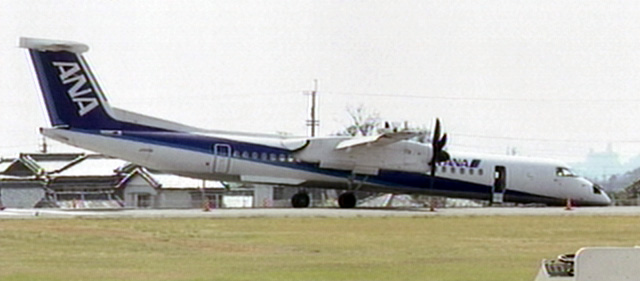
Accident Overview
On March 13, 2007, a Bombardier DHC-8-402 registered as JA849A operated by Air Central Co., Ltd. departed Osaka International Airport at 08:21 JST as All Nippon Airways flight 1603, a regularly scheduled service to Kochi Airport. There were 60 persons on board: the pilot in command, three other crewmembers, and 56 passengers. No injuries resulted from the accident.
Flight History
During a visual approach to Runway 32 at Kochi Airport, the landing gear lever was moved to the down position at an altitude of 1,500 ft. The landing gear control panel displayed two green lights for the main landing gears, an amber light for the nose landing gear doors, and a red nose landing gear unsafe advisory light. The crew requested holding at 3,000 ft over Katsura Beach to perform troubleshooting.
Crew Troubleshooting Actions
The pilot in command executed the alternate landing gear extension checklist twice, but the situation did not change. The first officer then opened the alternate gear extension door and pulled the nose landing gear release handle; the instrument panel display remained unchanged, and the first officer described the handle operation as somewhat heavy. The Landing Gear Downlock Verification Light check illuminated only the main landing gear lights; the nose landing gear light did not illuminate.
The aircraft conducted two low passes over the runway at approximately 500 ft for ground observation. During the first low pass, circuit breakers were checked and found not tripped. For the second low pass, the crew raised the gear lever to the up position; the main gear lights extinguished, but the amber nose door light flickered. Alternate extension was attempted again without success. Further attempts included a steep turn with a bank angle of about 50 degrees at 170 knots to use acceleration force, and a touch-and-go landing to apply impact. The pilot in command also applied several hard pitch changes. None extended the nose landing gear.
Landing
Before landing, the cabin crew moved some passengers to the aft cabin, and fire extinguishing agent was sprayed on the runway. At 10:54 JST, the aircraft landed on the main landing gears at 106 knots while the nose remained up. The nose touched down 12 seconds later at 79 knots. The aircraft decelerated on the runway centerline and came to rest around the mid-runway 22 seconds after nose touchdown. The forward lower fuselage sustained damage.