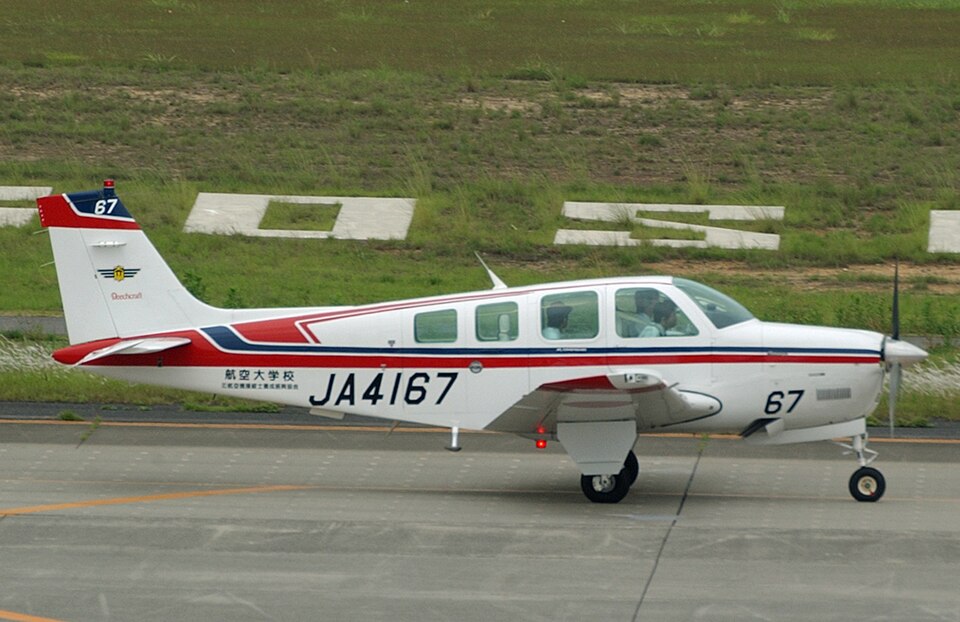
Incident Details
On November 5, 2010, at about 13:49 Japan Standard Time, a Beechcraft A36, registered JA4167, operated by the Civil Aviation College, landed on Runway 09 at Miyazaki Airport and subsequently became immobile on the runway. The aircraft had departed at 13:09 for solo flight training with one trainee pilot on board. The trainee did not sustain any injuries, and no fire occurred, but the aircraft suffered substantial damage.
Flight History
According to air traffic control communications and statements, the aircraft took off from Miyazaki Airport, conducted training in a designated area, then returned for landing. At 13:44, the trainee reported to the control tower that he had received airport information and requested landing clearance. The tower instructed a direct entry to the base leg for Runway 09. At 13:46:50, the tower reported wind 080° at 4 knots and cleared the aircraft to land. The aircraft landed around 13:49 and became immobile. At 13:49:26, the tower asked if the aircraft could move; the trainee responded that it could not and that the fuel valve was closed.
The trainee stated that he had never directly entered the base leg at Miyazaki Airport but had observed it and received about 12 hours of flight training there. During the approach, he set flaps fully down at 300 feet, confirmed 90 knots airspeed, and verified the landing gear was down. At the runway threshold, he set the engine to idle and began a flare. Feeling the groundspeed was slightly fast, he made the flare less aggressive to avoid overshooting the touchdown point. He felt the main gear and then nose gear touch down, but the aircraft suddenly lifted and bounced several times. The aircraft then slowed as the nose skidded along the runway. The trainee did not make major control inputs during the bouncing; he did not perform a go-around because he did not understand why the aircraft lifted and did not see the need.
Aircraft and Operator Information
The aircraft was a Beechcraft A36, serial number and engine details not specified. It was operated by the Civil Aviation College. The sole occupant was a trainee pilot who had previously soloed at Obihiro Airport but not at Miyazaki.
Investigation Findings
The Japan Transport Safety Board investigation determined that the aircraft bounced at touchdown and entered a porpoising state without a go-around. The final touchdown occurred with the nose gear striking the runway first, causing airframe damage and immobilization. The probable cause of the bounce was that the trainee, after reducing engine power to idle at the threshold with airspeed slightly faster than normal, eased the flare to avoid flying over the touchdown point. This resulted in insufficient reduction of airspeed and rate of descent, causing a touchdown with residual lift and a bounce from the landing gear impact. The trainee did not perform a go-around because he lacked the knowledge and skills to do so without hesitation upon a bounce.
Recommendations
The report recommended that the Civil Aviation College improve its risk assessment system, ensure thorough education on proper landing attitude and go-around procedures, and regularly repeat safety education and go-around training.
Probable Cause
It is highly probable that the accident occurred as follows: the aircraft bounced at touchdown and subsequently fell into a state of porpoising without performing a go-around, eventually touched down with the nose gear severely hitting the runway first, sustained damage to the airframe, and then became immobile on the runway. The bounce was probable because the trainee, with airspeed slightly faster than normal after reducing engine power to idle on passing the runway threshold, eased the flare, resulting in touchdown with residual lift. The failure to go-around was probable because the trainee lacked the knowledge and skills to perform a go-around without hesitation upon bounce.