Factual Information
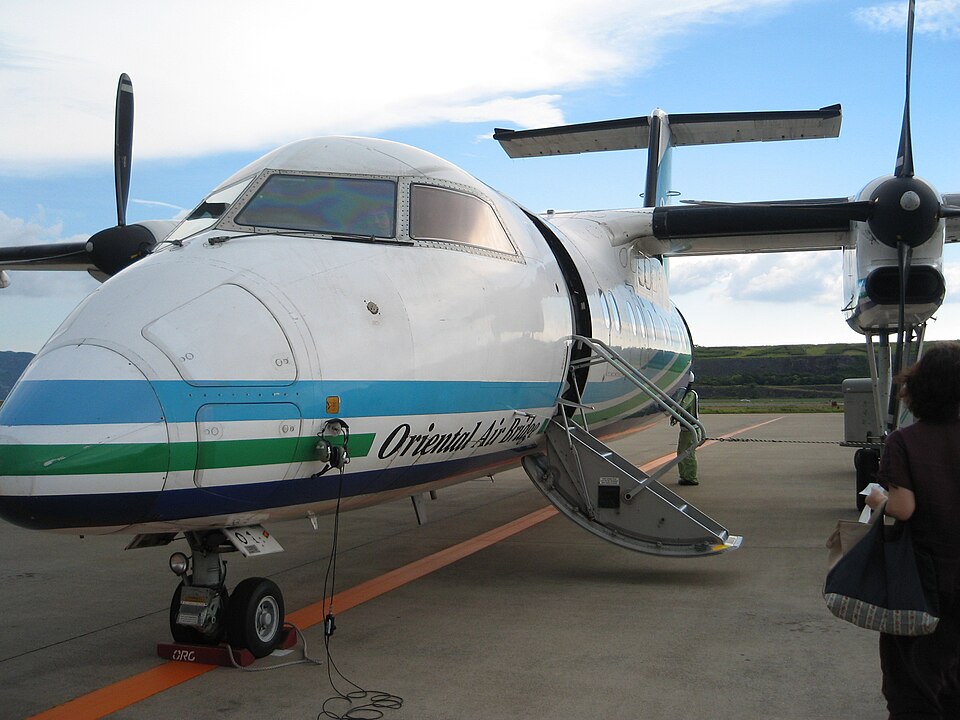
On Wednesday, February 12, 2014, at approximately 14:07 Japan Standard Time, a Bombardier DHC-8-201 registered as JA801B, operated by Oriental Air Bridge Co., Ltd., experienced a strong impact during a touch-and-go landing on Runway 32 at Nagasaki Airport. The aircraft was conducting company flight training for a first officer qualification. The captain, serving as instructor, occupied the right seat, and the trainee occupied the left seat.
The aircraft had already performed three touch-and-go landings prior to the accident. For the fourth touch-and-go, the approach was flown simulating a left engine failure. The wind was from 040° at 17 knots, creating a right crosswind. The trainee transitioned from a crab method to a wing-low method during the approach. The right main landing gear touched down first, followed by a simultaneous touchdown of the nose landing gear and left main landing gear, accompanied by a thud noise. The captain felt an unusually strong impact.
Flight data recorder (FDR) and cockpit voice recorder (CVR) data indicated that at 14:06:44, the captain remarked on the right main landing gear grounding. Subsequently, the elevator moved in the nose-down direction for about four seconds. At 14:06:47, a vertical acceleration of +2.016 G was recorded, and the weight-on-wheel sensor briefly indicated ground then air. At 14:06:48, the pitch angle reached -4.57° (nose down), and a severe impact sound was recorded. The captain expressed concern about the aircraft's condition at 14:06:49 but instructed to continue touch-and-goes at 14:07:02.
Two additional touch-and-go landings were conducted, and the aircraft finally landed for the seventh time at about 14:22. After taxiing to the apron and shutting down engines, the captain asked a mechanic to inspect the aircraft. The mechanic reported damage to the nose landing gear. Postflight inspection also revealed damage to the forward outer skins of the fuselage section. The aircraft was substantially damaged, but there was no fire. Both crew members were uninjured.
Probable Causes
The Japan Transport Safety Board determined that the accident occurred while JA801B was landing with strong crosswinds. The main landing gear touched down without sufficient load being applied, causing the nose to lower excessively. The nose landing gear then impacted the runway heavily, resulting in damage to the nose landing gear and forward fuselage skin. The trainee continuously lowered the nose of the aircraft, and the captain, as instructor, failed to provide appropriate corrective action.