Accident Details
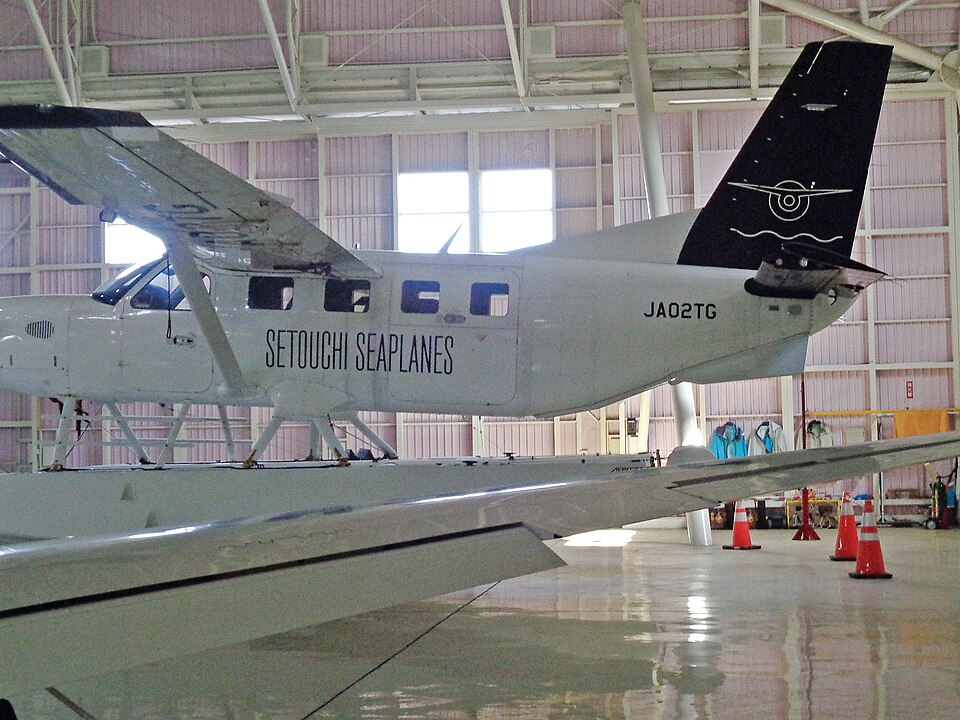
On March 24, 2017, at approximately 16:20 Japan Standard Time, a Quest Kodiak 100 amphibian, registered JA02TG, operated by Setouchi SEAPLANES, Inc., experienced bounces during the takeoff run from water about 2 km off Beppu City, Oita Prefecture. The aircraft had departed Beppu Port at 15:59 to return to its base at Sakai-ga-Hama in Onomichi City, Hiroshima Prefecture. The pilot taxied for about 20 minutes to a location in the north area of Beppu Bay and commenced the takeoff run. During acceleration, the aircraft crossed swell and bounced twice, at approximately 23 kt and 38 kt airspeed. The second bounce was larger, and the pilot rejected takeoff upon receiving a strong impact when contacting the water surface. After the rejected takeoff, the aircraft bounced several times due to swell during deceleration. The aircraft returned to port by taxiing at around 16:57. Post-flight inspection revealed damage to the lower parts of the engine firewall, lower forward fuselage, engine mount frame, struts and tie rods of both left and right floats, and the float fairings.
Aircraft and Crew
The aircraft was a Quest Kodiak 100, serial number 100-0156, manufactured on October 23, 2015. It had a total flight time of 320 hours 59 minutes. The pilot, aged 68, held an airline transport pilot certificate and a specific pilot competence certificate with type rating for single-engine airplane (amphibian). The pilot had a total flight time of 19,186 hours 40 minutes, including 287 hours 50 minutes on the accident aircraft type. No injuries to persons were reported. The aircraft's weight and center of gravity were within allowable limits at the time of the accident.
Meteorological and Sea Conditions
According to the pilot, prior to takeoff the wind direction was 040° to 060° with a velocity of 3.0 to 3.6 m/s (6 to 7 kt). The synthesized wave height of wind wave and swell was approximately 30 cm, with irregular swell from multiple directions having a wavelength of several meters. Observations from the Oita Meteorological Office (about 15 km southeast) recorded north-northeasterly wind at 2.4 m/s at 15:00 and northeasterly wind at 2.0 m/s at 16:00. Kitsuki Regional Meteorological Observatory (about 13 km southeast) recorded easterly wind at 3.0 m/s at 15:00 and southeasterly wind at 3.3 m/s at 16:00.
Additional Information
The aircraft's integrated instrument system recorded flight data every second. The engine power reached takeoff power normally. The pitch angle was not stable from the start of takeoff, accelerating with up-and-down motion of the nose in approximately 4° amplitude. A pitch-up attitude of +16.84° was recorded when the speed reached approximately 36 kts at around 16:19:55. The company had limited operating experience and knowledge regarding swell conditions and had not provided specific training guidelines for swell operations. The Federal Aviation Administration's handbook notes that takeoff should not be attempted when the wavelength is longer than the float length, as it creates dangerous pitching motions.