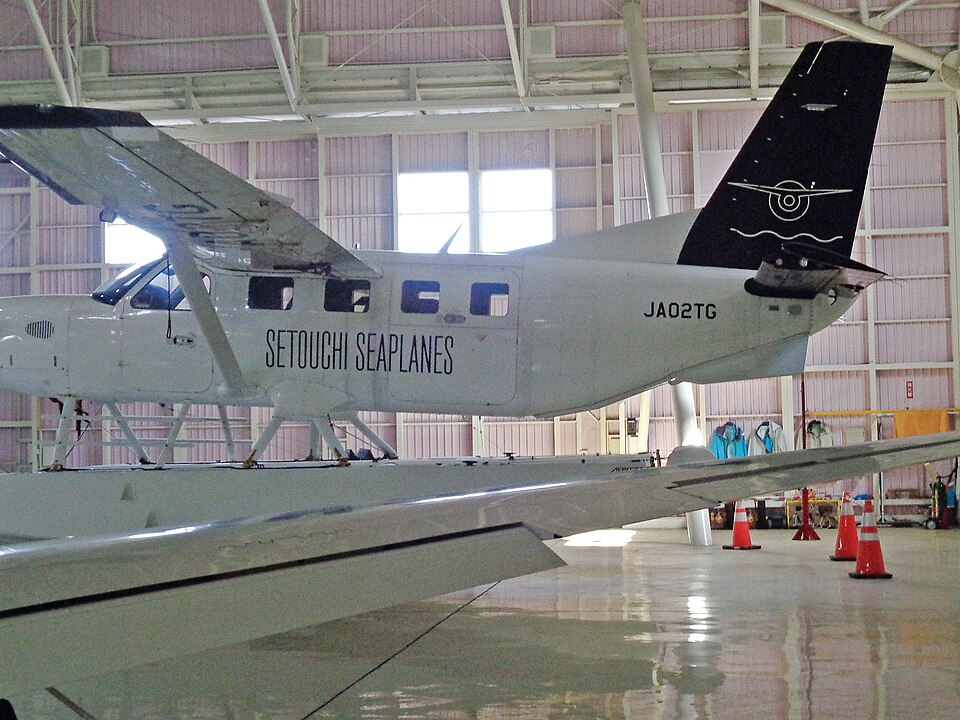
Accident Overview
On April 15, 2018, at approximately 11:13 Japan Standard Time, a Quest Kodiak 100 amphibian, registration JA02TG, operated by Setouchi SEAPLANES Inc., was conducting a water landing off Sakaigahama, Urasaki Town, Onomichi City, Hiroshima Prefecture. The aircraft suffered substantial damage after a bounced landing.
Flight History
The aircraft departed at about 10:02 from a water area southwest of the company's pier for a familiarization flight. The pilot in command occupied the left seat, and an advisor (a company flight instructor) occupied the right seat. Weather was fine with good visibility; wave height was approximately 20 cm (later recorded as 25 cm or less), and wind was from the north at 10 kt (later 12 kt) according to the pier anemometer. The pilot performed eight previous takeoffs and landings without incident.
For the ninth landing, the pilot attempted a crosswind landing from the left side, estimating a crosswind component of about 5 kt. He maintained an easterly heading and used a wing-low approach. After touchdown, the pilot reduced power but soon felt the nose weathervane left; he increased right rudder but felt no further rudder authority. He decided to go around and began increasing power. The advisor questioned the power increase, and the pilot then reduced power again. The aircraft became airborne and then touched down, initiating a series of bounces. The pilot reduced and increased power again, but the aircraft touched down nose-down with a loud impact sound. The pilot then commenced a go-around. The advisor, sensing danger and seeing the aircraft approaching a cape, took over control, maximized power, and executed a go-around. They flew to the pier for visual inspection by a mechanic, who confirmed damage to float struts. The pilot then diverted to Kounan Airport for an emergency landing.
Damage to Aircraft
The aircraft sustained substantial damage: the right front strut was broken; the right front strut attachment structure parts were damaged; and the fairings of the left and right main struts were damaged.
Injuries
No injuries to persons were reported.
Probable Cause
The investigation report did not state a probable cause.