Background
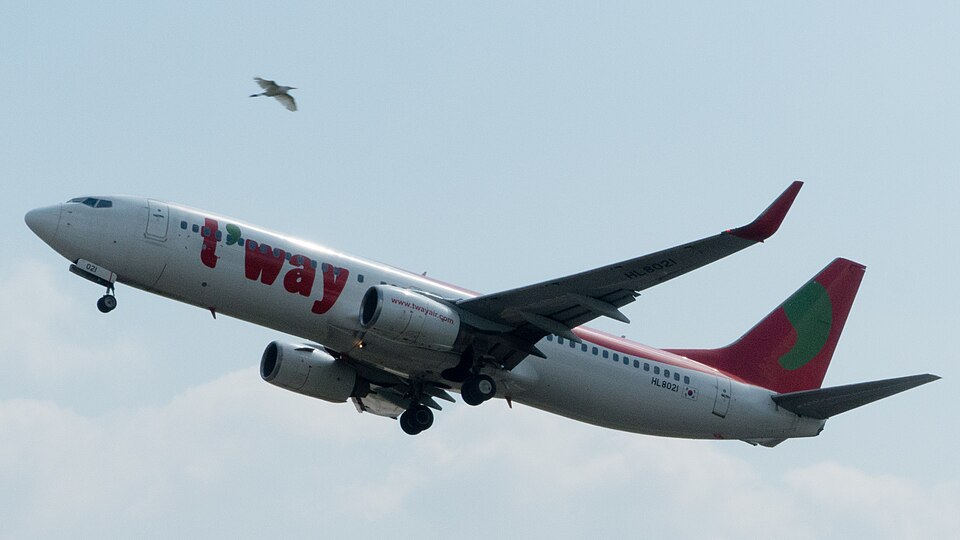
On May 2, 2019, T'way Air flight 201, a Boeing 737-800 registered HL8021, departed Incheon International Airport at 08:26 local time bound for Narita International Airport. The aircraft carried 186 persons, including the pilot in command (PIC), first officer, four other crew members, and 180 passengers.
Flight History
During descent at flight level 200, the PIC rang chimes three times per company procedures, instructing flight attendants to prepare for landing. Upon visually observing a thin cloud belt at approximately flight level 180, the pilot illuminated the seat belt sign and rang chimes once, anticipating light turbulence. The aircraft entered the cloud, and both pilots felt shaking significantly stronger than expected.
At that time, flight attendants were ensuring passengers had fastened seat belts. A flight attendant covering the right aft area (Flight Attendant A) was near row 23 when the aircraft suddenly shook severely. She felt a floating sensation, lost balance, and fell backward, experiencing immediate pain in her right ankle. Unable to stand, she took an empty seat (25D). The descent was conducted on autopilot; no turbulence was indicated on the weather radar or reported by other aircraft.
According to the flight data recorder, between 09:57:12 and 09:57:14, the aircraft’s roll angle varied from 15.3° left to 3.7° right, and vertical acceleration changed from +0.685 G to +2.308 G. Lateral acceleration shifted by 0.048 G left and 0.074 G right. The event occurred at 09:57 local time at flight level 160 over Hitachiota City, Ibaraki Prefecture.
Injuries
The flight attendant sustained serious injuries: fractures of the right tibia and distal end of the fibula. No other injuries were reported.
Meteorological Conditions
Prior to departure, the flight crew reviewed weather forecasts indicating a light thunderstorm near Narita after arrival but deemed conditions acceptable. In flight, no turbulence reports were received from dispatch or air traffic control. Post-accident analysis showed vertical wind shear of 6 to 9 knots per 1,000 feet near the accident site, and precipitation of 5 to 10 mm per hour along the route. Lightning was observed in clouds nearby.
Analysis
The investigation determined that the shaking experienced by the aircraft corresponded to the recorded changes in vertical and lateral acceleration. It is highly probable that the aircraft was descending through thin cloud at the time. The shaking caused the flight attendant to lose balance and fall. No issues with pilot actions or aircraft systems were identified.