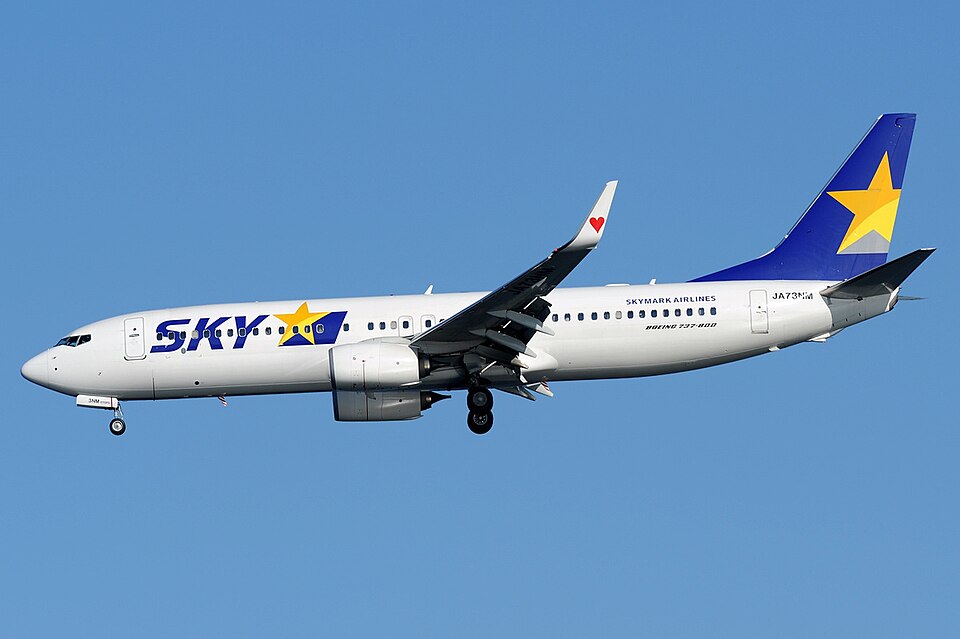
Flight History
On August 29, 2020, Skymark Airlines flight 21, a Boeing 737-800 registered JA73NM, departed from runway 16R at Tokyo International Airport at 17:30 JST, bound for Fukuoka Airport. The aircraft carried 76 persons: a captain, a first officer, 5 cabin crew, and 70 passengers. The captain served as Pilot Monitoring (PM) and the first officer as Pilot Flying (PF).
The climb proceeded normally until 17:34:16, when the aircraft reached an altitude of approximately 8,500 ft and a speed of 240 kt near the waypoint PLUTO. An impact sound was heard from the left lower part of the captain's seat, accompanied by a transient smell resembling burning plastic. The crew checked engine and pressurization instruments and found no anomalies.
The captain discussed the event with the first officer and concluded that a bird strike was the most likely cause. They contacted the company via radio to request a postflight inspection. The crew judged the aircraft airworthy and continued the flight at cruising altitude FL340 at a turbulent air penetration speed. The bird strike was not reported to air traffic control. The aircraft landed uneventfully at Fukuoka Airport at 18:47.
Damage
Postflight inspection revealed damage to the left outer skin of the nose. Two dents were found: one measuring 16.5 cm long, 16.5 cm wide, and 0.95 cm deep; another measuring 10.2 cm long, 6.35 cm wide, and 0.16 cm deep. The inner frame and stiffener showed signs of bending. The engines were examined internally with no evidence of bird residue or damage. The aircraft was classified as substantially damaged.
Investigation
The Japan Transport Safety Board (JTSB) initiated an investigation on August 30, 2020, with an accredited representative from the United States (as the state of design and manufacture) participating. The Flight Data Recorder (FDR) did not show abnormal accelerations or engine parameters related to the strike. The Cockpit Voice Recorder (CVR) captured the impact sound but no crew callouts indicating visual bird detection.
Meteorological conditions at the accident time included scattered clouds at 2,500 ft, visibility 10 km or more, and winds from 200° at 13 kt at the airport, with lighter winds at altitude. The bird species could not be identified, as the residue was wiped off during inspection. The National Transportation Safety Board (NTSB) performed numerical simulations, suggesting the bird's weight was possibly between 1.8 kg and 3.6 kg.
The JTSB report did not state a probable cause for the accident.