Flight History
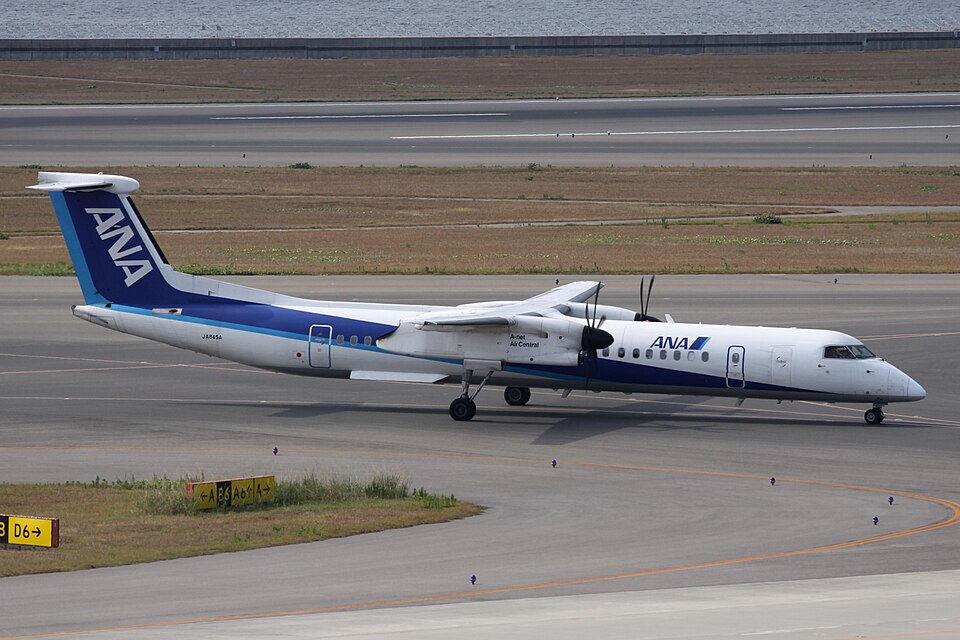
The accident occurred on October 23, 2020, at 09:24:32 JST when a Bombardier DHC-8-402, registration JA845A, operated by Oriental Air Bridge Co., Ltd., struck the runway with its tail during landing on Runway 03 at Fukue Airport, Nagasaki Prefecture, Japan. The aircraft was operating as scheduled flight 93 from Fukuoka Airport with 54 persons on board: a captain, a first officer, two other crew members, and 50 passengers. No injuries were reported.
According to the flight data recorder and cockpit voice recorder, the aircraft took off from Fukuoka at 08:49. During descent, the crew encountered air current disturbances below 5,000 ft. The captain manually controlled the aircraft after disengaging the autopilot at about 700 ft. Final approach was conducted under visual meteorological conditions with wind from 340–350° at 20–30 kt. The aircraft experienced intermittent shaking and speed deviations; the first officer made deviation calls. The aircraft touched down at 09:24:32. After touchdown, a warning light indicated fuselage contact with the runway.
Damage to the Aircraft
The accident resulted in substantial damage to the airframe. The outer skin of the lower aft fuselage was damaged, and partial structural members were damaged and deformed.
Personnel Information
The captain, aged 67, held an airline transport pilot certificate with type rating for the Bombardier DHC-8 and had a total flight time of 18,157 hours 41 minutes, including 947 hours 07 minutes on type. The first officer, aged 31, held a commercial pilot certificate with type rating and had a total flight time of 3,587 hours 44 minutes, including 1,866 hours 18 minutes on type.
Aircraft Information
The aircraft, a Bombardier DHC-8-402 (serial number 4096), was manufactured on October 3, 2004. Its certificate of airworthiness was valid. Total flight time at the time of the accident was 32,073 hours 46 minutes. Weight and center of gravity were within allowable limits.
Meteorological Information
At the time of the accident, the aerodrome routine meteorological report at 09:00 indicated wind from 340° at 18 kt with maximum instantaneous wind of 31 kt, visibility 10 km or more, and few clouds at 3,000 ft. Wind observations provided by Fukue Remote during the approach ranged from 350° at 16–20 kt with gusts up to 32 kt.