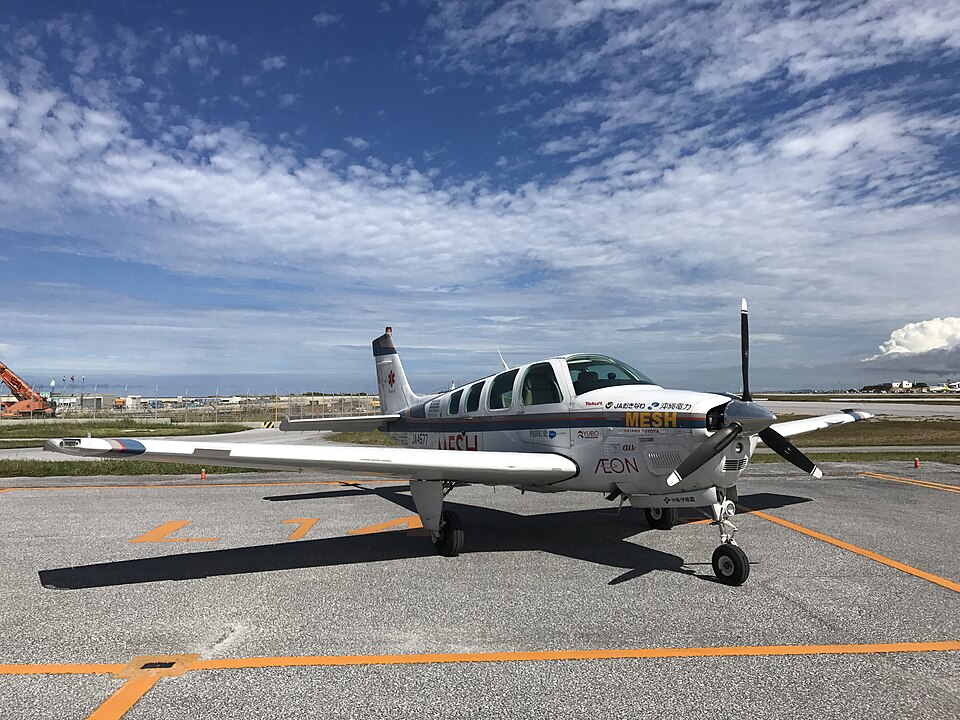
Accident Summary
On March 12, 2022, at about 12:46 Japan Standard Time, a Beechcraft A36, registration JA4577, operated by the non-profit organization Mesh Support, crashed short of Runway 04 at Iejima Airport in Okinawa Prefecture, Japan. The aircraft collided with a fence and slopes before the runway, bounced, and came to rest in a grassy area, where it was destroyed and burst into flames. The two occupants, a captain and a passenger, suffered fatal injuries.
Flight History
The accident occurred during a familiarization training flight. Earlier that day, the aircraft had flown from Naha Airport to Iejima Airport with four persons on board, landing at about 08:42. For the second flight, only the captain (seated in the left pilot seat) and a passenger (seated in the right pilot seat) were on board. The captain had no prior experience in the Beechcraft A36 and had only completed one take-off and landing in the type during a previous flight at Naha Airport.
The second flight departed Runway 04 at about 12:40 for take-off and landing practice. According to radar records, the aircraft turned right after departure, flew a right downwind leg at 1,200 ft, descended to 1,000 ft, and began descending further on the base leg. The captain broadcast a one-way transmission stating "Final Approach," which was heard by personnel in the airport terminal. A witness who heard the engine sound observed the aircraft flying lower than usual.
Accident Sequence
The aircraft collided with a fence approximately 118 m southwest of the runway threshold, causing about 8 m of the fence to collapse. The fence posts, about 2.2 m high, showed paint marks matching the aircraft's wing color at about 1.8 m above the base. The aircraft then struck slopes, bounced, and crashed into the grassy area about 100 m southwest of the threshold. A fire broke out, and the witness heard several blast sounds. Personnel from the airport and NPO Mesh Support arrived with fire extinguishers, and a fire truck extinguished the fire about one hour later.
Aircraft and Meteorological Information
The aircraft, a Beechcraft A36 (serial number E-2616, manufactured April 8, 1991), had a total flight time of about 2,173 hours. Its weight and center of gravity were within allowable limits at the time of the accident. The aircraft was not equipped with a flight data recorder, nor was it required to be. Meteorological conditions at the airport were visual: wind from east-northeast at 5.4 to 5.8 m/s, no precipitation, and mostly fine weather.
Injuries and Damage
Both occupants sustained fatal injuries. The aircraft was destroyed by impact and fire. The fence sustained damage over approximately 8 m, with four posts broken. The cockpit, right wing, right horizontal stabilizer, and vertical stabilizer were extensively burned. The left wing was burned except for the wing tip. The altimeter was read at approximately 200 ft, but other instruments were unreadable due to fire damage.
Personnel Information
The captain, aged 61, held a commercial pilot certificate and a type rating for single-engine land aircraft. He had a total flight time of 5,227 hours and 10 minutes, but had not operated an aircraft for about seven years until March 2022, when he passed a pilot competence assessment using a flight simulator. His flight time on the Beechcraft A36 was estimated at about 1 hour 30 minutes, all from the previous flight. The passenger, referred to as Passenger B, was responsible for supervising the NPO's aircraft and had instructed pilots to aim for the runway designation marking instead of the aiming point marking, with a 3° descent angle.