History of the Flight
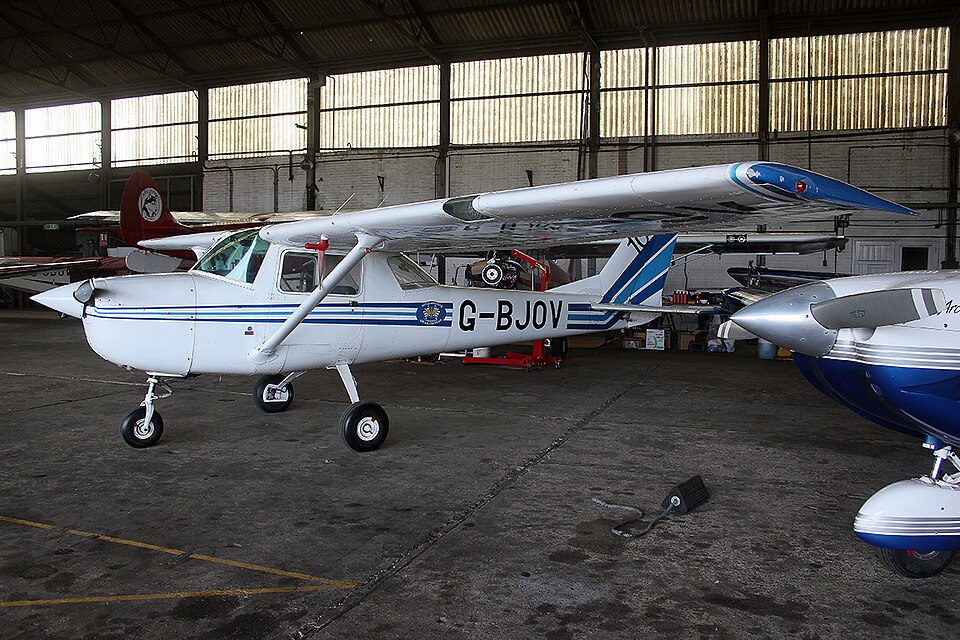
The aircraft, a Cessna F150K registered G-BJOV, was flown from Headcorn Aerodrome to Tiffenden Airfield by two pilots qualified on the type. The pilot in command (PIC) occupied the right seat as the non-handling pilot. The aircraft was positioned to land on Runway 07 despite a 5 kt tailwind, to take advantage of the uphill slope and reduce landing roll. The PIC reported it was normal practice to accept a light tailwind on Runway 07.
On final approach, the handling pilot judged that the aircraft was high and selected full flap (40°) to increase the descent rate.
The Go-Around and Emergency Landing
Likely due to the steep approach combined with the tailwind, the aircraft landed heavily further along the runway than planned, approximately abeam the windsock. The heavy landing caused G-BJOV to bounce back into the air. With less than half the runway remaining, the PIC took control and initiated a go-around.
The aircraft did not climb as expected. The PIC asked the second pilot to raise the flaps in stages to reduce drag. He then lowered the nose to gain speed but had to raise it again to clear trees at the airfield boundary; the stall warner sounded. Once clear, the PIC again lowered the nose to accelerate, but a further line of trees approximately 100 m beyond required raising the nose; the stall warner sounded and both pilots felt the landing gear striking branches.
After clearing the second treeline, the PIC lowered the nose to accelerate again, but as he raised it to clear the next set of trees, a wing drop to the left developed. He countered by lowering the nose and using opposite rudder, but it became apparent that the aircraft would not climb over the treeline ahead. The PIC felt he had no option but to carry out an immediate emergency landing in the field.
Airfield Environment
Tiffenden is a private unlicensed grass airfield with two marked strips: Runway 06/24 and Runway 07/25. The latter is the longer; Runway 06/24 is rarely used. Both runways slope down towards the west. To avoid buildings beyond the end of the runway, the go-around track from Runway 07 requires a left turn to parallel Runway 06. Pooley's guide warns pilots that 'rising ground and trees' beyond the end of Runway 07 pose a hazard for go-arounds.
Aftermath
At touchdown in the field, the nosewheel collapsed and the aircraft slid to a halt at the edge of the field. Both pilots were able to evacuate without assistance and were unhurt. The PIC reflected that discontinuing the initial steep approach and going around before touchdown would have been a better option in the circumstances.