History
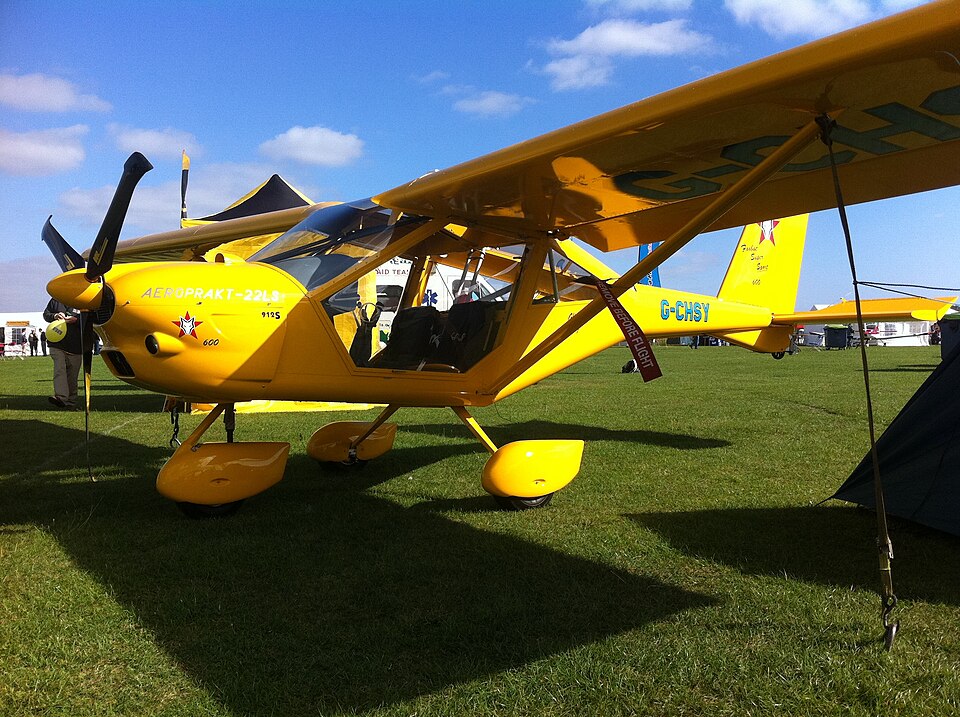
On 16 July 2019 at 1515 UTC, a private flight in an Aeroprakt A22-LS Foxbat Supersport 600, registration G-CHSY, departed from Otherton Airfield, Staffordshire. The pilot, aged 67, held a Private Pilot’s Licence and had 621 total flying hours, of which 524 were on type. One passenger was on board.
The pilot had flown to Otherton that morning with a friend. The aircraft underwent an annual check before a test flight was conducted by the UK importer with the pilot’s friend onboard. No anomalies were found during the annual check, and instrumentation, handling, and performance were reported normal throughout that flight.
Accident
During the accident departure, the aircraft stalled shortly after becoming airborne. It came to rest upright in a crop field at the end of the runway. Both occupants sustained serious injuries, and the aircraft was destroyed. Photographs indicated the aircraft struck the ground with very little forward speed and with the right wing low. Damage to the propeller suggested it was turning at impact.
Aircraft Information
The Aeroprakt A22-LS Foxbat is a high-wing, strut-braced, two-seat microlight aircraft with a maximum gross weight of 450 kg (UK variant; MTOW 650 kg per POH). It is equipped with a Rotax 912ULS piston engine and a Dynon Skyview avionics system with non-volatile memory that records flight data.
Investigation
Weight and balance calculations provided by the pilot indicated a takeoff mass of approximately 567 kg, within acceptable limits. The Pilot’s Operating Handbook (POH) lists stall speeds: 37 mph (32 kt) at MTOW with full flap, and 48 mph (42 kt) with flaps retracted. Vx is 56 mph (49 kt), Vy is 62 mph (54 kt).
The runway used was Runway 34, 300 m long. The POH states a minimum takeoff distance of 100 m at MTOW under standard conditions. The pilot selected first stage of flap for takeoff, which the aircraft dealer confirmed as appropriate. The grass was 100–150 mm long, and wind was reported as “straight down the runway at about 6 kt”.
Before the flight, the pilot noted a discrepancy between the altitude on backup instruments and the Skyview display, but decided to continue. He reported flying the departure between Vx and Vy according to the Skyview. He stated the left wing dropped at about 100 ft, and he attempted correction with ailerons, asked the passenger to retract flaps, and checked airspeed, which he believed was slightly above Vy. As the roll reached approximately 60°, he reduced engine power and applied full right rudder. Just before impact, engine power was reduced to idle.
The pilot attributed the accident to the Skyview indicating incorrect, high airspeed.
Data from the Skyview system was successfully downloaded. It showed the aircraft became airborne at an indicated airspeed of approximately 30 kt, with speed fluctuating between 26 kt and 32 kt during the climb. The maximum height reached was about 70 ft above the airfield, with an indicated airspeed of 28 kt. The engine speed began reducing as the left wing dropped, and a maximum roll angle of about 57° was recorded. The roll direction reversed as the aircraft descended, and engine speed increased slightly just before impact with the right wing low. Total airborne time was approximately 16 seconds.
After the accident, the Skyview was tested by an approved repair agent, with no anomalies found in the processing and display of flight data, including airspeed and altitude. A visual assessment of the pitot/static system showed no obvious anomalies.
The AAIB noted that the aircraft weight was below MTOW, the runway distance was sufficient, and the check flight was uneventful. The airspeed remained low for the entire flight. The pilot stated flaps were retracted after the wing dropped, which would have increased stall speed, making recovery unlikely at the available height.