History of the Flight
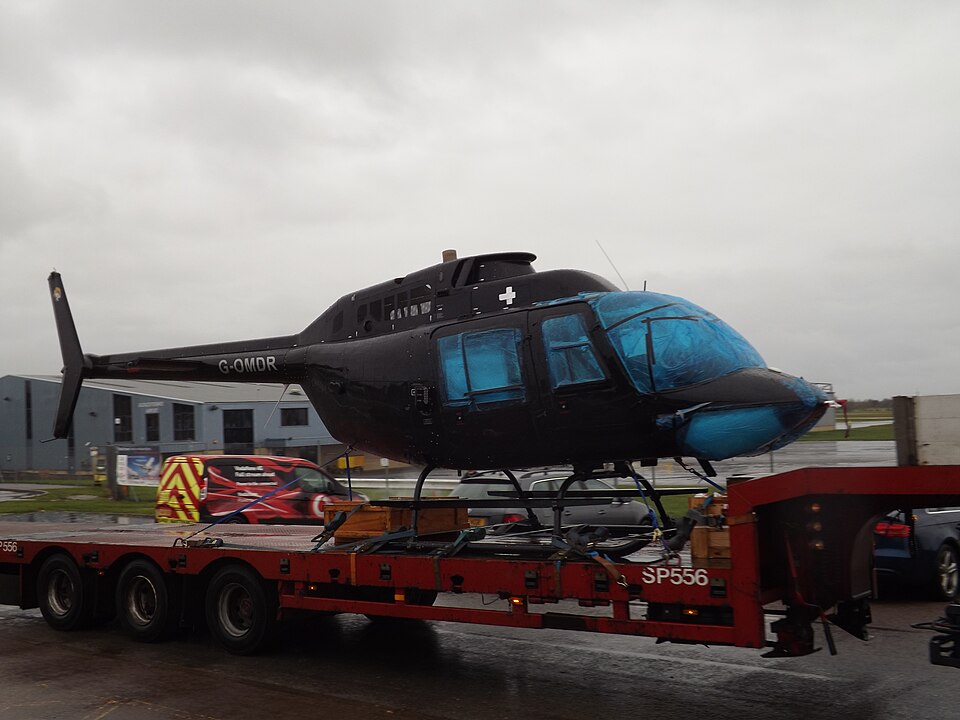
On 27 June 2014, at 1504 hrs, the pilot of Agusta Bell 206B Jet Ranger III, registration G-OMDR, departed from Bicester intending to fly to Breighton Airfield for refueling, with a final destination near Scarborough. The pilot was aware of a weather front to the north but did not anticipate low cloud. As he approached East Midlands Airport, cloud base was 2,000-3,000 ft, but he encountered cloud layers at 400-500 ft with clear air in between. North of East Midlands, weather deteriorated unexpectedly. While considering diverting to Gamston or routing east, the helicopter entered cloud.
Loss of Control
In cloud, the pilot slowed to 60 kt and attempted a 180° turn. After completing the turn, he lowered the collective and began a descent. The airspeed indicator rapidly decreased below zero, and high vibrations occurred. The pilot believed he was experiencing vortex ring state (VRS): descending rapidly with low airspeed, power applied, and uncommanded yaw changes. He moved the cyclic forward to increase airspeed. After an undetermined time, the helicopter seemed to recover, but the attitude indicator then showed nearly 90° of bank, possibly to the right, and controls seemed unresponsive. The helicopter recovered to a more normal attitude before the pilot again felt VRS with little control. He selected forward cyclic and attempted a MAYDAY call (not received by ATC). The helicopter descended into clear air, and the pilot recovered and performed a precautionary landing at Gamston Airport.
Post-Loss-of-Control Events
After landing, the pilot conducted a thorough inspection without a checklist, focusing on the drag pin on the gearbox underside, which he considered the critical indicator of transmission movement. He found no damage and performed hovering checks without unusual vibrations, then continued to Breighton. At Breighton, he changed plans, embarked a passenger, and flew to Scarborough without shutting down or refueling.
On 28-29 June, the pilot discussed the event with the owner's duty engineer by telephone. The engineer was not willing to approve further flight and advised contacting the maintenance manager after the weekend. On 30 June, the pilot spoke to the maintenance manager, describing the event and stating the helicopter was 'flying OK with temperatures and pressures all OK.' The manager asked for photographs of specific areas, including the isolation mount top surface, which the pilot normally did not check.
The pilot emailed photos of the drag pin, stop mount, driveshaft, and isolation mount. The manager observed that the stop mount support plate appeared undamaged, and the drag pin had only minor paint loss. He did not notice the missing stop mount plate. On the driveshaft coupling, the high-temperature stickers had white dots, indicating no excessive overheating. He noted a gouge in the isolator mount top plate but did not measure its depth or refer to the Aircraft Maintenance Manual for allowable damage. Based on the photos and the pilot's report that the mast was free to move, the manager verbally approved a flight to Biggin Hill Airport for further examination. No defects were recorded in the technical log.
The pilot flew to Breighton for refueling and then to Biggin Hill, where the helicopter was taken out of service. The AAIB was notified in February 2015; no Mandatory Occurrence Report had been filed.
Aircraft Description
The AB206B is a single-engine, VFR-only helicopter with a teetering two-bladed rotor. The engine drives the main rotor transmission via a freewheeling unit and a driveshaft with flexible couplings. Temperature indication labels on the couplings change color at 330°F (low-temp) and 370°F (high-temp). The transmission is attached to the fuselage by two pylon support links and an elastomeric vibration isolation mount. A vertical drag pin on the transmission projects through a stop mount assembly; excessive movement can shear rivets and detach the stop mount plate.
Damage Description
Inspection revealed damage beyond allowable limits: gear teeth on both driveshaft couplings were chipped; the freewheeling unit's attachment flange was deformed; the isolation mount top plate was gouged through its entire thickness, and the internal elastomeric damper was mostly dis-bonded. The rear coupling's high-temperature stickers had white dots, indicating temperatures below 370°F. The forward coupling had similar functional stickers.