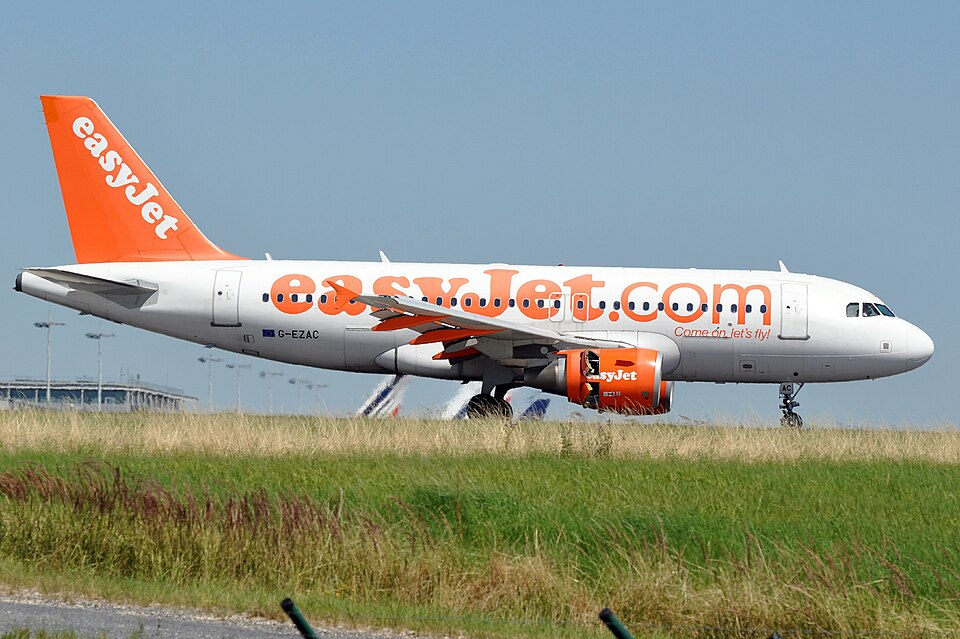
History of the Flight
On the preceding sector from London Stansted to Alicante, the No. 1 Integrated Drive Generator (IDG1) failed and could not be reset. The aircraft was dispatched from Alicante to Bristol with IDG1 selected OFF under the operator's Minimum Equipment List, with the Auxiliary Power Unit (APU) generator supplying the AC1 busbar and IDG2 supplying AC2. While cruising at Flight Level 320 under Brest ATC control, the crew heard a 'CLUNK' and lost numerous services: the captain's primary flight display, navigation display, upper ECAM, and MCDU; autopilot with master warning tone; autothrust with caution tone; all overhead panel annunciator lights; and some centre pedestal displays and lighting. The commander, as pilot flying, had only standby instruments. He handed control to the co-pilot, who noted the flight control system had reverted to alternate law. The commander attempted ECAM actions, first selecting the AC ESS FEED push button to ALTN, but with no effect. He could not see whether the push button was in normal or alternate. Unable to restore electrical power, he attempted MAYDAY transmissions on VHF1 and VHF2, asked the co-pilot to try, and later tried VHF3 via the observer's equipment, all unsuccessful. He then selected the emergency transponder code 7700 to alert ATC. Deciding to continue to the original destination, the crew proceeded. During approach, the landing gear failed to extend normally, and the crew used the emergency extension system. The aircraft landed safely at Bristol at 1133 hrs.
Electrical System
The aircraft's electrical system normally uses two engine-driven IDGs powering AC1 and AC2 busbars via Generator Line Contactors (GLC). Bus Transfer Contactors (BTC) isolate the outputs. A Generator Control Unit (GCU) monitors IDG output and opens the GLC if out-of-limits. The APU generator can supply either main busbar via BTCs. The system includes an AC Essential busbar (AC ESS) normally from AC1, and DC busbars. Loss of AC1 de-energises AC ESS and its derived busbars, causing an amber FAULT caption on the AC ESS FEED push button. Selecting ALTN transfers AC ESS to AC2, restoring essential services and illuminating a white ALTN caption. The aircraft was fitted with an upgraded digital Audio Management Unit depending solely on DC ESS power, meeting certification standards.
Investigation Findings
Flight data recorder (FDR) data, powered from AC2, recorded throughout. At 10:52:40 UTC, AC1, AC ESS, and DC ESS busbars de-energised and did not recover until after landing. The cockpit voice recorder (CVR), powered from AC Essential Shed, ceased recording at that time. The FDR showed BTC2 cycled three times shortly after the loss, consistent with the APU generator or IDG2 switching off and on. Post-incident inspection and wiring checks revealed no anomalies; the system functioned normally during ground tests. Bench testing of the AC ESS FEED button and associated contactors and relays also found no anomalies. However, laboratory testing revealed an intermittent fault with GCU1, where a current was incorrectly detected by one of the current transformers within the generator. The aircraft manufacturer had previously issued an Operator's Information Telex (OIT 999.0106/06, 24 August 2006) concerning a known failsafe issue with certain GCUs and GAPCUs, where Static Read-Only-Memory (SRAM) content could alter, causing isolation of the associated IDG. The OIT listed affected serial numbers and recommended that each aircraft have at least two units that had not experienced a failsafe in the last 30 days, issued for maintenance purposes rather than flight safety reasons. The investigation continues.