History of the Flight
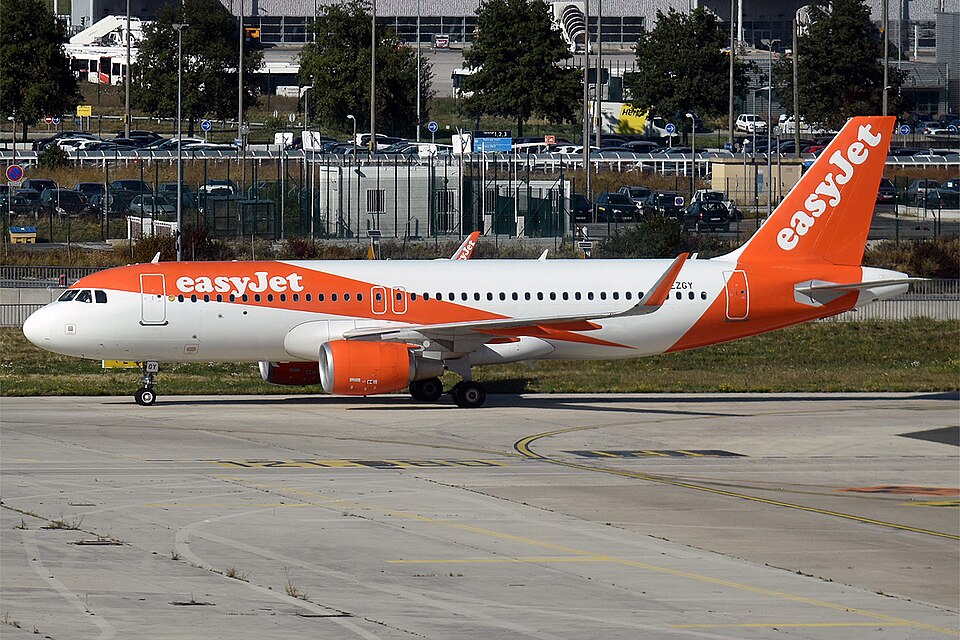
The aircraft, an Airbus A320-214 (registration G-EZGY), was operating a commercial passenger flight from an unspecified origin to Kerkira Airport, Corfu. On 19 June 2024 at 1955 UTC, a night landing was being conducted on Runway 34. The approach was flown by the co-pilot and was stable, but the aircraft drifted high on short finals due to an early and protracted flare, resulting in a deeper than expected landing near the end of the touchdown zone (TDZ).
The co-pilot reported that darkness and the lack of runway centreline lighting made judging the final approach and discerning TDZ markings during the flare more difficult. He selected reverse idle thrust when he felt the mainwheels touch down. The commander, however, assessed that the aircraft passed the last TDZ marker at a very late stage in the flare. Per the operator's policy, a go-around should be flown if the mainwheels are not on the runway before the end of the TDZ. The commander called "I have control" and selected takeoff and go-around (TOGA) thrust to initiate a baulked landing go-around. At that moment, he was unaware that the co-pilot had already selected reverse idle thrust (rev idle). By the time he realised the thrust levers had been advanced from rev idle rather than idle, they were already at the TOGA stop.
The Airbus A320 Flight Crew Techniques Manual (FCTM) directs that pilots "must not initiate a go-around after the selection of thrust reversers." Aware of this direction but having already selected TOGA, the commander experienced startle and surprise, leading to hesitation on whether to continue with the go-around or reject it. His startle and surprise increased when a master warning tone sounded because TOGA had been selected while full flap was still deployed. During this period, he briefly cycled the thrust levers from TOGA to maximum reverse thrust (rev max) and back to TOGA. There was a further brief thrust reduction on both levers before the commander finally reselected rev max and applied maximum manual braking to reject the go-around.
The co-pilot stated he did not sense significant acceleration after the second TOGA selection and became increasingly concerned about insufficient runway remaining. He called "stop" and independently applied maximum manual braking. Recorded data showed he also applied a nose-down input on the sidestick, which was nulled because the commander had pressed his sidestick priority button after taking control. The co-pilot's "stop" call was approximately coincident with the commander also calling "stop," making a final selection of rev max and applying maximum manual braking.
The aircraft came to a halt on the runway approximately 340 m before the end. After an external inspection by emergency services, the aircraft taxied to stand under its own power. The commander assessed the touchdown as firmer than normal, but after an engineering check procedure for a possible heavy landing, the aircraft was released for flight and the crew flew it back to the UK.
Recorded Information
The Flight Data Recorder (FDR) and Cockpit Voice Recorder (CVR) recordings were overwritten before the investigation began, as the State of Occurrence initially declined to investigate. The investigation relied on Quick Access Recorder (QAR) and Digital ACMS Recorder (DAR) data, which included parameters such as sidestick priority button press and which sidestick had priority.
Recorded data showed the approach was normal, with flaps full and autobrake medium set. The autopilot was disengaged at about 1,800 ft AAL. The aircraft flew over the threshold at about 55 ft AGL, initiating the flare. Pitch attitude increased gradually; at about 20 ft AGL the thrust levers were retarded to idle, disengaging auto thrust. Further aft sidestick inputs by the co-pilot increased pitch attitude. The aircraft touched down at 130 KCAS approximately 660 m from the threshold, on or just after the final TDZ marker. The thrust levers were then moved to rev idle, and thrust reverser doors opened.
Almost simultaneously, the commander pressed his sidestick priority button and advanced the thrust levers to TOGA. The thrust reverser doors closed. The thrust levers remained at TOGA for three seconds while the commander applied aft sidestick. They were then briefly moved to rev max and back to TOGA, causing the reverser doors to open and close briefly. A master warning activated due to the takeoff configuration with full flap. After three more seconds, both thrust levers were retarded again – the right lever between flex takeoff/max continuous thrust (FLX MCT) detent and TOGA, the left between maximum climb (CL) detent and idle – then advanced back to TOGA for less than one second. Finally, the thrust levers were moved to rev max, and maximum manual braking was applied. At that point, the aircraft’s airspeed was 129 KCAS, and it was approximately 1,400 m from the threshold, with about 915 m of runway remaining.
As the aircraft de-rotated from 5° nose-up pitch, the commander briefly moved his sidestick forward then slightly aft of neutral, while the co-pilot applied forward sidestick for about two seconds. Because the commander continued to press his sidestick priority button, the inputs were not summed. As the aircraft decelerated, a master caution related to auto thrust disconnection appeared. At about 50 kt groundspeed, the thrust levers were moved to rev idle, but maximum manual braking continued until the aircraft stopped at approximately 1,970 m from the threshold, with 340 m of runway remaining. Brake temperatures rose to just below 500°C, triggering a brake overheat warning three minutes later. The maximum recorded normal load during landing was just under 1.7 g, and the flaps remained in the flaps full position.
Personnel
The commander, aged 40, held an Airline Transport Pilot’s Licence and had 5,303 total flight hours (5,047 on type), with 213 hours in the last 90 days and 77 in the last 28 days. He had not flown a baulked landing go-around in an A320 family aircraft before but had practised them in the simulator, including ones initiated after mainwheel touchdown. He noted that on the incident flight he likely had not detected the selection of thrust reversers due to lack of tactile feedback.