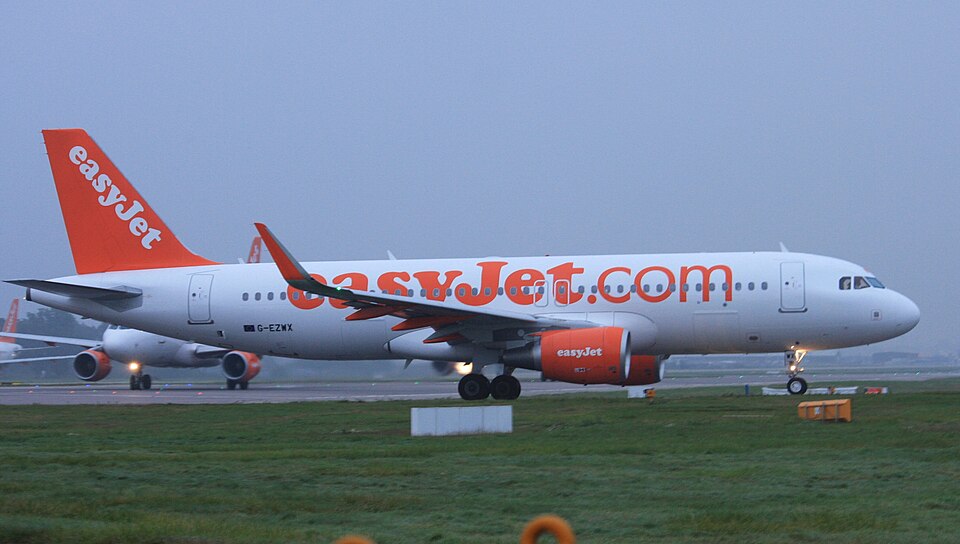
History of the Flight
On 27 July 2016, an Airbus A320-214, registration G-EZWX, was in cruise at flight level 340 from Heraklion, Greece, to London Gatwick. The aircraft experienced a pitch oscillation and normal acceleration anomaly. A fault was detected in the stabiliser system, triggering the Electronic Centralised Aircraft Monitor (ECAM) message 'stab jam' and the autopilot disengagement. The co-pilot took control while the commander executed the ECAM checklist. The checklist required the flight crew to check manual trim availability and move the stabiliser trim until the elevator was neutral. The crew moved the trim wheel slightly but decided not to move it significantly as the aircraft felt largely in trim. Consequently, the control law degraded to Alternate Law, which provided reduced protections and no autopilot, but maintained load factor demand and low/high speed stability. The aircraft climbed 100 ft from its assigned altitude; the crew corrected with minor control inputs. The flight descended below RVSM airspace and continued to Gatwick with the autopilot disengaged. Upon landing gear extension during approach, the control law changed to Direct Law, and an uneventful landing was performed. Post-flight maintenance removed the trimmable horizontal stabiliser actuator (THSA) for examination.
Recorded Information
Flight data recorder (FDR) data showed pitch and normal acceleration oscillations from 1401:50 to 1402:10 UTC. Maximum normal acceleration reached 1.37 g and minimum 0.65 g over 4 seconds. During these oscillations, the elevator aileron computer (ELAC) handed over from ELAC 2 to ELAC 1 at 1402:06, and the autopilot disengaged two seconds later. The oscillations were caused by a stabiliser position oscillation, which the elevator attempted to compensate. The stabiliser settled 0.6° more nose-down and the elevator 2° more nose-up than before the upset. The ECAM actions called for manual trimming to bring the elevator to neutral; the stabiliser moved about 70 seconds after the upset, indicating it was not physically jammed, but the movement was insufficient to zero the elevator.
Stabiliser System Description
The horizontal stabiliser is controlled by the THSA, which can be trimmed electrically or manually via a cockpit trim wheel. Electrical trim is normally controlled by ELAC 2; if it detects unresponsiveness, control transfers to ELAC 1, then to spoiler elevator computers (SEC 2, then SEC 1). The commanded stabiliser position is measured by the COM transducer (three RVDTs) via a mini reduction gear assembly; actual position is measured by the MON transducer. Discrepancy between COM and MON triggers the 'stab jam' message and halts electrical stabiliser movement.
THSA Component Examination
The THSA was sent to the manufacturer. The mini reduction gear assembly was not driving the COM transducer. Approximately 2 ml of water was found inside the mini reduction gear liner/cavity, an unusual finding. The output shaft was jammed, and gear damage was evident. The COM transducer also contained water and corrosion. Seals and sealant were satisfactory, but a leak check was not performed before opening, as water was not expected. The manufacturer reported this as the first instance of water ingress into this component.
Operator Comments
After confirmation from the manufacturer, the operator inspected the THSA installation area on the incident aircraft and found no signs of water or moisture. As a precaution, a COM transducer from a similar-age aircraft was removed and tested; pressure leak checks, electrical tests, and visual inspections revealed no issues or water.
Analysis and Probable Cause
According to the THSA and aircraft manufacturers, the failure most probably resulted from water ingress into the THS COM transducer, which migrated into the mini reduction gear. The water likely froze during flight, and subsequent THSA movement caused torque damage to the mini reduction gear. The stabiliser moved as commanded (sensed by MON), but the COM transducer did not sense any movement; the discrepancy was detected, preventing further electrical commands. Although the water source could not be determined, the aircraft manufacturer stated that the worst-case scenario is the one experienced—the aircraft remains fully controllable in Alternate Law with manual stabiliser trim available.