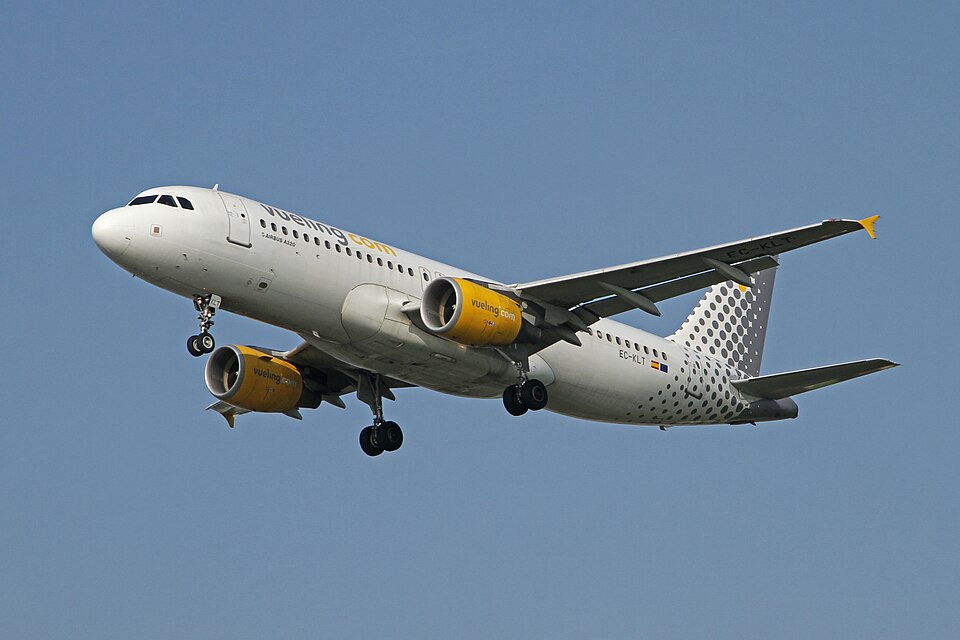
Synopsis
On 26 August 2019, an Airbus A320-216 (EC-KLT) operated by a commercial airline on a passenger flight from Barcelona to Birmingham encountered two missed approaches due to deviations from the correct approach profile. During the second missed approach, the aircraft initially continued descending and was not appropriately configured, leading to activation of the alpha floor energy protection mode. A subsequent event on 20 December 2019, involving the same operator and aircraft type but different flight crew, also involved an approach deviation.
History of the Flight
The aircraft, with 6 crew and 189 passengers, was cleared for an RNAV approach to Runway 33 at Birmingham Airport. The co-pilot was the handling pilot. Weather was good with light winds and no cloud below 5,000 ft. ATC cleared the aircraft to descend to 2,000 ft and carry out the approach. The pilots initially did not descend and requested clarification, then began descending late. At 9.4 nm from the runway, the aircraft was at 3,800 ft, 1,000 ft above the correct profile. At 3 nm, it was at 2,000 ft, 660 ft above. At 0.3 nm from the threshold at 470 ft, the crew announced a go-around. ATC cleared them to 4,000 ft and provided vectors for a second approach.
On the second approach, the commander took over as handling pilot and requested a localiser/DME approach. ATC cleared the aircraft to descend to 2,000 ft, but the crew mistakenly read back 3,000 ft, which was not corrected. The aircraft descended to 3,000 ft while positioning. When beginning final descent from 3,000 ft at about 7 nm, it crossed the final descent point (5.1 nm) at 200 ft above the correct altitude. The crew initially continued but then reported being too high and requested a left turn. ATC instructed a left turn to 240° and climb to 4,000 ft. The crew commenced the turn 2.5 nm from the runway descending through 1,900 ft, selecting open climb mode with landing gear down and full flaps. They did not select TOGA thrust. The aircraft pitched up to about 10° nose-up and decelerated. The crew changed to vertical speed mode, reducing pitch to about 1° nose-up, but alpha floor protection activated, automatically setting TOGA thrust. The commander then adjusted thrust levers to prevent exceeding flap limiting speed. With pitch reducing, the aircraft descended to 1,300 ft (about 940 ft agl) before starting to climb at about 900 ft/min in vertical speed mode. The aircraft climbed to 4,000 ft and conducted another localiser/DME approach, landing without incident.
Further Occurrence
On 20 December 2019, a different crew flew a localiser/DME approach to the same runway. Cloud base was broken at 1,300 ft and scattered at 900 ft. ATC cleared them to descend to 2,000 ft (platform altitude) and then to descend with the approach. The pilots were unsure of the correct descent point when cleared from a higher altitude than the charted platform altitude. They attempted to calculate the descent point, losing situational awareness and descending too late, remaining above the profile and going around. ATC then offered an RNAV approach, causing confusion; the crew requested another localiser/DME approach. During this second approach, the aircraft was high again; pilots attempted to regain the path but at 6.5 nm descended 700 ft below the correct profile to 1,300 ft, then climbed 500 ft before descending again. At 3 nm it was 360 ft above the profile but continued and landed.
Operator's Investigation
The operator assessed fatigue using the Samn-Perelli scale; scores for all four pilots ranged from 2.22 to 2.43, with 2 defined as 'very lively, responsive, but not at peak' and 3 as 'Okay, somewhat fresh'. Crews were determined to be appropriately experienced. For the 26 August event, the investigation found that the crew struggled to reduce speed in the distance available but, with correct energy management, sufficient distance existed. It highlighted a difference between the RNAV approach descent profile in the UK AIP (platform altitude 2,000 ft, final descent from 5.1 nm) and the operator's chart (continuous descent from 2,800 ft at 7.6 nm), leading to pilot confusion and delayed descent. For the 20 December event, the investigation found that the aircraft was initially slightly high but sufficient distance existed; however, the pilots believed it inadequate. They did not establish a stable approach and went around at 1 nm. During the second approach, the aircraft started slightly high; pilots selected a 2,900 ft/min descent in vertical speed mode until 6.2 nm, then climbed and descended, eventually landing.