Synopsis
During a commercial passenger flight from Sumburgh to Glasgow, the aircraft experienced a contained failure of the No 1 engine while cruising at FL180. The failure was followed by a fire inside the engine cowlings, caused by fuel leaking from a fuel return line that had become loose as a result of the engine failure. The flight crew followed the appropriate checklists, shutting down the engine and extinguishing the fire. The aircraft diverted to Aberdeen International Airport and landed without further incident. There were no injuries to the 3 crew members or 30 passengers.
History of the Flight
The flight was the crew's fourth sector of the day, a return leg from Sumburgh to Glasgow. After takeoff from Runway 27 at 1129 hrs, the aircraft climbed to FL180 on a southerly track. At approximately 1201 hrs, near the reporting point RISDU (28 nm northeast of Aberdeen), the commander heard a "big thump" or "muffled bang". The aircraft yawed left, and the autopilot applied rudder trim to correct. The commander observed an amber 'hbv' label on the No 1 engine torque indicator, with torque dropping to nearly zero, while the interstage turbine temperature (ITT) rose rapidly. The co-pilot noted an 'eng 1 over limit' caution. After cancelling the Master Caution, the crew began the abnormal checklist, but it was interrupted by an 'eng 1 fire' warning. They executed the engine fire in flight checklist, discharging both fire bottles before the warning extinguished.
The co-pilot declared a MAYDAY to Scottish Control, and the commander initiated a descent and called cabin crew to stations. The aircraft was 24 nm from Aberdeen, and at ATC instruction they descended to FL130 and were handed to Aberdeen Radar. The crew completed the Single Engine Operations checklist. During the approach, a 'fuel feed lo pr' caution appeared for the No 2 engine, but the engine ran normally, so the crew prioritised the one-engine-inoperative landing on Runway 34, which was completed at 1228 hrs. After shutdown, a ground engineer reported fuel leaking from the No 1 engine area.
Recorded Information
Flight data recorder (FDR), cockpit voice recorder (CVR), and quick access recorder (QAR) data were analysed. Key events (UTC): at 12:01:02, No 1 engine torque dropped from 90% to zero in one second, with sideslip and rising ITT; at 12:01:13, engine fire warning; at 12:01:21, engine shutdown message; at 12:01:43, crew pulled the fire handle; at 12:02:08, first fire bottle discharged; at 12:02:41, second bottle discharged; at 12:02:53, MAYDAY declared. The crew began the Single Engine Operation checklist about four minutes after the first bottle discharge, and the co-pilot confirmed the No 1 engine fuel pump was off 20 seconds later.
Aircraft Information
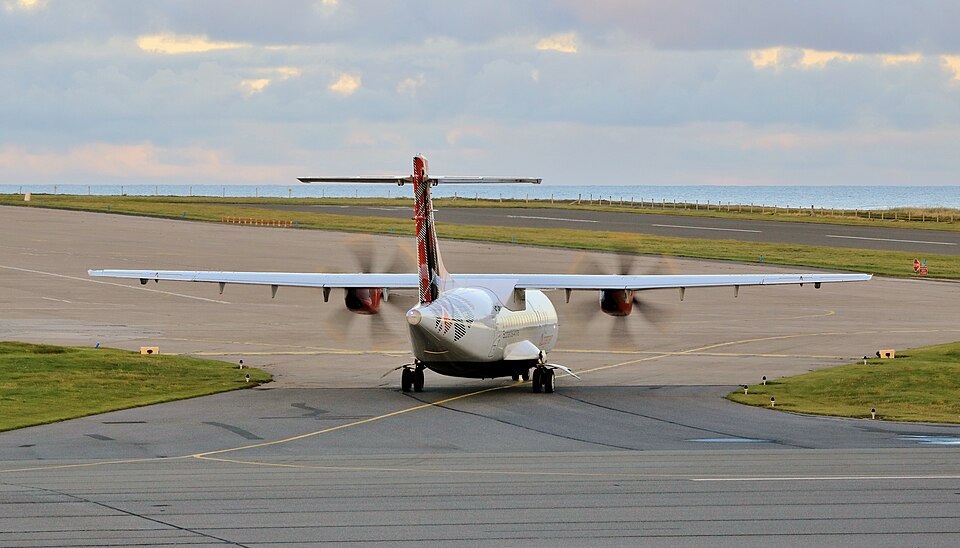
The ATR 42-500 (600 version) is a twin-engine turboprop regional airliner, seating up to 48 passengers. It is powered by two Pratt & Whitney Canada PW127M turboprop engines, each with a two-spool gas turbine and reduction gearbox. The No 1 engine was installed in February 2024, and the fuel return line had not been disturbed since installation.
The engine fire detection system uses two continuous sensing loops, and extinguishing is provided by two bottles per engine. The fuel system includes a motive flow valve that controls fuel from the hydro-mechanical unit (HMU) to the engine feed jet pump. The valve's inlet is connected to the fuel return line. In normal flight, the valve solenoid is de-energised with the electric fuel pump switch selected in.
Post-Incident Actions
The aircraft manufacturer has initiated a safety review to identify possible actions to reduce the likelihood of fuel return line leakage. The AAIB field investigation is ongoing.