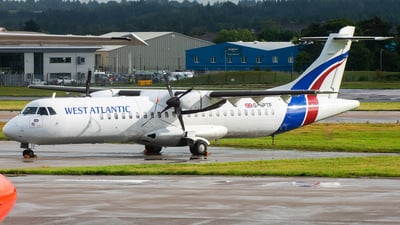
History of the Flight
The crew reported for duty at 2320 hrs at East Midlands Airport. The aircraft's tech log contained an entry for an Acceptable Deferred Defect to the TCAS system, but no other technical issues. The aircraft was de-iced due to frost conditions and departed at 0030 hrs. The flight to Belfast International was uneventful. After a routine turnaround, the aircraft was again de-iced due to low temperatures and active frost, departing at 0310 hrs.
The departure from Belfast and cruise toward East Midlands were uneventful. Due to a forecast of freezing fog, the crew prepared for a CAT II approach with the commander as pilot flying. Approaching East Midlands, they were told to expect holding due to Low Visibility Procedures. After about 10 minutes in the hold, ATC gave radar vectors to intercept the ILS for Runway 27.
The initial stages of the CAT II approach proceeded normally. The aircraft achieved stable approach conditions at 1,300 ft amsl, and at 1,000 ft radio altitude, the crew saw correct dual autopilot indications. At approximately 500 ft radio altitude, the aircraft entered cloud.
Electrical Malfunction
Shortly after entering cloud, the elec caution on the Centralised Crew Alerting System illuminated. The crew checked electrical indications on the overhead panel and noted the dc gen2 fault amber light flashing. The co-pilot's Electronic Attitude and Direction Indicator and Electronic Horizontal Situation Indicator were also flashing. The autopilot disconnect horn sounded, and flight director modes disappeared, though guidance bars remained visible. The crew decided to go around.
During the go-around, numerous audio and visual warnings occurred, including Enhanced Ground Proximity Warning System warnings for "terrain ahead" and "too low gear." The co-pilot's displays continued flashing, and his airspeed indicator cycled from maximum to minimum. The commander's displays went blank for a few seconds, recovered, then blanked again about one minute later. Standby instruments worked normally.
Both pilots recalled hearing sounds like electrical relays cycling. The Autopilot Display Unit flashed, and the crew could not reselect autopilot. They retracted flaps from 30 degrees without exceeding limits. They carried out the published go-around procedure, levelled at 3,000 ft amsl, and turned toward the EME NDB.
Crew Actions
Once level, the crew made a PAN call but heard no response. They tried 121.5 MHz with no response. They reselected the tower frequency, set transponder to 7600, and broadcast a MAYDAY. Amidst severe static, they heard a faint message to contact radar. They changed frequency and communications were restored. They requested vectors for a diversion to Birmingham International Airport.
With dc gen2 fault light flashing, the crew performed QRH actions, selecting that generator off about seven minutes after the event started. When DC Gen 2 was switched off, audio and visual warnings stopped; the co-pilot's screens went blank. The commander noted the bus tie contactor did not close, so DC Bus 2 was unpowered. The crew consulted the QRH loss of equipment list for DC Bus 2 off.
The commander noted additional electrical failures beyond the list, including loss of the environmental control system recirculation fan and the Aircraft Performance Monitoring System. They recognized the main battery was discharging and the Green hydraulic system was unpowered. They performed performance calculations for landing at Birmingham and used the Blue hydraulic system to pressurize the Green hydraulics to lower the landing gear.
The left navigation receiver could be tuned to the ILS for Runway 33 at Birmingham, but all automatic flight functions were unavailable. The commander flew a manual raw data ILS approach, and the aircraft landed without further incident.
Meteorology
At East Midlands at 0350 hrs, wind was 270° at 8 kt, visibility 400 m in freezing fog, cloud broken at 100 ft, temperature and dewpoint both -2°C. At Birmingham at 0350 hrs, wind was 230° at 1 kt, CAVOK, temperature -5°C, dewpoint -6°C.
Recorded Information
Flight data recorder, cockpit voice recorder, and EGPWS data were downloaded. Ground radar data from Clee Hill and Claxby were also obtained. Radar track data showed the approach and diversion. From 0418:51 hrs, with the aircraft about 400 ft aal, the transponder transmissions stopped, and the aircraft was tracked only by primary radar.
FDR data showed that just after 0418 hrs, the master warning alert was triggered together with spurious VHF 2 transmission indications and radio altimeter heights. Spurious heights were intermittent over seven minutes and ten seconds, triggering 31 EGPWS alerts. Spurious VHF 2 indications continued for the remainder of the flight, as did the master warning alert.
Aircraft Information
The ATR 72-202 is a twin turboprop regional aircraft. G-NPTF was manufactured in 1990, held a valid airworthiness review certificate, and operated as a cargo variant. It joined the operator's fleet in May 2022.
For a CAT II ILS approach, the single autopilot is coupled to both horizontal situation indicators by 1,200 ft radio altitude, confirmed by dual cpl indications on the autopilot display unit. If not present by 1,000 ft, the approach may not continue below 200 ft aal. The operator's manual states any failure not completely treated before 1,000 ft aal, or occurring below that, shall lead to a go-around.
Maintenance History
Routine scheduled maintenance had been completed two days before the incident. During that check, the No 2 engine DC starter-generator brushes were worn to their service limit, so it was replaced with an overhauled unit. The replacement had been overhauled and bench tested six months previously, supplied with a valid EASA Form 1.
Electrical Systems
During flight, electrical power is provided by two engine-driven 28V DC starter-generators, two DC-supplied static inverters, main and emergency 24V DC batteries, and two propeller-driven AC frequency wild generators. Two separate electrical networks (No 1 left, No 2 right) operate independently for DC and constant frequency AC. In failure, each side can be connected to its opposite side using DC bus tie contactor or AC bus tie relay. The AC wild network is standalone. Each network powers buses distributing power to equipment with redundancy.
The wiring defect that caused the electrical malfunction was probably caused by incorrect use of mechanical wire stripping tools at a third-party organisation. Action has been proposed by the equipment manufacturer and taken by the third-party maintenance organisation to promote alternative tooling to prevent reoccurrence.