Incident Details
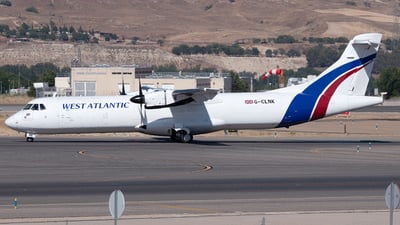
On 25 October 2022 at 2030 UTC, an ATR 72-211, registration G-CLNK, was landing on Runway 09 at East Midlands Airport following a cargo flight from Jersey Airport. The reported wind at the airport was from 150° at 10 kt (METAR later indicated 140° at 12 kt). The commander, who was the pilot flying, conducted an autopilot-coupled approach, disconnected the autopilot during the flare, and touched down aligned with the runway. After selecting ground idle, as the aircraft decelerated through 80 kt, it began to swerve to the right. The commander handed control to the co-pilot and applied left nosewheel tiller to straighten the aircraft. The right wing lifted, which the commander attributed to the turn and crosswind from the right. Additional left tiller, left pedal, and differential left brake inputs were applied, and the aircraft slowly responded. During the landing roll, the commander saw an object on the runway ahead and to the left; subsequent CCTV showed a 'spark' under the aircraft. The aircraft had struck a runway edge light, causing damage to the nosewheel tyre. The runway inspection revealed a broken edge light. The crew reported no injuries.
Aircraft and Crew
The aircraft, an ATR 72-211 manufactured in 1989, was powered by two Pratt & Whitney Canada PW121 turboprop engines. The commander held an Airline Transport Pilot's Licence, was 61 years old, and had 11,011 total flying hours, including 63 hours on type. He had recently completed his type conversion from the BAe ATP. The co-pilot also had recently converted to the ATR 72. The commander reported limited exposure to crosswinds greater than 10 kt during line training but had subsequently landed in significant crosswinds without issues. He stated that on the BAe ATP he routinely used the tiller below 80 kt to maintain direction, partly due to experience with asymmetrical braking.
Operator's Response
The operator's investigation of flight data showed the aircraft abruptly swerved right through 10° as it decelerated through 80 kt, with little to no aileron input into the wind during the ground roll and no rudder application during the turn. The operator concluded that a lack of into-wind aileron was the most likely cause of the divergent path, and that the crosswind induced a weather-vane effect. Recovery occurred via the co-pilot's left pedal and brake inputs, not nosewheel steering. The operator identified aircraft handling during crosswind landing rolls as a key threat and implemented several actions: the crew received additional simulator training on crosswind techniques; the operator's conversion course syllabus was rewritten to maximize crosswind exposure; and training staff were advised to monitor for incorrect crosswind techniques or inappropriate use of nosewheel steering.
Manufacturer Information
The aircraft manufacturer had previously published guidance on crosswind landing techniques, including safety notes and flight operations information notices. These emphasized maintaining aileron input into the wind, using rudder above 70 kt, and progressively using the tiller below 70 kt. The manufacturer's analysis of 18 similar events between 2013 and 2017 highlighted common characteristics.