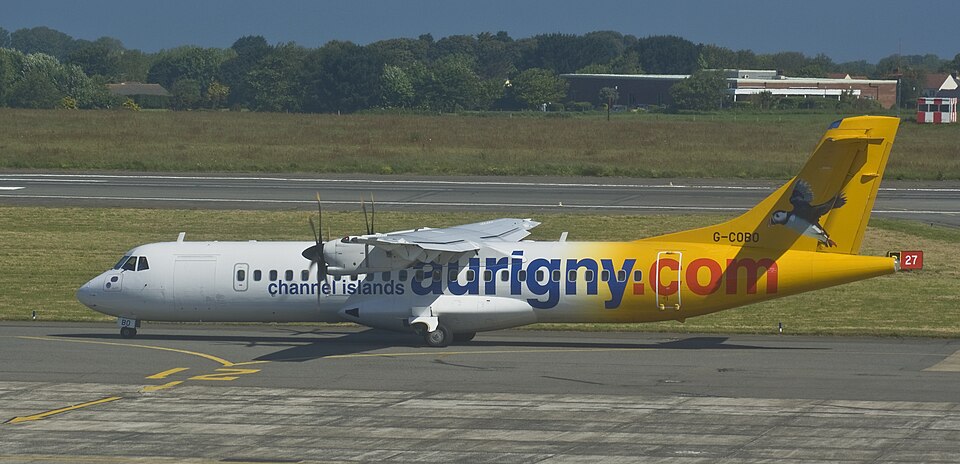
Aircraft and Crew Information
The aircraft involved was an ATR 72-212A, 500 version, registered G-COBO. It was powered by two Pratt & Whitney Canada PW127M turboprop engines and manufactured in 2009 (serial number 0852). The commander, aged 46, held an Airline Transport Pilot's Licence and had 6,040 total flying hours, with 1,401 hours on type. The co-pilot was undergoing line training under the commander's supervision, who was a line training captain. The commander was the pilot flying (PF) and the co-pilot was the pilot monitoring (PM).
Synopsis
The aircraft was on a scheduled commercial passenger flight from Guernsey to Manchester on 21 December 2016. During the climb to FL170, the aircraft accumulated airframe icing. The crew received degraded performance and increase speed cautions. They did not fully action the appropriate checklists and failed to maintain the correct climb speed because they focused on climbing out of the icing conditions. While levelling at FL130 as requested and turning as instructed by ATC, the aircraft experienced an in-flight upset. The crew recovered to controlled flight and returned to Guernsey. No injuries were reported.
History of the Flight
The flight crew had completed two earlier sectors without incident. During the turnaround at Guernsey, they noted that a frontal weather system with moderate icing conditions would be encountered over the English Channel. The aircraft took off at 1718 hrs with a mass of 21,937 kg. After takeoff, the autopilot engaged and the aircraft climbed at 170 kt on a northerly track. Anti-icing systems were activated at 5,300 ft, and de-icing systems at FL090 when icing was encountered. The crew reviewed the memory items of the 'SEVERE ICING' procedure but not the detection notes.
At approximately FL110, the degraded performance and increase speed cautions illuminated. The commander increased the target speed to 175 kt (red bug +10 kt), which extinguished the caution and reduced the rate of climb to about 25 ft/min. However, he then reduced the target speed to 165 kt to improve climb, increasing pitch attitude. About one minute later, the increase speed caution reappeared. The commander again increased speed to 175 kt, causing the aircraft to descend to nearly FL120 before levelling. He reduced speed to 165 kt, initiating a climb. Recognizing insufficient performance to reach FL170, the crew requested and received clearance to level at FL130 and proceed direct to NORRY, involving a heading change of about 10°. The commander reprogrammed the flight director and selected lateral navigation (lnav) mode. As the aircraft levelled and turned, an upset occurred. The autopilot disengaged, and the aircraft rolled to 32° left, then 38° right, then 73° left with a 16° nose-down pitch. Stick shaker and pusher activated. The commander directed the co-pilot to execute upset recovery items, including extending flaps to Flap 15. Control was regained at FL130 after a descent of about 1,000 ft. A MAYDAY call was made, and the crew decided to return to Guernsey. The aircraft landed without further incident. Post-flight inspection revealed no damage, but the flap system had experienced a 5 kt overspeed during recovery. All ice detection, anti-ice, de-ice, and performance monitoring systems were tested and found normal.
Meteorological Information
Forecast charts indicated moderate icing conditions from below FL100 to FL190 over the English Channel and southern England. An aftercast confirmed an active frontal zone with thick cloud layers up to FL190, expected to cause moderate icing. No evidence of cumulonimbus or severe icing conditions was present.
Aircraft Technical Information
The minimum manoeuvre speed in icing conditions with high bank selected was red bug +10 kt. The Aircraft Performance Monitoring (APM) system compared actual drag to theoretical drag and monitored minimum severe icing speed. A degraded performance caution illuminated when drag exceeded theoretical levels and speed was above the minimum severe icing speed. An increase speed caution illuminated when drag exceeded theoretical levels and speed was below that speed.
Safety Actions
The operator and manufacturer amended the aircraft's checklist and operating manuals following the incident.