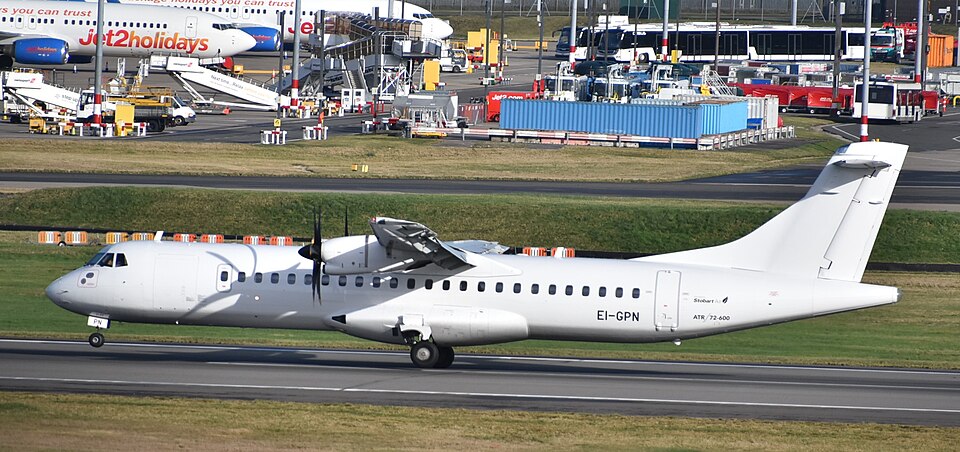
Incident Overview
On 19 September 2022, an ATR 72-212A (registration EI-GPN) operated a commercial flight from Leeds Bradford Airport to Belfast City Airport. During the approach, several aircraft systems dropped off-line, including those required for landing. The flight crew, experiencing startle and surprise and lacking a specified procedure, continued the approach and restored systems by turning off the Transformer Rectifier Unit (TRU).
Background
The aircraft was operating under an Operations Engineering Bulletin (OEB) requiring the TRU to be continually powered. On earlier flights that day, transient master caution messages and brief electrical anomalies had occurred, but the crew decided to return to Belfast for investigation.
Incident Flight
At approximately 0850 UTC, while descending through FL82 towards Belfast, a master warning triggered, and the autopilot and yaw damper disengaged. The flight director command bars disappeared, the selected altitude reset to zero, and the heading bug jumped 180°. The crew re-engaged the systems, but they disengaged again. Multiple failure indications appeared on the engine warning display, including DC standby bus undervoltage. The engines' propeller speeds increased unexpectedly, and the crew moved the condition levers to 100% override. Normal pitch trim control stopped, requiring significant force to reduce the rate of descent. Fail flags appeared on the co-pilot's airspeed indicator, altimeter, and vertical speed indicator. The commander's navigation display changed modes. Using the standby instrument and compass, the commander confirmed his remaining primary flight display information was reliable.
VHF 1 and transponder 1 failed, and the crew transmitted a pan call on VHF 2. ATC had already lost SSR contact. The co-pilot could not scroll through or select the EWD alerts. The crew attempted to check circuit breakers and re-engage flight director modes, autopilot, and yaw damper, without success.
Resolution
At approximately 0856 UTC, the commander instructed the co-pilot to select TRU off. Immediately, the display units and normal pitch trim control returned; the landing gear and flaps deployed successfully. The crew configured for landing and landed at 0859 UTC.
Safety Action
The aircraft manufacturer has taken safety action to improve guidance for flight crew in the event of a contactor failure when operating under the OEB. They have also introduced a modification that, when embodied, removes the requirement to operate with the TRU permanently powered. The operator plans to adopt a rule-based method for managing startle to help pilots manage workload and situation awareness before flying an approach.