Incident Overview
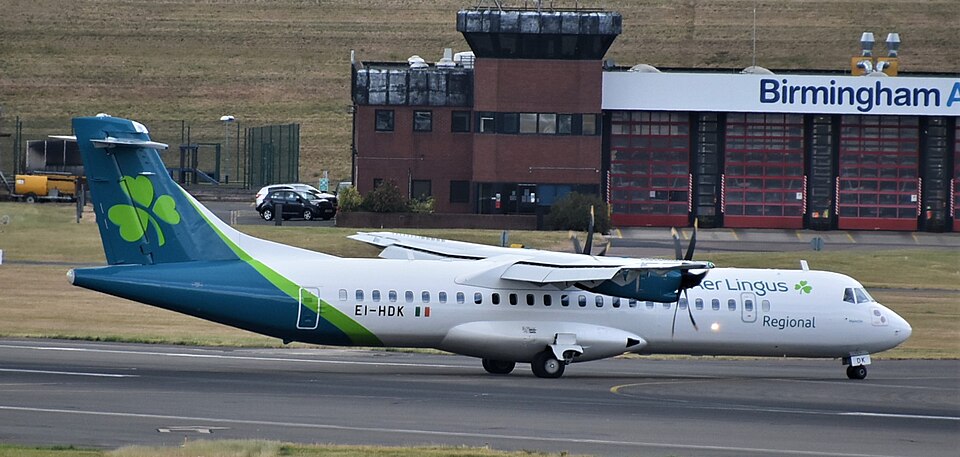
On 14 August 2023, an ATR 72-212A-600, registration EI-HDK, was involved in a serious incident during a commercial passenger flight from Dublin to Liverpool Airport. The aircraft, manufactured in 2016, was powered by two Pratt & Whitney Canada PW127M turboprop engines. There were 5 crew and 66 passengers on board; no injuries were reported.
Flight History
The crew operated a scheduled passenger service. After an initial takeoff, they returned to Dublin due to a pitot heat failure. The crew changed aircraft to EI-HDK and departed for Liverpool approximately 90 minutes behind schedule. The co-pilot was pilot flying.
During the approach to Runway 09, the crew noted red radar returns near the airport and a shower to the south. The aircraft was stable by 1,000 ft above aerodrome level. The tower reported surface wind from 220° at 5 kt, creating a tailwind. The commander advised the co-pilot to monitor power for wind changes.
On short final, rain intensified. The commander switched windscreen wipers to fast and offered to take control, but the co-pilot continued. Passing 50 ft, visibility rapidly deteriorated to near zero. The co-pilot recalled the flight deck “going dark, like someone had pulled the curtains.” The aircraft touched down firmly; the commander immediately executed a missed approach.
After climbing away, the tower offered an approach to Runway 27. The crew began positioning but discontinued due to a required runway inspection. The runway was wet with standing water on shoulders; taxiways E, F, and G were flooded. The aircraft was vectored south to avoid weather and landed uneventfully on Runway 27.
Recorded Information
The Cockpit Voice Recorder (CVR) and Flight Data Recorder (FDR) captured the flight. CVR audio confirmed the crew’s recollection, including radio height callouts from 50 ft to 10 ft with short intervals, indicating vertical speed was not reducing before the hard landing. The heavy landing sound was recorded, followed by the commander’s go-around call about 4 seconds later.
FDR data showed a stable descent until 50 ft above ground level. A small pitch-up input began at 50 ft. The flare started at 30 ft with an airspeed of 109 kt. Touchdown occurred at a vertical acceleration of 2.8 g, vertical speed around –670 fpm, and airspeed 95 kt. Increasing engine torque and pitch attitude indicated the go-around.
FMS wind calculations showed a crosswind from the right, which shifted between 30 ft and touchdown to give an increasing tailwind component, then returned to crosswind. The wind changes may have lagged real-time conditions due to algorithm smoothing.
Aircraft Examination
No obvious damage was found, but the manufacturer recommended replacing both main landing gear assemblies after analysis. The assemblies were sent for further mechanical analysis and overhaul. The aircraft returned to service on 30 August 2023.
Meteorological Conditions
A TAF issued at 1059 hrs forecast temporary visibility 7,000 m in rain showers, with 30% probability of heavy rain showers and 3,000 m visibility between 1200 and 1600 hrs. Later updates included heavy rain showers, hail, thunderstorms, and lower visibility.
METAR at 1320 hrs: surface wind 160° at 10 kt, visibility >10 km, showers in vicinity. METAR at 1350 hrs: wind 200° at 9 kt, visibility >7 km but 2 km to southeast, light rain, recent rain.
Flight Crew Experience
The commander, aged 43, held an Airline Transport Pilot’s Licence with 3,160 total hours (2,927 on type) and 1,135 hours in command. The co-pilot had 1,290 total hours, with 172 hours on type.
Analysis
As the aircraft crossed the runway threshold, it entered heavy rain and visibility reduced to near zero. Airspeed decayed without corresponding thrust increase. In the flare, vertical speed did not reduce before touchdown, resulting in a hard landing at about –670 fpm. The commander executed a missed approach.
Reduced visibility likely hindered visual detection of the rate of descent. Forecasts included a probability of heavy rain, but the severity was not indicated by flight deck indications or tower reports. Recorded wind data suggested an increasing tailwind component at the time of the hard landing, which may have caused the airspeed reduction.