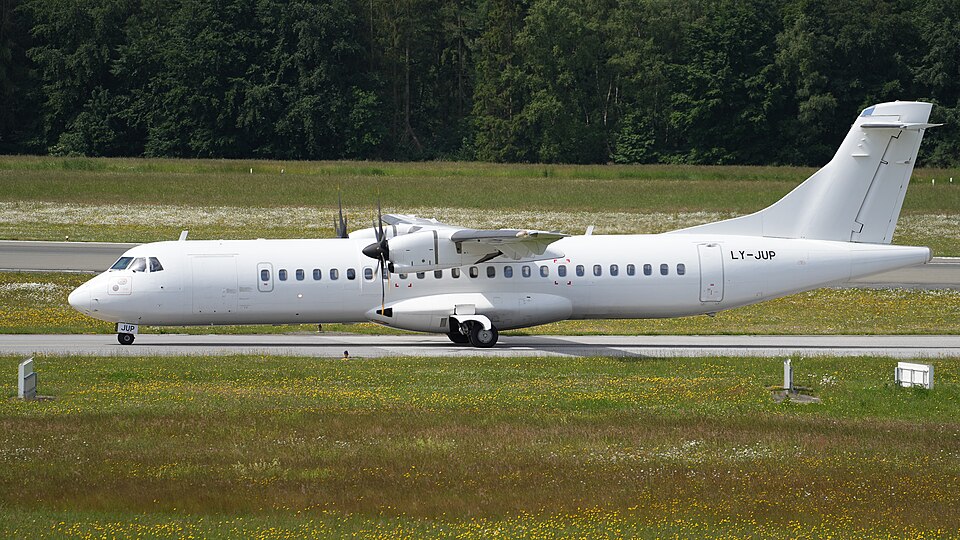
Synopsis
On 12 August 2024 at 0842 UTC, an ATR 72-500 (registration LY-JUP) operating a commercial passenger flight from Southampton to Guernsey was on approach to Runway 27 at Guernsey Airport. The crew continued to descend below the approach ban altitude despite the reported Runway Visual Range (RVR) being below the required minimum. After passing through approach minima at approximately 70 ft agl, a go-around was initiated. Following advancement of the power levers, the aircraft remained between 61 and 78 ft agl for 15 seconds before establishing a climb. The flight diverted to Southampton Airport without further incident. Both crew members were aware of the approach ban, but it was not discussed before or during the approach. As the aircraft passed the decision altitude, there was confusion and miscommunication between the crew, resulting in the aircraft remaining approximately level with the landing gear extended.
History of the Flight
The aircraft had departed Guernsey earlier at 0645 hrs for Southampton, where it refueled and boarded passengers for the return leg. At departure, fog was developing but RVR was above 1500 m. The commander assessed that weather would improve by the expected arrival time. The aircraft departed Southampton at 0715 hrs. During the flight, the crew received weather updates and reduced speed to delay arrival. RVR remained variable, rarely above the 550 m required for a CAT I approach. The crew entered a hold at the GUR VOR. After several holding patterns, ATC advised that RVR had improved to 550 m, prompting the crew to commence the ILS approach to Runway 27. Although RVR had decreased from 550 m and remained below 450 m during the approach, the crew continued. ATC provided RVR updates as the aircraft descended, including values of 325 m at touchdown and 400 m at stop end at 1750 ft amsl, and 325 m and 375 m at 1540 ft amsl. Despite RVR being below requirements, the approach continued below 1000 ft aal.
As the aircraft neared decision altitude (536 ft amsl), both pilots gained visual references, but confusion in communication led the co-pilot to call for a go-around. The commander initiated the go-around, retracting flaps one stage and selecting go-around power. For the next 15 seconds, pitch attitude remained near level flight, with radio altitude between 61 and 78 ft. The aircraft traveled approximately 750 m before it began to climb. The go-around was completed, and the flight diverted to Southampton without further incident.
Recorded Information
The serious incident was reported to the AAIB the following day. The CVR recording was overwritten due to additional flight time. FDR data, radar, and radio transmissions were provided by the operator and Guernsey ATC. The aircraft contacted Guernsey Tower at 0841:23 hrs at about 6 nm from the threshold at 1800 ft pressure altitude, with autopilot engaged and glideslope and localiser captured. RVR was reported as 325 m at touchdown and 400 m at stop end. Two further RVR updates confirmed values below 550 m. At 0843:30 hrs, the aircraft descended below decision height (536 ft amsl) at about 0.5 nm from the threshold. The autopilot was disconnected seven seconds later at 475 ft amsl and 131 KIAS. Power was reduced to flight idle, and the aircraft pitched up. After crossing the displaced threshold, power levers were advanced to full power at 70 ft agl and 116 KIAS. The go-around pushbuttons were pressed (not recorded on FDR). Engine power increased, flap setting reduced to 15°, and indicated airspeed increased. Landing gear remained down. Pitch attitude stayed below 7.1° for 15 seconds. The aircraft remained between 61 and 78 ft agl, deviating right of the runway, coming within 40 m laterally of the Runway 27 DME transmitter while at 375 ft amsl (transmitter top at 348 ft amsl). At 0844:03 hrs, pitch attitude increased above 7.1° and landing gear was selected up. The aircraft climbed, reaching a maximum pitch of 15.8°, then reduced. At 0844:22 hrs, the crew transmitted a go-around and diversion to Southampton.
Meteorological Information
A southeasterly airflow brought settled conditions with light winds to the Channel Islands on 12 August, with mist and fog affecting western areas. Coastal sea fog, common in spring and summer, developed due to warmer air moving over cooler sea surface. The crew reviewed forecasts prior to departure. The overnight TAF indicated a 40% probability of fog between 0600 and 1200 hrs. An updated TAF at 0457 hrs delayed fog onset to 0700 hrs. A further TAF at 0657 hrs forecast fog with 100 m visibility and a 40% probability of improvement to 3000 m between 0600 and 1200 hrs. The TAF suggested clearing from 0800 to 1100 hrs. Another TAF was issued at 0804 hrs.