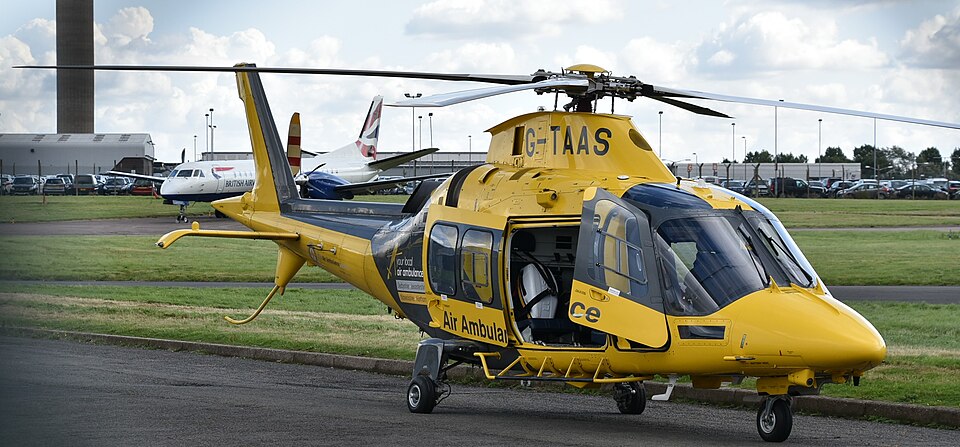
History of the Flight
The flight aimed to position medical personnel from a Bristol hospital to a Cardiff hospital to collect a patient for transfer to Plymouth. A staffed airdesk facility coordinated task requests, flight following, and operational booking. The Cardiff hospital was aware of the planned transfer and an estimated time of arrival. The procedure required the airdesk to inform the hospital when the helicopter was en route.
At Bristol, the medical personnel were ready earlier than expected, and the flight departed at 1039 hrs, ahead of schedule. Shortly after takeoff, one of the passengers used a messaging app to notify the airdesk of the departure. The message was not received until 1052 hrs, after the helicopter had landed, so the airdesk did not alert the hospital.
The flight was conducted in bright sunlight with good visibility and no cloud. Wind was from 070° at 13 kt. The pilot approached from the southwest and reported that a building obscured the view of the helipad until the landing decision point, but the site appeared clear during the pre-landing recce.
The helicopter arrived at 1051 hrs, nine minutes before the initial estimated time of arrival. As it reached a hover over the helipad, a passenger noticed the pad lights were off and the required two firefighting personnel were absent. The pilot judged it safer to land from the stable hover than to go around and proceeded to land.
Aerodrome Information
The helipad at the Cardiff hospital measures 30 m in diameter and is 30 ft above ground level. It is an elevated site that requires firefighting personnel to be present during landings. The hospital procedure also mandates pedestrian and traffic management during helicopter movements. At this site, the presence of illuminated helipad lights serves as the primary cue for pilots to confirm that the site is available and prepared for a landing.
Other Information
Neither the hospital procedure nor the operator's survey document for the site explicitly instructed pilots to confirm the landing site was prepared with appropriate fire cover or provided cues for this confirmation. However, the operator's Flying Staff Instruction for the use of elevated Final Approach and Take Off areas (FATOs) stated that pilots must ensure, on arrival by air, that the site is either clearly manned or has its lights turned on. The operator noted that pilots require specific training and assessment for landing at elevated helipads, and looking for lights or firefighters' helmets is standard procedure.
The hospital's representative indicated close liaison with the local air ambulance operator but no relationship with operators outside Wales who might use the helipad. The representative was unaware of how hospital procedures could be disseminated to all potential operators. The operator's expectation was that the pilot or passengers would communicate with the airdesk verbally by mobile phone, though use of the messaging app was described as common practice.
Analysis
The communication method used was not reliable for use in the air, resulting in the departure message not being received until after the helicopter had landed. This degraded safety because no firefighting service was available at the helipad, and vehicle and pedestrian movements in the vicinity were not controlled as required.
During the recce and approach, the pilot did not confirm the landing site was ready as required for an elevated helipad. This requirement and the method for doing so were specified in the operator's Flying Staff Instruction for elevated FATOs but were not emphasized in the hospital or operator's site-specific procedures. The pilot did not realize the helipad was not ready until in a stable hover and decided to continue the landing, considering it safer than a go-around.
The event highlights the importance of effective collaboration between hospital trusts and operators to ensure specific safety requirements and procedures for each hospital landing site are clearly communicated to pilots. However, no convenient mechanism currently exists for this, requiring each operator to engage with the owner of each potential landing site and vice versa.
Conclusion
The hospital elevated helipad was not prepared because the message informing the airdesk of the departure was sent too late and using an unreliable communication method. The pilot did not confirm the site was prepared during the approach, and the requirement to do so was not emphasized in site-specific procedures.
Safety Actions
Following the occurrence, the operator reviewed all elevated FATO surveys and stated its intention to reissue them with specific guidance for each site, subject to communication with the hospitals.