Introduction
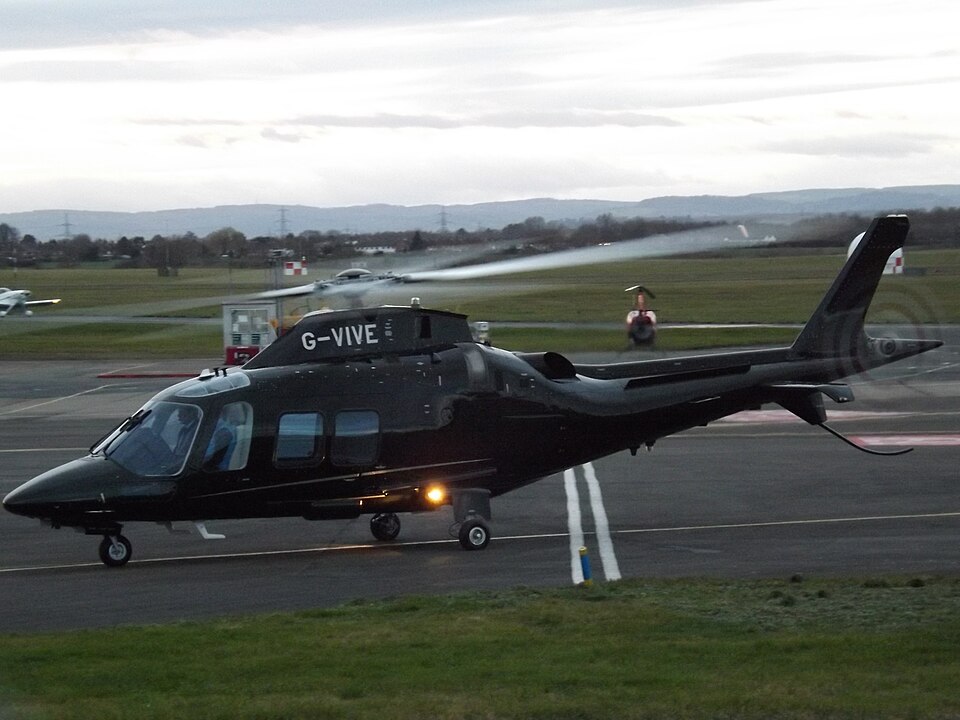
On 4 November 2019 at 1800 UTC, an AgustaWestland AW109SP helicopter, registration G-VIVE, struck power lines during a night approach to a private landing site at Robins Farm, Chiddingfold, Surrey. The helicopter was performing a private passenger flight with one pilot and three passengers on board. No injuries occurred, and the aircraft sustained only minor damage to the nose landing gear door.
History of the Flight
The flight was conducted between two private landing sites under Visual Meteorological Conditions (VMC) with CAVOK weather reported by the commander. The destination site had been surveyed in daylight, and the commander was familiar with it. Photographs from the survey indicated the location of power cables, and the approach was planned on an approximately westerly heading as recommended. Due to the rural location and lack of cultural lighting, the commander elected to use the autopilot's Visual Flight Rules (VFR) Approach Mode. This mode does not ensure obstacle clearance; the pilot remains responsible for maintaining a safe flight path.
The approach profile consisted of a 5° descent from 1,400 ft amsl to a 'Gate' at 600 ft amsl (landing site altitude plus 300 ft) at 50 kt IAS, after which a manual approach was to be flown. A vehicle was positioned at the site to illuminate the landing area with its headlights, and another pilot provided weather updates via radio.
The commander stated that he normally set a minimum altitude warning at the Gate altitude but did not do so on this occasion. He had been informed of mist patches in the vicinity by the pilot at the site, and he believed his concern over visibility caused him to allow the aircraft to descend about 100 ft below the Gate altitude before taking manual control. Consequently, the manual approach began below the planned path.
Incident
During the later stages of the approach, the aircraft descended below the intended flight path and struck power cables. The commander did not recognise the shallower-than-expected approach and did not recall hearing the radio altimeter automated height callout at 200 ft agl. He remembered being in a stable, shallow, speed-reducing descent toward his Landing Decision Point (LDP), defined as height 80 ft, groundspeed 20 kt, and rate of descent 200 ft/min ±50 ft/min. In the final stages, he flared to reduce speed to the LDP, at which point he saw and immediately contacted domestic power cables short of the landing site.
The aircraft sank onto the cables at very low speed. The commander brought the helicopter to a hover, moved backward to clear the cables, and then landed. All occupants were uninjured. The commander exited through the co-pilot's door because his own door was obstructed by a length of cable entangled on the aircraft.
Analysis
The weather for the approach was generally good, though a local report of mist caused the commander some concern. This distraction likely led him to not set an altitude warning bug at the planned Gate altitude. The transition from automatic to manual flight occurred at a lower altitude than planned, making the approach slope shallower than anticipated. The site was illuminated by vehicle headlights, but there was very little other cultural lighting.
It is likely the commander's attention was closely focused on reducing speed toward the LDP while manually flying with limited external references. This significantly increased his workload above his expectation and likely caused him to miss altitude cues, such as the automated height callout. Due to the lower-than-planned altitude, the aircraft struck the power cables at low speed, short of the planned landing area.
Conclusion
Restricted visual cues led the commander to not recognise a low approach path. The aircraft struck power cables in the undershoot of the planned approach.