Introduction
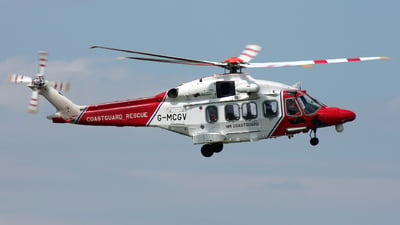
On 7 January 2022 at 1622 UTC, an AW189 helicopter, registration G-MCGV, experienced a heating duct failure while in flight near Lydd Airport, Kent. The aircraft was conducting a training sortie and had four crew members on board; no passengers were carried. The commander held an Airline Transport Pilot's Licence and had 5,823 flying hours, including 963 hours on type. The helicopter was manufactured in 2017 and was powered by two General Electric CT7-2E1 turboshaft engines.
Incident Details
Following the completion of a search and rescue (SAR) training sortie involving winching operations, the cabin and cockpit heating system was selected on for the return transit to the helicopter's base at Lydd. Approximately 6 nautical miles from Lydd, the rear crew alerted the flight crew to the presence of fibres floating in the air, which were causing respiratory irritation. The flight crew immediately selected the heating and ventilation system to off and donned personal protective equipment (PPE) face masks carried in the cockpit. Given the proximity to Lydd, the commander elected to expedite the approach and perform a running landing. During the approach, the non-flying pilot experienced some mild respiratory irritation, but the commander, who was pilot-flying, reported that he was not noticeably affected. Upon landing, the cabin doors and storm windows were opened for ventilation and to clear the contamination.
Subsequent examination revealed that the aft heating duct had failed, allowing duct insulation material to be drawn into the heating and ventilation system.
Previous Incidents and Safety Actions
The operator had experienced several previous heating duct failures on its AW189 fleet. Two of these, occurring on G-MCGU on 4 March 2021 and G-MCGT on 17 April 2021, were investigated by the AAIB (Report AAIB-27128). Those investigations determined that the failures were due to non-uniform adhesion on the bonding surfaces between the rigid and flexible duct sections. The collapse of the duct led to discharge of insulation fragments through cabin and cockpit heating vents, causing respiratory irritation and, in the case of G-MCGU, the presence of smoke that necessitated an emergency landing.
In response, on 23 July 2021, the aircraft manufacturer published Service Bulletin (SB) 189-296, requiring a one-off inspection of the heating duct and modification of the duct installation. The modification involved repositioning an existing 'P-clamp' at one bonded joint and introducing an additional fixing at another joint. Compliance was required within 400 flight hours or 12 months from publication. SB 189-296 was embodied on G-MCGV on 30 October 2021; the inspection revealed no findings, but the duct fixings were modified per the SB instructions. However, G-MCGV experienced a duct failure on 7 January 2022, only 71 flying hours after embodiment. The failure was similar in manner to those on G-MCGU and G-MCGT.
Investigation Findings
The failed ducts from G-MCGU, G-MCGT, and G-MCGV were sent to the duct manufacturer for examination. The duct manufacturer determined that the relevant manufacturing processes and procedures were followed and that the ducts met the applicable drawing specification. While recognizing that non-uniform adhesion of the bonded joints was evident on the failed ducts, the duct manufacturer considered that this was not the single causal factor. The manufacturer indicated that redesign considerations would include improving the strength of the bond between flexible and rigid sections, reducing the number of joints, and relocating clamping positions to rigid duct elements to reduce the duct's ability to creep along the clamp over flight cycles.
The duct manufacturer also noted that the same duct type is used on AW139 and AW169 helicopters and that it was qualified for use on the AW189 by similarity with the AW139, without further testing. The manufacturer was not aware of any duct failures other than those on AW189s within this operator's fleet. It commented that the air pressure and flow rate through the heating duct are higher on the AW189 than on the AW139/AW169, which may have contributed to failure of the bonded joints.
Safety Actions
As a result of the duct failure on G-MCGV, the aircraft manufacturer plans to publish Revision A of SB 189-296 in the fourth quarter of 2022. This revision will require removal of the duct from the aircraft and reinforcement of the duct joints by application of aramid lacing tape and silicon-covered glass cloth tape. It will also require additional fixing points and a change to the sequence of duct installation instructions to avoid introducing preload on the duct. This is intended as an interim solution to make the existing duct configuration more robust. In parallel, the duct manufacturer is redesigning the heating duct as a long-term solution. At the time of publication, installation drawings for the redesigned duct were undergoing approval, and qualification testing for the new design was planned for the remainder of 2022. The aircraft manufacturer intends to issue a separate SB for replacement of the present duct configuration with the new design in 2023.
Separately, following the duct failure on G-MCGV, in March 2022 the operator issued an internal Technical Directive requiring replacement of the heating duct on the remaining AW189s in its fleet that had not previously had the duct replaced due to a failure. The ducts will be replaced at the next annual inspection, with the replacement programme to be complete by January 2023. The removed ducts will be returned to the duct manufacturer for assessment of their condition against aircraft operating hours.